

Liberty Trees
As we approach the 250th anniversary of the American Revolution, it seems appropriate to reflect on how the historically famous Liberty Trees impacted the founding of our country. The term Liberty Tree generally describes a large tree that was used as a landmark for communities to gather and discuss the important news of the time. In the City of Boston, it refers to a specific tree, a large elm tree located near the Boston Common at the modern-day intersection of Washington Street and Essex Street. The tree was planted in 1646 and was nearly 120 years old by the time of the American Revolution. The area under its branches became a popular meeting place for Boston citizens in the 1760’s, as it was situated along a main artery going into and out of the city. The Sons of Liberty, a secret society of men who advocated for the rights of colonists, would meet at the tree and stage protests to British taxation and rule.
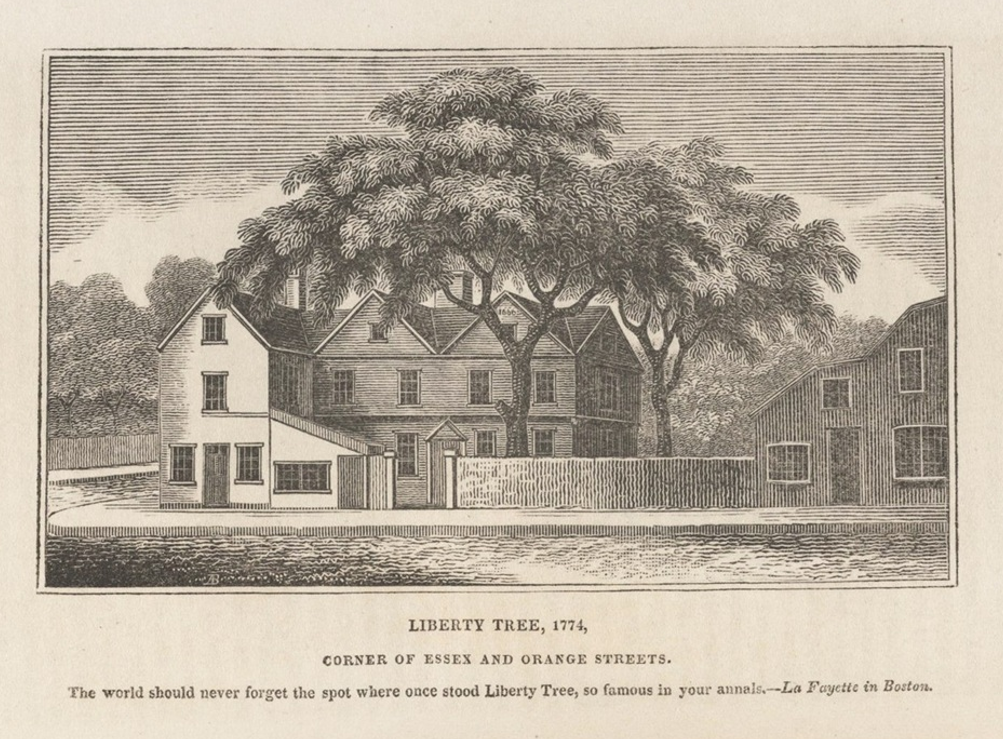
In 1765, the British Parliament introduced the Stamp Act, which was directed at Britain's American colonies. It required all legal documents, permits, commercial contracts, newspapers, pamphlets, and playing cards in the American colonies to carry a stamp tax. The Stamp Act was met with widespread anger in the colonies. In Boston, a group of businessmen calling themselves the Loyal Nine, began meeting secretly to plan a series of protests against the Act.
It was under this Boston elm tree, where on August 14, 1765, a group of colonists gathered with effigies, one representing the tax collector of Boston, Andrew Oliver, and the others representing Earl Bute and Lord George Grenville, who were responsible for creating the Stamp Act. The Loyal Nine organized this protest and they enlisted shoemaker, Ebenezer Macintosh, to make the effigies. After the protest, the effigies were used in a mock funeral procession. The events of the day were described by Francis Bernard, the Governor of Massachusetts. He detailed the protestors beheading the effigy representing Andrew Oliver and parading it down the street in a coffin. The mob’s actions culminated in the stamp office building being pulled down and the timber used for a bonfire that burned the effigy of Andrew Oliver. Mr. Oliver narrowly escaped the stamp office as it was being ransacked. August 14, 1765, is considered by historians to be the first public protest against British rule.
After the Stamp Act Riot, the large elm tree became the default meeting place for the Loyal Nine, who eventually became the leaders of the Sons of Liberty. The members were:
Jon Avery, Henry Bass, Thomas Chase, Stephen Cleverly, Thomas Crafts, Benjamin Edes, Joseph Field, John Smith and George Trott. The elm tree became known as the Liberty Elm and Ebenezer Macintosh was called the “Captain General of the Liberty Tree.”
Later that year, in December 1765, the Sons of Liberty invited Andrew Oliver to appear under the Liberty Tree for a special Ceremony. It was revealed that during the previous protest, Mr. Oliver was not yet officially appointed as the tax collector and his resignation might not be binding. The “ceremony” was to be on December 17th, 1765, and the purpose was for him to publicly resign his title of tax collector, and the Citizens of Boston were invited to hear it. The invitation from the paper was as follows:
Tuesday-Morning, December 17, 1765
THE True-born Sons of Liberty,
are desired to meet under LIBERTY-
TREE, at XII o'Clock, THIS DAY, to hear the
public Resignation, under Oath, of Andrew
Oliver, Esq; Distributor of Stamps for the Province
of the Massachusetts-Bay.
The Stamp Act was repealed on March 1st, 1766 and a sign was placed on the tree: “This tree was planted in the year 1646 and pruned by order of the Sons of Liberty, Feb. 14th, 1766.” The Sons of Liberty celebrated the Stamp Act Riot every August 14th. A quote about the party from John Adams:
MONDAY AUGUST 14.
Dined with 350 Sons of Liberty at Robinsons, the Sign of Liberty Tree in Dorchester. We had two Tables laid in the open Field by the Barn, with between 300 and 400 Plates, and an Arning of Sail Cloth overhead, and should have spent a most agreeable Day had not the [illegible] Rain made some Abatement in our Pleasures. Mr. Dickinson the Farmers Brother, and Mr. Reed the Secretary of New Jersey were there, both cool, reserved and guarded all day. After Dinner was over and the Toasts drank we were diverted with Mr. Balch's Mimickry. He gave Us, the Lawyers Head, and the Hunting of a Bitch fox. We had also the Liberty Song-that by the Farmer, and that by Dr. Chh [Dr. Church], and the whole Company joined in the Chorus. This is cultivating the Sensations of Freedom. There was a large Collection of good Company. Otis and Adams are politick, in promoting these Festivals, for they tinge the Minds of the People, they impregnate them with the sentiments of Liberty. They render the People fond of their Leaders in the Cause, and averse and bitter against all opposers.
During the Liberty Riot of 1768, a mob dragged a British naval ship from Boston Harbor to the Liberty Tree in protest of the seizure of John Hancock’s ship. Many other riots occurred during the Tea Act of 1773. In 1774, John Malcom, a Loyalist and customs official, was brought to the Liberty Tree and was tarred and feathered, then forced to resign. In 1775, Thomas Paine wrote a poem about the tree.
After the Battle of Lexington and Concord, the British created a blockade around Boston. This created hardships for the British Soldiers and Loyalists that stayed in Boston. The Colonists wouldn’t allow any food or supplies to enter Boston by land so the only way for supplies was through British ships coming into the Harbor. Resources became scarce and the Liberty Tree was cut down by British Soldiers and Loyalists sometime in 1775, not only to remove a symbol of the Sons of Liberty but to provide firewood since that was in short supply.
After the British evacuated Boston, the colonists erected a liberty pole on the site of the old tree. The Marquis de Lafayette, while visiting Boston in 1825, visited the stump and was quoted: “The world should never forget the spot where once stood Liberty Tree, so famous in your annals.” No one is certain when the stump was removed but it would most likely have occurred sometime between 1825 and the 1850’s.
The only part of the Liberty Tree to survive is a bundle of roots held by the Massachusetts Historical Society. There is a plaque on the Registry of Motor Vehicles at the corner of Washington St. and Essex St. This was placed in the 1850’s. On the Corner of Washington St. and Boylston St. is a small park dedicated to the Liberty Tree.
The Boston elm tree was certainly the most famous Liberty Tree, but it wasn’t the only one to be given this name. Additional Liberty Trees in Massachusetts were located in Quincy and Acton. Outside of Massachusetts, Liberty Trees were located in Newport, RI and Charleston, SC. The last surviving Liberty Tree (a tulip poplar) was located at St. John’s College in Annapolis, MD. The tulip poplar was over 120 feet tall and fell during Hurricane Floyd in 1999.
The Acton Liberty Tree was thought to be planted by Henry Sparks who built a house on the property in 1715. The Acton Liberty Tree died in 1925 but near its former location, the Acton Peace Tree was planted in 1915 by schoolchildren and still stands today. A sign was placed on the maple tree which reads: “The Peace Tree planted with due ceremony by the school children of Acton on Arbor Day 1915 as a stand-in for the Liberty Tree.”
The Quincy Liberty Tree was located near Brackett’s Tavern and was referenced in John Adam’s Diary dated May 4th, 1766: “I saw for the first time, a likely young Button Wood Tree, lately planted, on the triangle made by the Three Roads, by the House of Mr. James Brackett. The Tree is well set and well guarded and has on it, an Inscription ‘The Tree of Liberty,’ and ‘cursed is he, who cuts this Tree.” The site is currently where Hancock St., Elm St., and Mechanic St. intersect. In 1959 the Quincy Granite Manufacture’s Association placed a commemorative stone, marking the site.
The New England tradition of liberty continues to this day. Let’s work together to honor these symbols of freedom by preserving the venerable trees in our communities and carry the tradition into the future by planting trees with our colleagues and neighbors for the common good. Happy Birthday America, let’s remember our roots.
Story by DCR Urban Forester Nathan Tobey
Footnote:
Visit the birthplace of America. Massachusetts 250 is embracing our history of the American Revolution. It includes commemorations and the many battles that led to independence. Explore Massachusetts and experience the special events that showcase our history with untold stories that pay homage to the past. Let Massachusetts 250 be your guide to the many “firsts” and innovations created in our state. From the hills of the Berkshires to the beaches of Cape Cod, join us as we take you on a journey through the last 250 years.
Reference Links
Forester Focus
Tree Wardens and Foresters’ Association
Sturbridge — This winter, the DCR Urban & Community Forestry (U&CF) Program participated in the 113th Annual Conference of the Massachusetts Tree Wardens and Foresters Association. The first day started with program updates for DCR UCF by Mathew Cahill, DCR Forest Health by Felicia Hubacz, and UMass Amherst by Rick Harper. Then Rian Holmquest of Herrington Heep LLP presented on the “Understanding the Tree Warden’s Responsibility – Public vs. Private Lands.” This was followed by “Municipal Pruning Oversight” by Nicole Forsyth of Norfolk Aggie HS. The afternoon keynote address was by presented by Larissa Yocom of Utah State University, “Fire Ecology: Post Forest Fire Regeneration.”
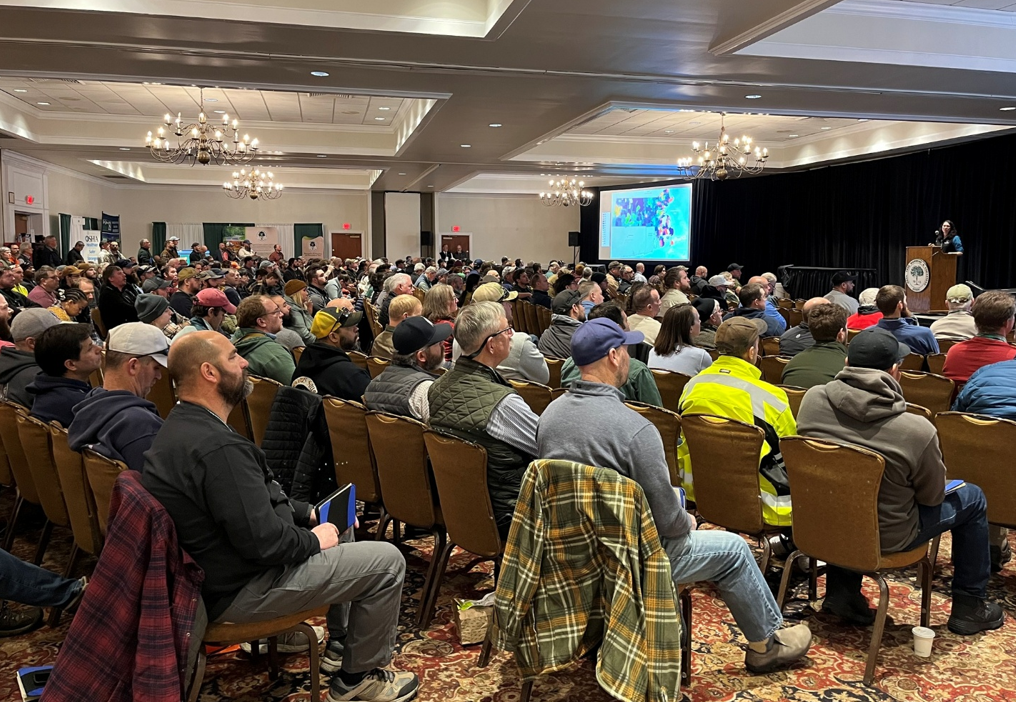
Day two provided more technical talks including “Spotted Lanternfly: Impacts, Current Status, and Management Options” from MDAR’s Elizabeth Barnes and a “Tree and Shrub Disease Review for 2025” by Dr. Nick Brazee. DCR’s Chief Fire Warden, Dave Celino, presented on “Wildfires and Post Fire Mitigation on Public Lands.” The afternoon included a talk on “Improving Safety Outcomes: HCS Compliance for Pesticide Handlers” by Jennifer Tetraeult of HazCommpliance LLC. The conference included the announcement of the Tree Warden of the Year Award, which went to Marc Welch from Newton. Congratulations Marc!
MTWFA Seedling Sale
The Massachusetts Tree Wardens’ and Foresters’ Association (MTWFA) Seedling Program celebrates Arbor Day/Earth Day by supplying bulk seedlings to promote the planting and caring for trees in Massachusetts.

Proceeds from the seedling program support the MTWFA Scholarship Fund. Scholarships are awarded annually in March to students enrolled in arboriculture and urban forestry programs statewide. Seedlings are available now, click here for more information.
https://www.masstreewardens.org/mtwfa-seedlings/
Climate Resiliency
Healey-Driscoll Administration Energy and Environmental Agency Releases Yearly Report
Report highlights progress made in energy affordability, protecting nature and climate resilience efforts
BOSTON – The Healey-Driscoll Administration released the Executive Office of Energy and Environmental Affairs (EEA) 2025 Annual Report, highlighting key milestones and accomplishments from its agencies. Over the past year, EEA’s organizations have engaged residents and partners across the state through intentional environmental initiatives. These efforts include legislation to lower energy costs for families, investments in extreme weather preparation, and strategies to protect nature. Together, this work has contributed to creating more resilient and sustainable communities in Massachusetts.
“Our agencies are at the forefront of protecting our natural resources, making energy affordable, building resilient and prepared communities, and expanding outdoor accessibility,” said EEA Secretary Rebecca Tepper. “I extend my heartfelt gratitude to our commissioners and the over 3,000 dedicated staff members who tirelessly serve the residents, ecosystems, and wildlife of Massachusetts.”

This year, Governor Maura Healey released an Energy Affordability Agenda, as well as filed the Energy Affordability, Independence & Innovation Actto reduce costs for residents and businesses. The proposed legislation saves customers money, brings more energy into Massachusetts, and drives innovation. Key reforms included eliminating and reducing certain charges on the bill and reducing barriers to new nuclear technologies. An independent analysis found the legislation could save customers $13 billion.
In addition to increasing energy affordability for residents, this year the Healey-Driscoll administration introduced the Mass Ready Act, a historic bill proposing $3 billion to strengthen infrastructure and protect communities from extreme weather events. This legislation aims to upgrade roads, dams, and bridges, and establishes a Resilience Revolving Fund for similar projects. It also streamlines permitting for priority housing, culvert replacements, and restoration projects that protect communities from flooding. Additionally, the bill invests in farming and coastal economies and provides communities with resources to reduce flood and heat risk.
Massachusetts is pioneering initiatives to restore ecosystems and strengthen coastal resilience by rebuilding wetlands, upgrading culverts, removing outdated dams, and improving habitats. The Healey-Driscoll Administration set nation-leading Biodiversity Goals for Massachusetts. The Massachusetts Department of Fish & Game, alongside many partners, has developed a 25-year plan to protect and restore nature, sustain farms and fisheries, boost local economies, and connect people with nature. Likewise, the Massachusetts Office of Coastal Zone Management (CZM) released the ResilientCoasts Plan, a statewide strategy to support coastal communities in preparing for storms, flooding, sea level rise, and erosion. The plan aims to save taxpayers billions by guiding smart coastal management decisions and preserving natural buffers to reduce flood risks.
In 2025, EEA and its agencies distributed more than $237.9 million in grants across 70+ programs, supporting over 1,600 individual awards statewide. Investments supported programs for environmental justice, recycling, outdoor recreation, farmland preservation, drought management and much more.
In 2026, the Healey-Driscoll administration is looking forward to continuing its commitment to protecting and enhancing the state's environmental resources while ensuring a clean energy future for residents.
Read the full end of year report.
Species Spotlight
American elm, Ulmus americana
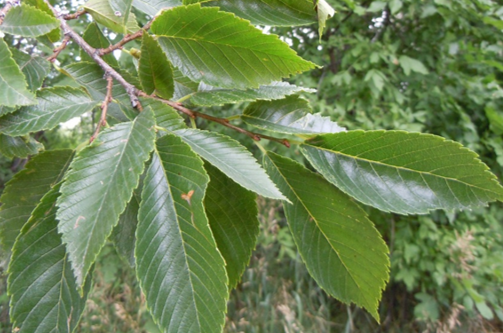
Native to eastern and central North America, American elm is adaptable to many parts of North America, readily growing in USDA hardiness zones two to nine. Once stretching far and wide across this range, American elm was decimated by Dutch Elm Disease (DED) in the 1900’s. Fortunately, DED resistant varieties are being introduced and trees are being returned to the landscape. American elm is a large sized tree, reaching heights of 60-80 feet tall with a vase-shaped, broad-rounded crown. It has a medium to fast growth rate. In certain conditions, American elm can grow to be over 100 feet tall. Like all elms, American elm is alternate, with leaves that are simple and ovate to oblong. They can range in length from 3 to 5 inches long and 1 to 3 inches wide and are unequally rounded at the base. The margins are coarsely and doubly serrate. Leaves have a green and glabrous upper surface and are paler and downy beneath.
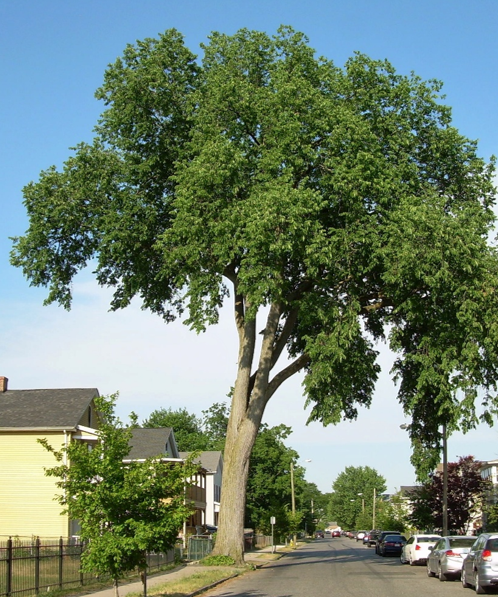
The twig is slender, glabrous, slightly zigzag and reddish brown. The buds are ovate, over 1/4-inch long, reddish brown with darker edged scales. Flowers are small, in drooping clusters of 3 to 5, and appear in early spring before leaf buds open. Fruit is rounded, flat, papery samaras, 3/8-inch long, and hairless except for the margins. The bark of American elm is dark, ashy gray, with flat-topped ridges separated by diamond-shaped fissures. Like a lot of trees in the landscape, American elm does best in moist, well-drained, fertile soils, but it is tolerant of multiple soil conditions, making it a candidate for urban areas.
When sited in an open area, the tree tends to fork and develop an arching crown, ending in a maze of graceful drooping branches. It is valuable to wildlife as a food source, nesting site and habitat. To reinvigorate the urban forest, plant this tree in a woodland, naturalized area, or on a slope. It is at home in a butterfly/pollinator/native plant instillation.
Insignificant small green flowers appear in spring before the foliage emerges. Flowers give way to single-seeded wafer-like samaras (each tiny seed is surrounded by a flattened oval-rounded papery wing). Seeds mature in April-May as the leaves reach full size. Rough-textured, ovate-elliptic, dark green leaves (to 6” long) have toothed margins and asymmetrical bases. Leaves typically turn an undistinguished yellow in fall.
DED, a fatal fungal disease spread by airborne bark beetles, attacks the water-conducting tissue of the tree, resulting in wilting, defoliation and death. Phloem necrosis is a disease caused by a phytoplasma that attacks the food-conducting tissue of the tree, usually resulting in a loosening of the bark, wilting, defoliation and death. Newer selections of Ulmus americana show good to excellent resistance to DED and are recommended for planting. These include the following: 'Jefferson', 'New Harmony', Prairie Expedition®, 'Princeton', and 'Valley Forge'. Many hybrid elms are also resistant to Dutch elm disease. Due to their rapid growth, elm saplings should be pruned each year while they are young, with the goal of developing a sturdy trunk before the main limbs become prominent. If left unmanaged, young elms can develop weak V-shaped crotches that could split in strong winds or ice storms. With time and attention, American elms will be a beautiful and stately addition to your urban forest.
News
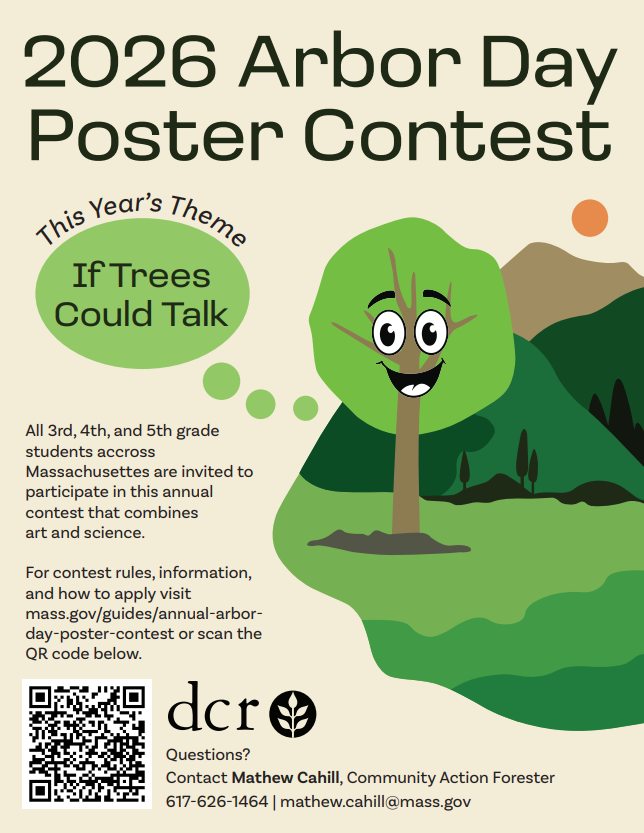
UCF’s Arbor Day Poster Contest
This year Massachusetts third, fourth, and fifth graders can participate in the Arbor Day Poster Contest. Each school holds its own poster contest and submits their winning poster to the DCR. Prizes may include art supplies, books, and a tree for the winner’s school.
This year’s theme is: “If Trees Could Talk…”
Click here for more information and to join the contest!
DCR’s Environmental Justice Webpage
DCR launched a public-facing Environmental Justice webpage. This webpage provides information on DCR's EJ Strategy, Language Access Plan, programs at DCR that serve EJ communities, related funding opportunities, mapping resources, and more.
Drought Status
How do things look for tree planting in your area this spring?
Find out the current drought status in Massachusetts, learn about past droughts and find past drought declaration maps.
On The Horizon
March 3: (Event) UMass Amherst Community Tree Conference
Location: Bowker Auditorium, UMass Campus, Amherst, MA
Visit website for details and to register.
March 3 @ 12:00pm CST (Webinar) - Caleb Wilson with University of Kentucky will present his project titled, "Increasing Biological Control of Soft-scale Insects by Excluding Ants from Trees" from his 2024 John Z. Duling Grant Program Register Here
March 25-27: (Event) ArborEXPO 2026
Location: The Big E, West Springfield, MA
Speakers include Dr. Brian Kane, Dr. John Ball, Ed Carpenter, Dr. Ed Gilman, the Women's Tree Climbing Workshop, and MORE
April 21 @ 12:00pm CST (Webinar) - Dr. Richard Hauer, along with Andrew Koeser and Jake Miesbauer will present their project titled, "Tree Health Implications of Long-term Strategies to Treat Emerald Ash Borer: Long-term Effects on Tree Injections and Tree Tissue" from their 2021 Hyland Johns Grant Program Register Here
April 29: (Webinar) Reading the Leaves: Common Hardwood Tree Diseases with Foliar Symptoms
Dr. Ellen Crocker (Associate Professor – University of Kentucky) will cover the biology and management of some hardwood tree diseases with foliar symptoms.
Contact
Phone
Please leave a message and your call will be returned shortly after.