
Authors: Courtney Cardello (Bureau of Accounts Public Finance Section), Donna Matarazzo (Bureau of Accounts Public Finance Section), and Tony Rassias (Deputy Director of Accounts)
Regional school and special purpose districts have borrowing authority and purposes granted to them by the Massachusetts General Laws (G.L.). This article provides definitions for long-term, short-term and authorized and unissued debt, a graph of this debt since FY2014 and report in more detail this debt as of June 30, 2025 compiled from Statements of Indebtedness filed annually with the Bureau of Accounts on an unaudited basis. (The Statement of Indebtedness (“SOI”) is the annual report to the Director of Accounts required from Treasurers with respect to the authorization and issuance of loans.)
Borrowing authorization, procedures and limitations for these districts are most often referenced in G.L.:
- for regional school districts, G.L. c. 70B, § 6(d) and § 6(e), and G.L. c. 71, § 16 clauses (d), (g) and (n); and
- for special purpose districts, G.L. c. 44, §§ 7, 8 and 9.
Special provisions for districts may apply by special act or by district agreement.
G.L. c. 70B allows regional school districts (RSDs) to borrow for projects approved by the Massachusetts School Building Authority (MSBA) and defines RSDs as “any instrumentality of the commonwealth, established by two or more cities and towns for the purpose of operating a regional school.” The MSBA has a dedicated revenue stream of one penny of the state’s 6.25-percent sales tax and has made more than $13.7 billion in reimbursements to cities, towns, and regional school districts for school construction projects. The borrowing provisions in G.L. c. 71 reference RSDs established under G.L. c. 71, § 15.
G.L. c. 44, § 1 defines special purpose districts (SPDs) as “a fire, water, sewer, water pollution abatement, refuse disposal, light, or improvement district, or any other district, howsoever named, formed for the purpose of carrying out any of the aforementioned functions, whether established under general law or special act.” Note that RSDs are not defined by this section.
Both types of districts may issue debt on a long-term or short-term basis and issue debt as general obligation of the district meaning that the district pledges its full faith and credit, and that payment is not limited to a particular fund or revenue source. Long-term debt (LTD) involves loans with:
- typically a maturity date of 12 months or more
- an instrument (“bond”) in which the issuer promises to repay principal and interest to the buyer by a specified future date determined by a debt schedule, and
- a promise to complete payment by the date of maturity (“maturity date”).
Short-term debt (STD) involves loans in anticipation of a particular revenue source with:
- typically a maturity date usually of one year or less, and
- an instrument (“note”) in which the issuer promises to pay the buyer the note amount plus interest at a specified time.
Debt which has been authorized by the district does not need to be issued in its entirety all at once. The capital needs of the project may be such or a change of commitment toward a capital project may leave authorized debt as unissued.
Authorized and Unissued debt (A/U) is the amount of the authorization remaining to be issued as new money after LTD or STD has been issued. For example, if $10 million was authorized for a project and $8 million was issued as STD, $2 million remains to be issued as new money and is reported as A/U. In the future, however, $10 million may still be issued as LTD.
Of the two types of districts, only SPDs are subject to a debt authorization limit. There are two limits imposed by G.L. c. 44, § 10: a normal debt limit and a double-debt limit. LTD authorized under G.L. c. 44, § 7 is subject to the normal debt limit, while LTD authorized under G.L. c. 44, § 8, is outside this limit.
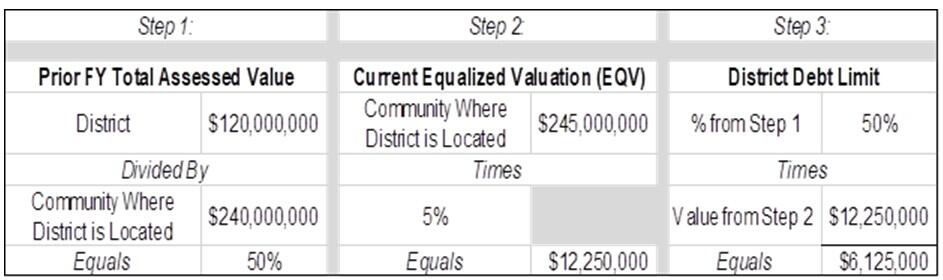
Calculating the limit includes applying the total assessed value of all property within the district to the total assessed value of the community where the district is located in. The calculation also includes a percentage of the equalized value or EQV of the community the district is located in. An EQV is the Commissioner of Revenue’s biennially determined estimate of full and fair cash value for each city and town in the Commonwealth as of a certain taxable date. EQVs have historically been used as a variable in distributing some state aid accounts and for determining county assessments and other costs.
The normal debt limit for a SPD located in only one community and borrowing under G.L. c. 44, § 7, is calculated in three steps. The example below shows that this district may authorize borrowing up to $6,125,000.
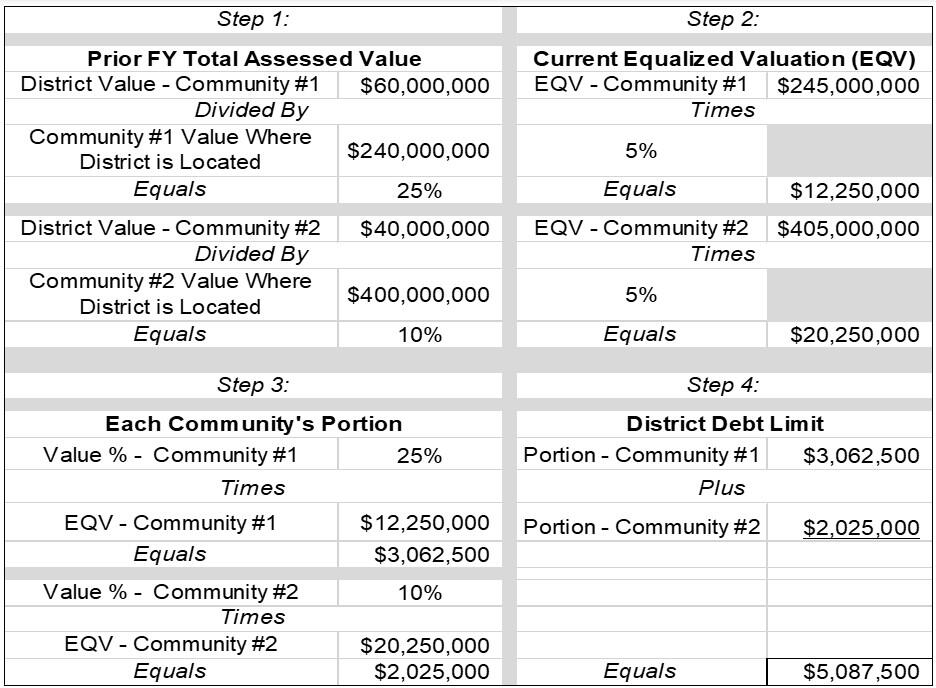
If a district located in more than one community is borrowing under G.L. c. 44,§ 7, the normal debt limit calculation is almost the same except both a percentage of the district’s assessed value within each community and the EQVs of each community are considered, requiring a fourth step. The example below shows a district within two communities and where this district may authorize borrowing up to $5,087,500.
Whether a SPD is located in one or more communities. a double-debt limit is allowed if borrowing under G.L. c. 44, § 7, provided the increased percentage limit is approved by the Massachusetts Municipal Finance Oversight Board(Board). Massachusetts Municipal Finance Oversight Board (“MFOB”) consists of the Attorney General, State Treasurer, State Auditor and Director of Accounts, or their designees, and must approve certain municipal debt authorizations and debt limitation, and may designate debt as “state qualified” allowing debt service to be paid by the State Treasurer from distributable aid payable to the District as defined in G.L. c. 44A. The 5% EQV factor shown in the previous two examples above may be increased up to a 10% EQV factor by vote of the Board.
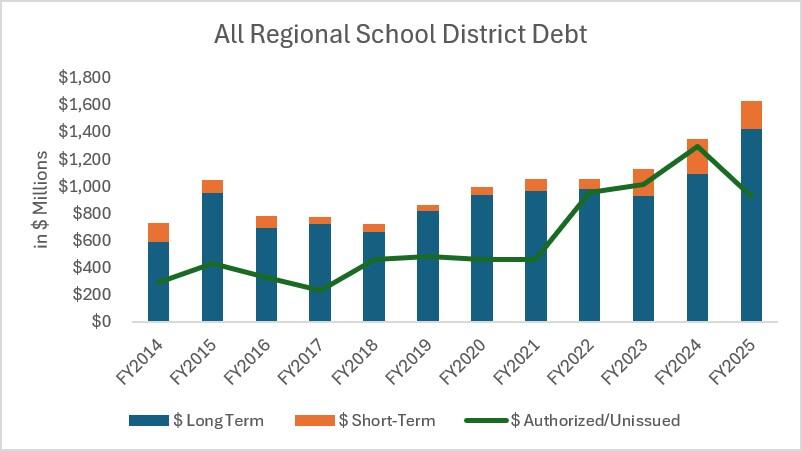
The next graph shows RSD debt reported from FY2014 to FY2025:
The following table shows FY2025 RSD debt reported by 84 districts:
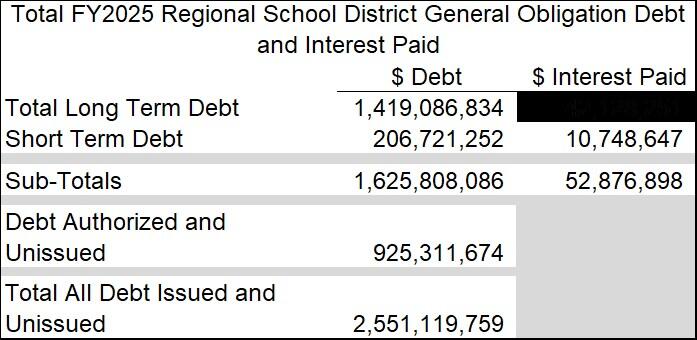
FY2025 RSD Stats
- 18 districts reported $0 debt;
- LTD issued 87.3% of all debt issued and 55.6% of all debt;
- STD issued 12.7% of all debt issued and 8.1% of all debt;
- A/U debt was 36.3% of all debt;
- Total debt issued was greater than FY2024’s total by $277.5 million or by 21%;
- A/U debt was less than FY2024’s total by $365 million or by 28%.
- 62 reported LTD ranging from $149.1 million to $64,000 with a median of $3.2 million;
- 22 reported STD ranging from $55 million to $146,402 with a median of $1.2 million:
- 26 reported A/U debt ranging from $185.6 million to $194,398 with a median of $4.1 million.
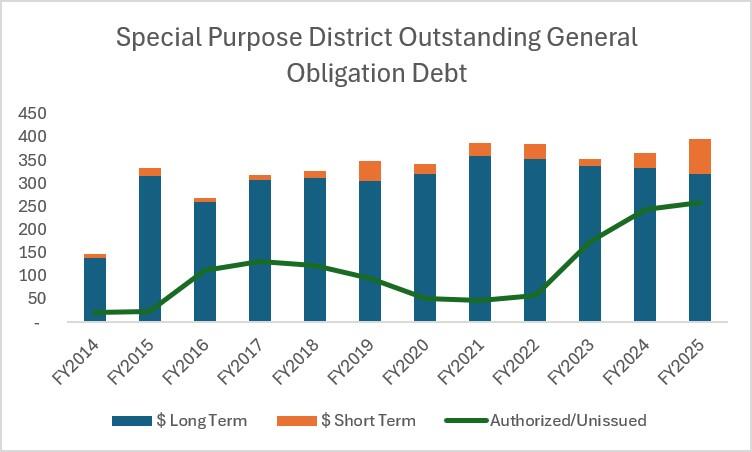
The next graph shows SPD debt reported from FY2014 to FY2025:
The following table shows FY2025 SPD debt reported by 76 districts:
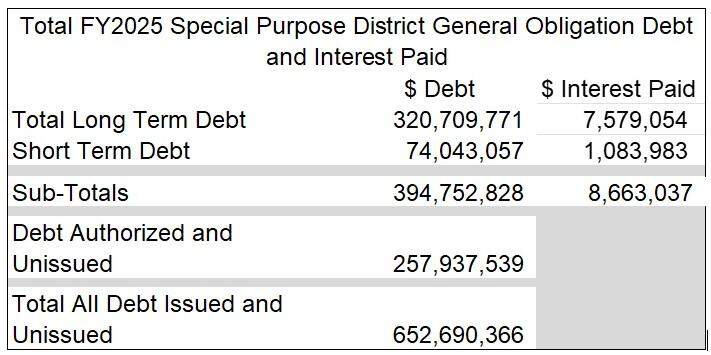
FY2025 SPD stats:
- 24 districts reported $0 debt;
- LTD issued 81.2% of all debt issued and 49.1% of all debt;
- STD issued 18.8% of all debt issued and 11.3% of all debt;
- A/U debt was 39.5% of all debt;
- Total debt issued was greater than FY2024’s total by $28.8 million or by 8%;
- A/U debt was greater than FY2024’s total by $15 million or by 6%;
- 49 reported LTD ranging from $115.8 million to $177,852 with a median of $2.0 million;
- 18 reported STD ranging from $17.9 million to $162,856 with a median of $2.4 million:
- 23 reported A/U debt ranging from $48.2 million to $10,000 with a median of $5.2 million.
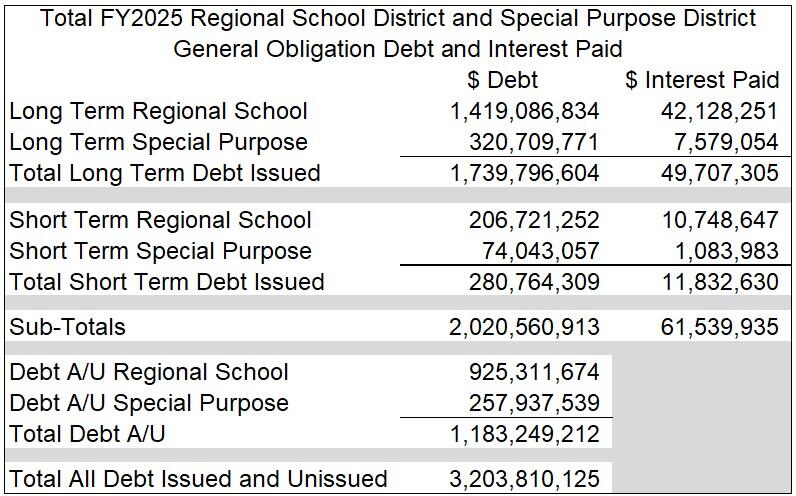
Finally, please see the below FY2025 Regional School District and Special Purpose District General Obligation Debt and Interest Paid totals.
Helpful Resources
City & Town is brought to you by:
Editor: Dan Bertrand
Editorial Board: Sean Cronin, Scott Ditto, Janie Dretler, Jessica Ferry, Christopher Ketchen, Paula King, Jen McAllister, Brianna Ortiz and Tony Rassias
| Date published: | October 15, 2026 |
|---|