Director's Letter
Dear Friends and Colleagues,
Today I’m looking back at what a busy few months we’ve had here at DER. We’ve heard the satisfying sounds of wetland construction at former cranberry bogs in the Southeast, dam removals in the central part of the state, and culvert replacement work in Western Massachusetts. Now, construction is wrapping up at many of those sites and we can hand the reins to nature.
In this issue of the Ebb & Flow, you’ll get a look at the construction that’s been underway the past few months, as well as a peek at some of the exciting announcements that have taken place, including additional funding opportunities for restoration work and a first-in-the-nation set of biodiversity goals for Massachusetts. DER’s restoration work continues at a fast pace as we head into the cooler weather.
Many of you have let me know how much you enjoy DER’s social media feeds. I wanted to tell you that DER’s beloved Social Media & Outreach Coordinator relocated out of state over the summer. Our outreach about all of DER’s exciting restoration work may be reduced until we are able to fill this crucial position. Please know that while you may see fewer posts on Instagram and LinkedIn, all of DER’s impactful work is still going strong behind the scenes.
Lastly, I’m so proud that DER’s cranberry bog restoration work was recently featured in several national news outlets! Check out these stories in the Associated Press, CBS News, and Inside Climate News.
The recent weather has been cool and crisp, perfect for a fall paddle. I'll see you out there!
Beth Lambert, Director
Construction Check-In
Here’s a look at DER’s partnership-based river and wetland projects that reached construction the past few months and what’s underway:
Becker Pond Dam Removal, Mount Washington: Construction is underway at the Becker Pond Dam removal site in Mount Washington, along an unnamed tributary to Schenob Brook. The Nature Conservancy owned the dam and SumCo Eco-Contracting completed channel work and then removed the dam during the first week of November. With the dam gone, natural riverine processes are restored, improving habitat for important coldwater species like Eastern brook trout. The Nature Conservancy is the primary project partner on this project.
Bowen’s Pond Dam Removal, Wendell: The Bowen’s Pond Dam Removal project is moving along, with construction expected to begin next month. This project will remove the Bowen’s Pond Dam at the headwaters of Osgood Brook in Wendell to restore natural flow and fish passage for important species like Eastern brook trout. Project partners include DER, the private landowner, the Millers River Watershed Association, Miller's River Trout Unlimited, and the Athol Bird & Nature Club.
Church Manufacturing Co. Dam Removal, Monson: Construction is just getting going on the Church Manufacturing Co. Dam removal in Monson and is expected to start in the coming weeks. Removal of the dam on Chicopee Brook will reconnect part of the brook and remove unneeded infrastructure and the maintenance and possible public safety issues that come with it. Construction is anticipated to last about three to four months, with planting and seeding to follow in the spring. Project partners include DER, the private dam owner, MassWildlife, and the Town of Monson Conservation Commission.
Dry Brook Culvert Replacement, Windsor: With construction wrapping up in September, the Town of Windsor replaced a degraded and perched culvert (meaning it sits above the stream’s surface) on a tributary to Dry Brook with support of a Culvert Replacement Municipal Assistance (CRMA) grant from DER. The crossing is adjacent to a wildlife management area and acted as a barrier to aquatic organisms and wildlife passage. This culvert was located on Cheshire Road, which is an important road between towns for emergency services, commuting, and for use as a school bus route. The project partner for this effort was the Town of Windsor.
Herring River Estuary Restoration, Wellfleet & Truro:With the first phase of construction ongoing this summer, the many partners on the Herring River Estuary Restoration project continued work on the Chequessett Neck Road bridge. Construction focused on the central span of the bridge, including placing the bridge beams and pouring the concrete deck. This project is the largest tidal estuary restoration ever undertaken in Massachusetts and the northeastern United States, and will restore up to 890 acres of degraded salt marsh and estuarine habitats. Project partners include the Town of Wellfleet, National Park Service, Natural Resources Conservation Service, NOAA, US Fish and Wildlife Service, National Fish and Wildlife Foundation, Friends of Herring River, and many others.
Kinne Brook Culvert Replacement, Chester: Construction on the Kinne Brook project in Chester wrapped up this fall. Project partners replaced a culvert on Kinnebrook Road on an unnamed tributary to Kinne Brook and removed a collapsed stone box culvert on the same tributary upstream in the Hiram H. Fox Wildlife Management Area. This work builds on a broader effort on the Kinne Brook system, including a dam removal on Kinne Brook in 2014 and culvert replacement on the Skunk Brook tributary in 2020. The project reconnects 10 miles of stream habitat for a Coldwater Fishery Resource and Outstanding Resource Water. Project partners include Trout Unlimited, Mass Wildlife, and the Town of Chester.
Larkin Mill Dam Removal, Newbury: Construction is well underway on the Larkin Mill Dam removal. The Town of Newbury and partners are removing Larkin Mill Dam and associated structures to restore fish passage and water quality on the Parker River. So far, contractors have removed the dam and replaced the USGS gage weir with a rock riffle. They’ll next be tackling scour protection under the I-95 bridge and expect seeding and final restoration to be completed in the spring. Project partners include the Town of Newbury, NOAA, US Fish & Wildlife Service, Division of Marine Fisheries, and Ipswich River Watershed Association.
Old Swamp River Dam Removal, Weymouth: The Town of Weymouth began removal of the Old Swamp River Dam in October, which is expected to wrap up in the coming month. Planting at the site is expected to be completed in the spring. This project will restore the natural river flow of Old Swamp River, support habitat for trout and herring spawning, improve the coldwater fishery, and restore the wetlands, floodplain and riparian buffer zone that have been degraded by the dam. Project partners include the Town of Weymouth and US Fish & Wildlife Service.
South Meadow Wetland Reserve Easement Restoration, Carver: The South Meadow Restoration project began construction in May on 34 acres of retired commercial cranberry farmland, and was featured in the news stories linked above in the Director’s letter. After nearly 100 years of farming on the property, the landowner retired the bogs in November 2021 and pursued a restoration pathway with the USDA Natural Resources Conservation Service (NRCS) and DER. This summer, construction was in full swing as the landowner’s heavy machinery worked to roughen the bog surface. Construction is expected to finish in the spring. Project partners include DER, the landowner, NRCS, and Beals and Thomas.
Swift River Culvert Replacement, Cummington: In October, the Town of Cummington started construction to replace a perched (meaning it sits above the stream’s surface) and degraded culvert on a tributary to Dry Brook with support of a Culvert Replacement Municipal Assistance (CRMA) grant from DER. A tributary to the Westfield River, the stream is an important coldwater habitat for rare species and the culvert currently acts as a barrier to fish passage.
Tributary to Mann Pond Culvert Replacement, Norfolk: Last month, the Town of Norfolk replaced a heavily deteriorated and failing culvert on a tributary to Mann Pond with support of a Culvert Replacement Municipal Assistance (CRMA) grant from DER, as well as ARPA and Water Enterprise funds secured by the Town.
Upper Coonamessett River Restoration, Falmouth: The Town of Falmouth and partners finished construction on the Upper Coonamessett River Restoration this summer, which restored 20 acres of former cranberry bogs into healthy wetlands along the upper Coonamessett River. In September, partners and community members celebrated this milestone with a ribbon cutting event, after which attendees were invited to walk the newly constructed pathways and take in the beautiful restored scenery. This project improves stream health, enhances fish passage, and provides recreational opportunities along the upper portion of the Coonamesset River Watershed. Project partners include DER, the Town of Falmouth, Coonamessett River Trust, USFWS, NOAA Restoration Center, Mass Audubon, and many others.
Ware River Restoration/Wheelwright Dam Removal, Hardwick and New Braintree: The Wheelwright Dam Removal is wrapping up construction for the winter. Over the past few months, with DER support, the dam owner drained the impoundment behind the dam and removed part of the dam. The remainder of the dam will be removed in 2026. Once complete, this project will improve public safety by removing an aging dam, reconnecting over 100 miles of mainstem and tributary habitat, and increasing recreational opportunities. Project partners include DER, the East Quabbin Land Trust, the private dam owner, MassWildlife's Natural Heritage & Endangered Species Program, and UMass Amherst.
Whitney Pond Dam Removal, Ashburnham: In August, the Town of Ashburnham removed the Whitney Pond Dam with help of DER and partners. The Town completed planting and installation of educational signage and a display of the preserved low level outlet gates in early November. This project removed a Significant hazard dam in poor condition, and restored river connectivity in the Whitman River, a designated coldwater fishery. Project partners include DER, the Town of Ashburnham, and the Nashua River Watershed Association which is one of the core partners of the Merrimack Restoration Partnership.
Staff Welcome
New staff joined DER this summer! DER is excited to welcome Bridget Livers Gonzalez and Kacey Ruderman to our team.

Bridget Livers Gonzalez: Bridget joins DER’s Dam Removal Program as an Ecological Restoration Specialist. Originally from Kansas City, Bridget examined morphology of mountain streams, the roles of forests and large wood in maintaining healthy riverscapes, and human impacts to watershed processes and landforms during her graduate studies in Colorado. She is an interdisciplinary river scientist that has taught a range of university earth science courses and worked in diverse stream systems across the US. She is excited to free rivers and restore Massachusetts’ diverse stream ecosystems with DER!
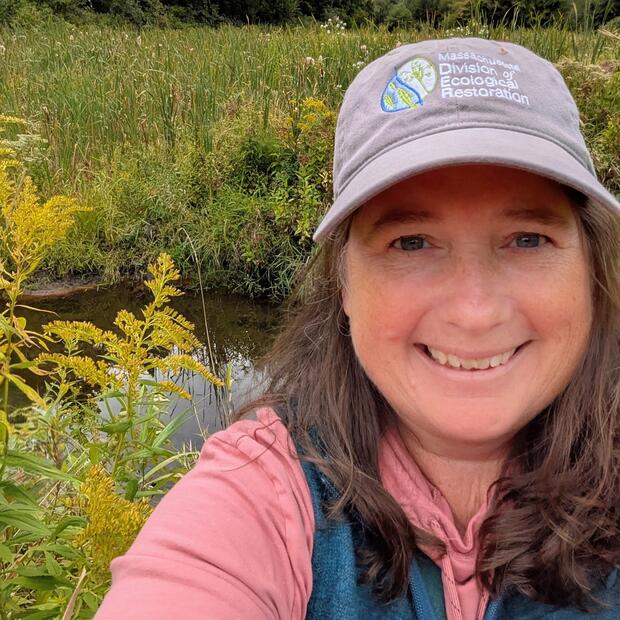
Kacey Ruderman: Kacey joins DER’s fiscal team as a Procurement Specialist. Prior to joining DER, Kacey worked as a buyer at the Department of Fire Services for over 9 years, supporting multiple divisions. In her new role, Kacey is assisting DER’s fiscal team with grant procurement and organizing new grant opportunities, an integral part of achieving DER’s mission. In her free time, Kacey enjoys hiking, camping, fishing, and participating in a yearly women’s “Friendsgiving” overnight excursion to one of the Appalachian Mountain Club's high mountain huts.
Funding Opportunities Support Restoration
It has been a special time for ecological restoration—the Commonwealth and DER announced multiple exciting investments in restoration projects this summer and fall.
Ecological restoration is a crucial piece of the puzzle to building a climate ready future for the Commonwealth and reaching environmental goals such as those to improve biodiversity. However, this work can’t move forward without funding. These new opportunities highlight the priority that restoration work is being given by the Commonwealth and the value of restoration to both people and the environment of Massachusetts.
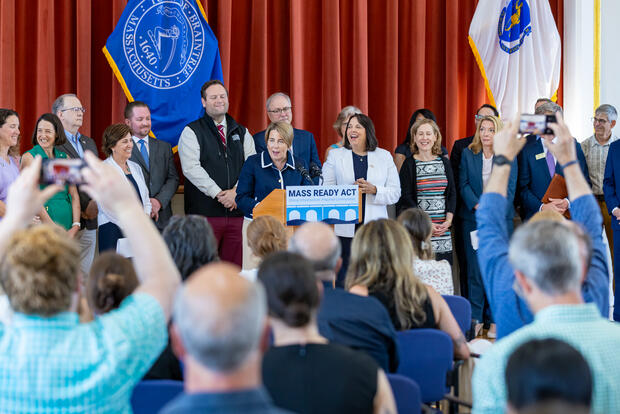
To start, summer began with an announcement from Governor Healey. The Governor filed the Mass Ready Act on June 24, which was formally announced in Braintree. Although the heat drove us inside, the event highlighted the Town of Braintree’s and DER’s Monatiquot River Restoration Project as an example of the type of work that will benefit from this funding. This recently-completed project removed two dams and opened the river to river herring for the first time in 200 years.
The Mass Ready Act is an historic $2.9 billion investment in our environment to strengthen Massachusetts infrastructure, protect water and wildlife, and prepare for disasters. It includes important investments in biodiversity conservation, public access to nature for all, and ecological restoration—including a proposed $40 million for DER. The Mass Ready Act could support future investments in projects like the Monatiquot River Restoration Project, which benefit their communities in many ways including increased climate resilience and new recreational opportunities. Learn more about the Mass Ready Act at mass.gov/massready.
In other funding news, in August, DER announced the award of $2.9 million for restoration projects throughout the state. Of this, $2.7 million will support culvert replacement projects in 21 towns through DER’s Culvert Replacement Municipal Assistance (CRMA) Grants and Culvert Replacement Training Site Initiative. These grant programs help municipalities replace outdated culverts with new, improved crossings. In addition, $200,000 is supporting the Herring River Estuary Restoration Project in Wellfleet and Truro through DER’s Priority Projects Program. This project is one of the largest tidal estuary restorations ever undertaken in Massachusetts and the North Atlantic coastal region. Once complete, it will restore up to 890 acres of degraded salt marsh and estuarine habitats, improve fish access to hundreds of acres of ponds, and restore a significant area of shellfish habitat. Read more about these awards in the associated press release.
Finally, DER was also proud to announce $716,300 to support three established Partnerships through DER’s Regional Restoration Partnerships Program. This funding supports the Merrimack Restoration Partnership; Buzzards Bay Watershed Restoration Partnership; and Berkshire Clean, Cold, Connected Restoration Partnership, which were originally selected as part of the Regional Restoration Partnerships Program in 2021. This program helps build the capacity of regional organizations and regional planning agencies that work with cities, towns, and other local partners to lead watershed-scale ecological restoration within their regions. Pairing partners' strengths with state investments empowers local communities to restore rivers and wetlands and help people and nature adapt to climate change. Read more about these awards in the associated press release.
DER looks forward to continuing to support our partners as we pursue river and wetland restoration together.
Governor Healey Announces Nation-Leading Biodiversity Goals
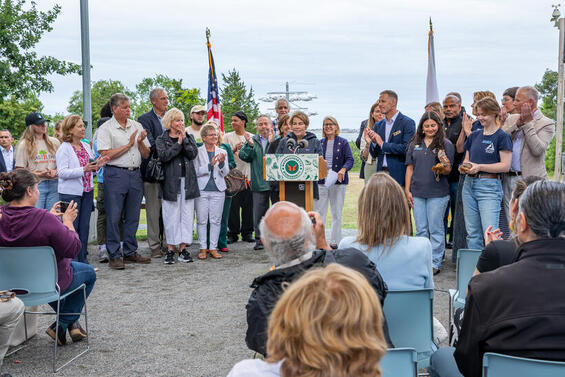
In August, Governor Healey announced a 25-year plan to protect and restore nature across Massachusetts, known as the Biodiversity Conservation Goals for the Commonwealth. DER was proud to be part of this event at Mass Audubon’s Long Pasture Wildlife Sanctuary in Barnstable, along with Executive Office of Energy & Environmental Affairs Secretary Rebecca Tepper, Department of Fish and Game Commissioner Tom O’Shea, and many other key partners. The newly-unveiled biodiversity goals are designed to rebuild nature, sustain the health and well-being of residents, improve access to fresh food, and enhance the overall quality of life and economy for everyone.
This ambitious, whole-of-government approach charts a path forward to halt and reverse biodiversity loss and invest in nature to sustain our health and well-being, food security, economy, and way of life. The 25-year plan sets four key goals—Protect, Restore, Sustain, and Connect—each with specific strategies for action, timelines for implementation, core commitments, and foundations for success. This highlights the importance of restoration work for biodiversity and how the benefits of ecological restoration work come together to support both people and nature.
Called for by Governor Healey's Executive Order No. 618, this is the first time a state has comprehensively set biodiversity targets for 2030, 2040, and 2050, including for coastal and marine habitats. Notably, this plan commits to doubling the pace of land protection to achieve 30% by 2030 and 40% by 2050 and restoring 75% of our most important habitats for wildlife by 2050.
DER’s restoration work directly contributes to the realization of these biodiversity goals and we are excited to work with other agencies and partners to move them forward.
DER’s Restoration Work is Highlighted to an International Audience
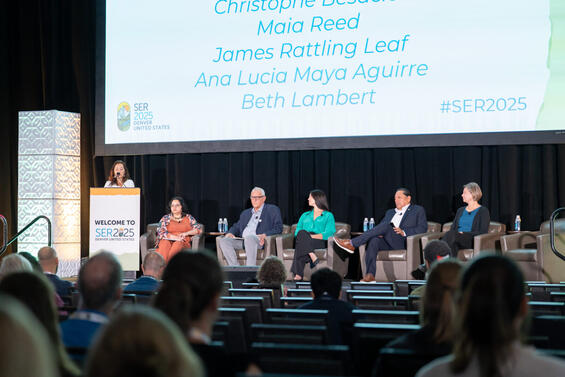
Beth Lambert (far right) sits onstage at the 11th World Conference on Ecological Restoration. (Photo Credit: SER)
Early last month, DER Director Beth Lambert participated as an invited speaker at the 11th World Conference on Ecological Restoration in Denver, Colorado, hosted by the Society for Ecological Restoration (SER). The conference describes itself as “an exciting and inspiring biennial gathering of global experts in ecological restoration...[and] the premier venue for those interested in being active members of the global restoration community.” Beth joined a high-level plenary discussion on “Exploring the Enabling Conditions for Accelerating Restoration” during the second day of the conference, where she spoke of the strategies for accelerating restoration work in Massachusetts. It was a great honor for Beth to be able to share DER’s restoration work on an international stage. Check out recordings of the conference’s opening ceremony and plenary sessions on the conference website.
Project Highlight: Windswept Bogs Restoration
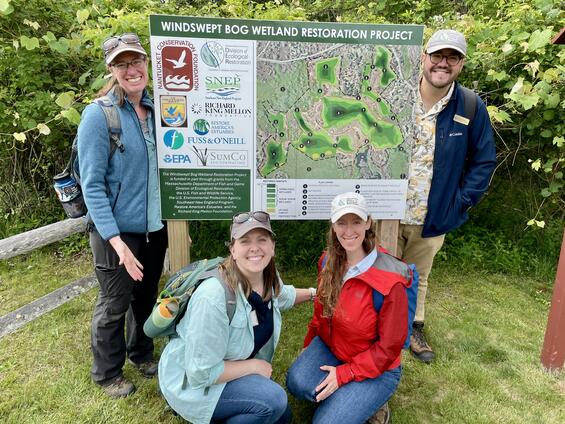
In June, DER and partners traveled to Nantucket to tour the site of the recently-completed Windswept Bogs Restoration project. This project restored approximately 40 acres of retired cranberry farmland to wetland habitat.
The Windswept Bogs Restoration Project became a DER Priority Project in 2021. After several years of data collection, design, and permitting, the first phase of construction began in January 2024. Construction was limited to the winter season to avoid impacting rare plants, nesting birds, and breeding wildlife that were documented at the site. Construction thus took place over two phases, with the first phase completed in March 2024 and the second and final phase of the project beginning in November 2024 and wrapping up in April 2025.
With the project complete, DER and partners were graciously hosted by the Nantucket Conservation Foundation to tour the newly-restored site in June. Only a couple months after construction equipment had left, the recently-restored areas of the site were already teeming with life and greenery. Those areas that had been part of the first phase of construction appeared as established wetlands, without a hint at their prior purpose. Time will continue to bring this site back to life as wetland habitat continues to emerge, establish, and thrive.
This site is an excellent example of the power of restoration and partnership. The project relied on the dedicated work of many partners, including the Nantucket Conservation Foundation, SumCo, Fuss & O’Neill, USFWS, EPA Southeast New England Program, and the Richard King Mellon Foundation. The site is open to the public and all are encouraged to visit to connect with nature and see the benefits of restoration in action. Learn more about the Windswept Bogs Restoration Project on the Nantucket Conservation Foundation’s website.