
Authors: Lauren Aldrich and Joseph Barbieri - Bureau of Local Assessment
Chapter land is a popular statutory property tax relief program, but why does Chapter land even exist? How are the values of Chapter land determined and who is responsible for determining those values?
Let’s explore the legislation; Massachusetts General Laws Chapters 61, 61A, and 61B establish the state’s property tax relief programs for forest land, agricultural and horticultural land, and recreational land. These statutes allow qualifying land to be assessed based on its current use rather than potential development value, while outlining eligibility requirements, enrollment procedures, valuation methods, and provisions related to changes of use, rollback taxes, and municipal rights of first refusal.
The Farm Value Advisory Commission (FVAC) was created by the Massachusetts legislature as the governing body to oversee the classification and taxation of forest land, agricultural and horticultural land, and recreational land. The mandated law assembles members from six different state or local agencies; the Commissioner of Revenue (Chair); the Commissioner of Agriculture; the Commissioner of the Department of Conservation and Recreation; the Director of Housing and Community Development; the Dean of the College of Food and Natural Resources of the University of Massachusetts and a Governor appointment of a member of a local board of Assessors.
On a statewide basis, the Commission administers forestry, agricultural/horticultural and recreational land that is owned by taxpayers who have applied and been allowed into the Chapter program at the local level. The land is commonly known as chapter land and is further defined in Massachusetts law as Chapter 61, Chapter 61A, and 61B.
The Commission values Chapter 61 and 61A land categories on an annual basis. The valuation of 61 and 61A is specific and distinct compared to the valuation of most municipal residential, commercial, or industrial land. Generally, in the Mass Appraisal process cities and towns estimate land value based on sales data. The sales data is usually in or around their respective municipalities. Chapter 61 and 61A are not valued in this manner and represent very different valuation models. Values are set by a multi-step process based on land use and income potential. State law dictates this methodology. The third category, Chapter 61B, is recreational land. It is valued within each municipality as a percentage of the estimated market (land) value.
For the commission and subsequent subcommittee, data collection begins at the start of each calendar year. Information is gathered from all types of national, regional and state sources including the USDA, Cranberry Growers Association, Massachusetts Department of Conservation and Recreation (DCR), etc.
Forestry values (Chapter 61) are determined by collecting, reviewing, and analyzing specific forestry data. The DCR representative calculates annual values using an established formula that looks at annual net growth, average stumpage values, costs, and harvest reduction factors. The result is an annual per acre value for forestry, also known as productive woodland. The value can further be divided into geographic areas west and east of the Connecticut River. Some years value divergence occurs, other times the values are the same. In fiscal year 2023 the FVAC voted to group Christmas tree values with forestry values to follow the same valuation process.
Cropland (Chapter 61A) that is harvested or pastured, as well as non-productive land is determined using a formula with specific data requirements. Rental data is collected for both irrigated cropland/pastureland and non-irrigated cropland/pastureland. Using a market developed capitalization rate and applying that to USDA rental data, a base rent using a five-year average for three categories (harvested cropland, pastureland and non-productive) is calculated. The values for each category are then averaged with the prior four-year values (for a total of a five-year average) for that category.
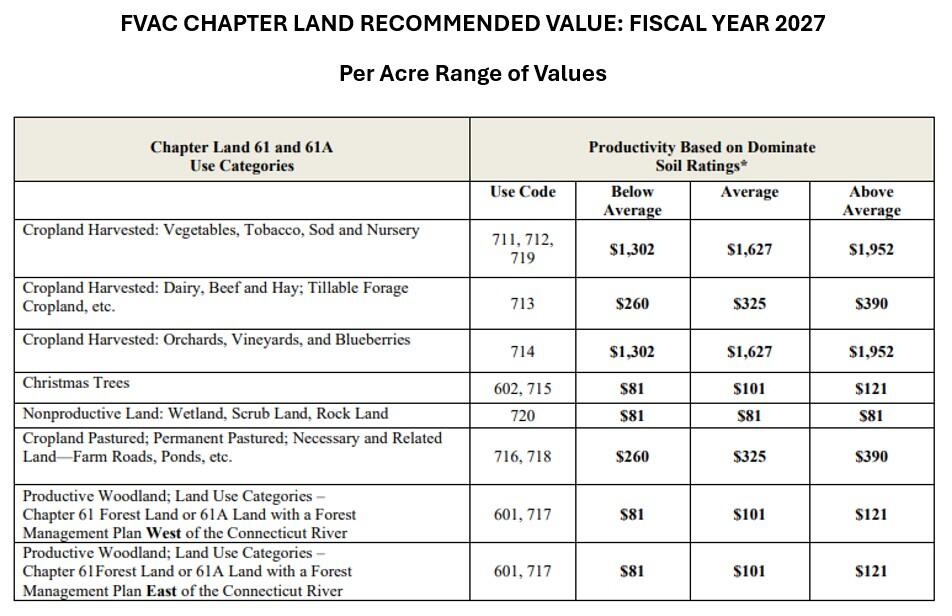
Cranberries are a distinct category as their cultivation and harvest processes dramatically differ from other crops. Cranberry data such as yield, production, price per barrel, and market value are collected and analyzed. Cranberry values are also calculated using a five-year average with five categories presented based on a farm’s yield.
The trend of using a five-year average was adopted by the FVAC to address any volatility in the agricultural markets. Some years farms have perfect growing conditions, other years they do not. As most Assessors know, there are numerous issues farmers can face annually that can seriously impact farm production. Using five-year averages mitigates excessive anomalies or fluctuations.

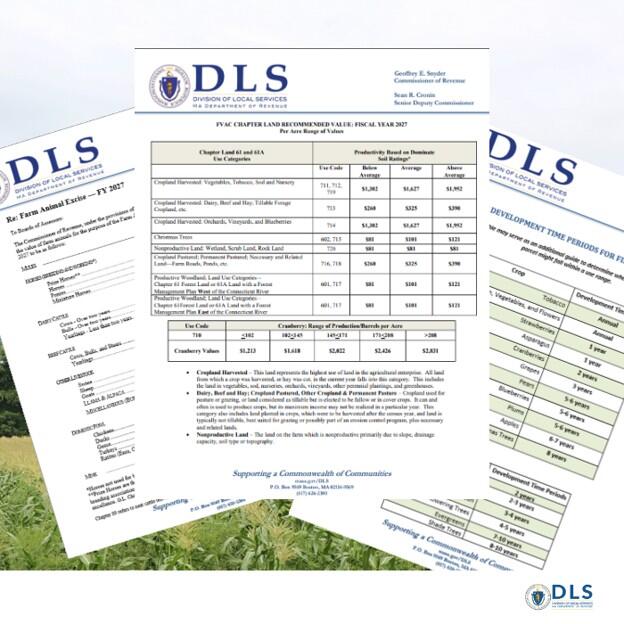
In addition to setting values for Chapter 61 and Chapter 61A, the FVAC also determines farm animal excise values and annual crop development periods. It is important to note that communities not executing the farm animal excise must have a vote from the Board of Assessors on file with this determination. Crop development time periods are a useful guide in determining the time it takes to establish crops that are classifiable. For example, tobacco can be planted and harvested annually whereas grapes may take up to three years to develop fruit to sell at market. Such distinctions are important when considering a chapter land application.
In conclusion, landowners classify their lands in Chapter 61, 61A and 61B to benefit from reduced property taxes. As development pressures increase around these properties, taxes often rise to cover the costs of expanded town services. Without Chapter 61, 61A, and 61B, these tax increases would force some landowners to sell their property.
The implementation of chapter programs has permitted many parcels in the Commonwealth to remain undeveloped or active farmland. This is a direct result of reduced property tax bills following enrollment in these beneficial state programs.
Helpful Resources
City & Town is brought to you by:
Editor: Dan Bertrand
Editorial Board: Sean Cronin, Scott Ditto, Janie Dretler, Jessica Ferry, Brianna Ortiz, Christopher Ketchen, Paula King, Jen McAllister and Tony Rassias
| Date published: | August 13, 2026 |
|---|