
Why Early Prevention Matters in Aquatic Plant Management
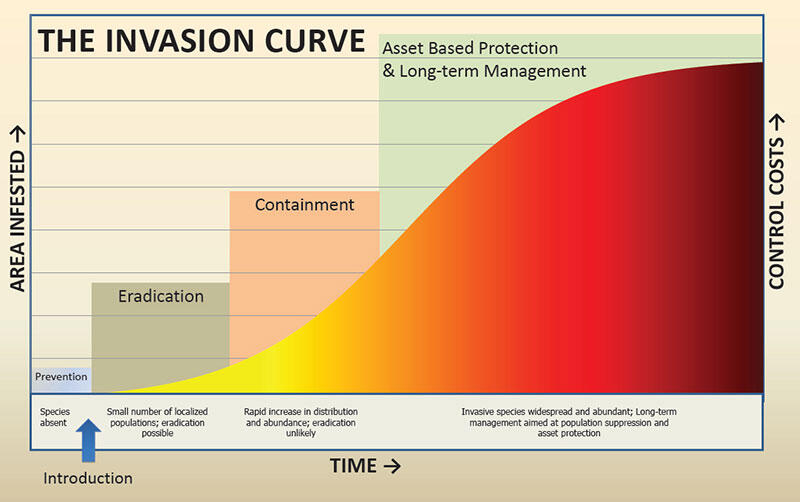
The invasion curve illustrates that prevention is the most efficient and least costly method of combating invasive species. As a non-native species becomes more established over time, the effort and associated costs of addressing it escalate exponentially. From the USDA Forest Service 2005 Invasive Plant Environmental Impact Statement; provided from the U.S. Army Corps of Engineers Headquarters Website.
For more in depth information on aquatic plant management in Massachusetts, please refer to the Eutrophication and Aquatic Plant Management in Massachusetts Generic Environmental Impact Report (GEIR) and its companion document, the Practical Guide to Lake Management in Massachusetts. If you would like to request a copy of these documents, please email the Lakes and Ponds staff. These documents present a brief summary of the science of limnology (the study of freshwater ecosystems), describes techniques for lake management, and reviews case studies of lake management in Massachusetts.
Massachusetts Aquatic Plant Management Guide (Mass APM Guide): Purpose and Background
The Massachusetts Aquatic Plant Management Guide (Mass APM Guide) is intended to provide an update to the 2004 Generic Environmental Impact Report on Eutrophication and Aquatic Plant Management in Massachusetts (GEIR) and the accompanying Practical Guide to Lake Management in Massachusetts. The original GEIR was developed in the late 1990s and early 2000s. Over the last two decades, much experience has been gained with the management of lakes and ponds. Additionally, changes in regulations have created additional needs not addressed in 2004 and this document incorporates this information. This 2025 guide incorporates updates to both the GEIR and Practical Guide into one hybrid document. Note: this document is still in a draft stage and has not yet been approved for use by the Massachusetts Environmental Policy Act (MEPA) Office.
The draft Mass APM Guide was posted in spring 2025 for public review and comment for 30 days. There were over 100 comments, questions, edits and suggestions received for the draft; all of these are currently under review by the interagency team that has worked on the Mass APM Guide. Replies to comments, questions, edits and suggestions will be posted once they are available. If you have any questions, please contact the DCR Lakes & Ponds Program.
What to Do If You Find an Aquatic Invasive Plant Species in Your Waterbody
So you’ve found a new aquatic invasive plant species in your waterbody that has previously not been present and now you’re panicking. Panic is not the first step, nor does it need to be any step in the process. Below we have provided a very basic outline of the aquatic plant management process from discovery to actual management.
- Discovery: whether this was accidental or intentional through a monitoring effort, proper identification of the species you’ve found is critical. If you’re unsure of what species you may have, please visit our Report an Aquatic Plant Sighting webpage to submit photos to us for identification. From there, we can provide more insight on applicable management strategies and next steps specific to what you have found.
- Survey: you cannot manage what you have not monitored! In order to determine the distribution and density of the AIS, an aquatic plant survey should be conducted. This survey will also prove to be crucial if you are to seek future permits for management. Surveying allows you to fully understand what other plant species are present within your waterbody and document changes over time to the entire plant population – both qualitatively and quantitatively. There are various survey methods that can be used, but for the initial effort, a visual survey should provide sufficient information. This survey should be done by a lake management professional who is experienced with aquatic plant surveys and identification.
- Survey Results: once you have a better grasp of the AIS conditions within your waterbody, you can determine if you want and/or need to consider managing the infestation. Deciding to manage an infestation depends on various factors, such as: the ecological, economic and/or recreational impact the AIS will have for your waterbody, the cost of management, the extent of the infestation, and more.
- The next steps are here under the assumption of proceeding with management.
- Management strategy: depending on the AIS present in your waterbody, there are often various strategies available for management use. Typical management strategies include, but are not limited to: diver hand-pulling, diver-assisted suction harvesting (DASH), benthic barriers, herbicide application, and mechanical harvesting. It is important to remember that AIS reproduce in various ways and not all management strategies are appropriate for all AIS. Please refer to the GEIR for more information about the approved management strategies.
- Permitting: almost all aquatic plant management requires permitting. These permits need to be filed with your municipality’s conservation commission as well as the Massachusetts Department of Environmental Protection (MassDEP). This can be done by a lake management professional that is familiar with the Wetlands Protection Act and plant management. Permitting is not a quick, or sometimes easy, process. It is recommended to anticipate this process taking at least a couple of months. There may be additional steps required if your waterbody is within a Natural Heritage and Endangered Species mapped habitat area. Please refer to our Aquatic Plant Management Permitting page for more information.
- Management: once all required permits have been issued, your management can begin. This is another task which can be done by a lake management professional.
If you need more information on a particular step in this process, please contact us.