
Author: Financial Management Resource Bureau
Capital planning in municipalities, despite its importance, is often deferred or happens reactively, sometimes when it’s too late to avoid escalating costs or service interruptions. The following best practices will help communities achieve a proactive, data-driven, and organized capital budget and capital improvement plan (CIP). A capital improvement plan is a comprehensive blueprint for planning a community's capital expenditures that spans five to ten years. It identifies capital items that cost more than a certain threshold determined by the community and provides a planning schedule with financing options. The capital budget is the upcoming year's spending plan for capital items that is presented to the legislative body for approval.
Capital projects are a significant financial undertaking, whether making a one-year capital purchase or financing long-term infrastructure improvements. Before effective capital planning can take place, we recommend developing a comprehensive five-year forecast of revenues and expenditures. This will help budget preparers understand their financial condition and ensure capital financing decisions are well-informed. DLS offers a helpful online tutorial about creating and implementing a forecast.
Financial policies related to capital planning and debt management are also important in framing related decisions. An effective capital planning policy will define a capital project in terms of a dollar threshold, years of useful life, and include any supporting services like design and engineering. The capital planning policy should also define the capital planning process and assign responsibility to staff and officials and identify the community’s financing strategy regarding the balance of cash versus debt, and the amount of annual revenue to allocate to capital. A debt management policy will also be helpful for many communities. DLS also offers an informative webinar on financial policies.
With a forecast and policies in place, staff should develop a centralized asset inventory. This should be compiled and kept by the finance director/accountant or whoever initiates the capital planning process. Public works departments will usually have an inventory of their buildings and heavy equipment, which is a good place to start. The community’s liability insurance can also be a good source.
An inventory will likely be a spreadsheet that lists the following:
- item name or number
- asset type (infrastructure/heavy equipment, etc.)
- date of construction or acquisition
- physical description
- purchase price
- replacement cost
- current condition
- use type
- space for comments
Once officials have an inventory in place, it should be updated annually and used as a basis for capital decisions regarding existing assets.
The next step in creating a structured capital budgeting process is standardizing project submissions. Where the capital process is informal, we have seen project requests that often vary in detail and form across departments. This makes it difficult to compare when evaluating projects for final approval, which is often exacerbated by the lack of a clear timeline. We recommend formalizing the capital planning budget process in a way that parallels the operating budget. There should be a capital budget calendar that identifies due dates for submissions and outlines the process of review, revision, and final adoption of the year’s approved capital submissions.
To support this process, budget officials should create capital submission forms that all departments are required to use and submit according to the calendar. The budget preparer would distribute these forms (likely a spreadsheet) to department heads along with a memo explaining that year’s guidance for capital spending, including the due date for submissions.
A good capital submission form should contain the following components:
- project title
- description of project
- impact on service
- benefit to residents
- project cost with proposed funding sources (5-year projection for multi-year projects)
- impact on operating costs
- stakeholders involved (for instance, abutters to a proposed construction project)
After submittal, the budget preparer can compile the proposals and create a summary according to department, five-year cost projection, and funding sources. The budget preparer should integrate this proposal into the community’s five-year CIP to capture its effects on future years and give context to the rest of the process. Depending on the community, the budget preparer may then wish to review the capital submissions and schedule one-on-one meetings with department heads to provide feedback and allow them to revise their project requests.
After review, the revised package can be submitted to policy boards and decision-makers. In a town, this may be the finance committee or select board, but if the community has a capital committee they will likely get it first. When reviewing capital projects, we recommend using a standardized rubric or checklist where each component has assigned points that policy makers can apply consistently across proposals. This will provide a standard basis for comparison and make the approval process more straightforward. This review process should also include a series of public meetings for department heads to present their submission before policy boards and answer their questions.
Once this review process is complete, decision-makers can vote on which projects to submit as that year’s capital budget. The budget preparer should then compile a list of approved capital project requests that will appear in the community’s budget document and update the CIP. The capital section of the budget document should include brief descriptions of all proposed projects and a summary by department, project title/description, the cost for the upcoming fiscal year, and the proposed funding source(s), such as debt, stabilization, free cash, community preservation act (CPA) funds, and departmental receipts.
With the right process, capital budgeting can be logical, timely, and organized while ensuring that departmental and community needs are accurately identified and addressed. However, capital planning also requires a comprehensive, strategic approach to give context to the process and meet capital and service needs into the future. As noted earlier, financial policies are a key part of providing this context. Policies can identify long-term goals such as the community’s preference for spending cash from reserves or for funding projects through debt, the balance of cash versus debt, and what percentage of total revenue to spend on capital each year.
Through policies and spending decisions, local officials should ensure they maintain a favorable balance of capital investment in the budget year-to-year. Since many long-term capital purchases require debt financing, this might look like maintaining debt service at a set percentage of revenue.
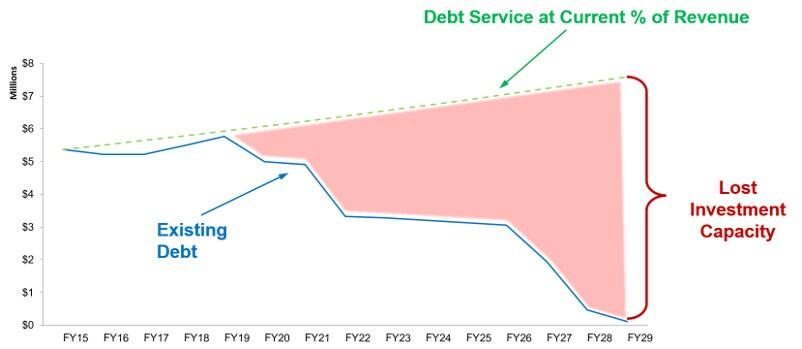
As debt is retired, the debt service budget decreases over time and could potentially be reallocated to departmental increases, program expansions, or other line items. With less room in the budget for debt service, it becomes increasingly challenging to invest in maintaining the community’s infrastructure, which may lead to sudden, costly failures in the future. By continually reinvesting in debt-funded projects, officials can ensure that the capacity for maintaining capital assets and infrastructure is available when needed most. For more information, please see the below DLS informational resources.
The Essentials of Capital Planning [DLS YouTube Video]
Capital Planning [Municipal Finance Training and Resource Center]
Debt and Borrowing [Municipal Finance Training and Resource Center]
Helpful Resources
City & Town is brought to you by:
Editor: Dan Bertrand
Editorial Board: Sean Cronin, Scott Ditto, Janie Dretler, Jessica Ferry, Christopher Ketchen, Paula King, Jen McAllister, Brianna Ortiz, and Tony Rassias
| Date published: | July 16, 2026 |
|---|