
History
Starting in 2010, Massachusetts began to see a large increase in opioid overdose deaths. Communities were looking for data that might provide information on the causes. The state’s current data systems couldn’t provide it. Each state agency held a piece of the puzzle, but no one could see the full picture.
In 2015, state leaders decided to change that. Legislators passed a new law. The new law allowed the Massachusetts Department of Public Health (DPH) to link data from across government agencies. This included hospitals, treatment programs, correctional settings, and more.
This unique data system linked information from over 20 sources covering 98% of Massachusetts residents, ages 11 and older. Now, Massachusetts could see how people moved through different systems.
The insights were powerful. The state learned that:
- Nonfatal overdoses were far more common than anyone realized.
- People leaving incarceration faced a much higher risk of overdose.
- Pregnant and postpartum women were also at a higher risk of overdose.
- Construction workers experienced overdose more than other types of workers.
- Many people who died had never received evidence‑based treatment.
These findings led to real change. Examples of action include:
- More treatment programs
- Better hospital protocols
- Expanded access to lifesaving medications
- Specific support for high‑risk groups
Today, the Public Health Data Warehouse guides decisions on more Massachusetts health priorities. It is one of the nation’s most comprehensive public health data systems. It remains a cornerstone of policymaking in Massachusetts.
Timeline
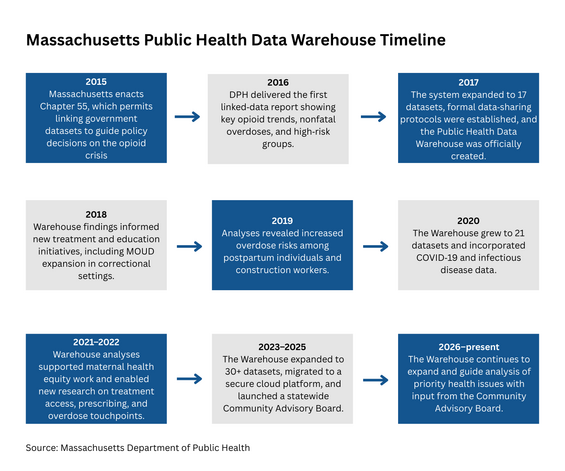
2015
- Opioid overdose deaths increased to dangerous levels. Governor Charlie Baker put together a new group, the Opioid Addiction Working Group, to address this crisis. This group included experts from across government, health care, law enforcement, and community. The goal was to develop recommendations to address the opioid crisis.
- The Working Group named a lack of integrated data as a main issue.
- The legislature passed Chapter 55 of the Acts of 2015. This new law authorized data sharing across government and health care agencies. This would allow for analysis of fatal opioid overdose.
- DPH began to build an integrated data system that could provide these links.
2016
- Chapter 133 of the Acts of 2016 reauthorized integrated data system efforts. Now the mandate included looking at nonfatal opioid overdoses.
- DPH delivered the first Chapter 55 report. The report showed new and important findings from across 10 linked datasets. These included Opioid Use Disorder prevalence (how common the disease is at a given time) and nonfatal overdose burden. The report also highlighted populations with a higher risk of opioid overdose.
- DPH shared initial findings with the public in other ways as well. This included the publication of data briefs and the creation of data visualization website (now archived).
2017
- DPH established a more defined protocol for data sharing across agencies. These protocols enhanced security of the data. The data system grew to include 17 linked datasets.
- DPH published new data briefs and legislative reports. Analysis showed greater risk of opioid overdose among several population groups. These included individuals leaving incarceration and people experiencing homelessness.
- DPH granted data analyst groups access to its integrated data system. DPH vetted these external data analyst groups using the state's competitive bidding process.
- The legislature passed Chapter 111, Section 237. The new law allowed DPH to analyze of broader health trends using the integrated data system.
- DPH named the integrated data system the Public Health Data Warehouse.
2018
- DPH continued to grant data analyst groups access to the Public Health Data Warehouse.
- Legislators called for pilot programs to begin in correctional facilities. These programs worked to expand access to medications for Opioid Use Disorder.
- Public Health Data Warehouse findings informed more efforts. These included substances use disorder treatment expansion across Massachusetts and medical education reforms.
2019
- The Public Health Data Warehouse published more findings. These showed that individuals who recently gave birth may have increased risk of opioid overdose. In addition, findings show that construction workers are more vulnerable to opioid overdose.
2020
- The Public Health Data Warehouse continued to add datasets, reaching 21 different sources.
- The COVID‑19 pandemic prompted inclusion of infectious disease data. DPH adds these data to the Public Health Data Warehouse.
2021–2022
- DPH used analysis from the Public Health Data Warehouse to inform maternal health equity initiatives.
- External data analyst groups tested new theories. These included access to medication for Opioid Use Disorder access, opioid prescribing practices, and overdose touchpoints.
2023 - 2025
- The Public Health Data Warehouse evaluated medication for Opioid Use Disorder in correctional settings.
- The Public Health Data Warehouse added more datasets, reaching over 30 different sources.
- The Public Health Data Warehouse team improved its data system structure. The team worked with to migrate its platform to a cloud‑based application. The new platform allowed for enhanced security, role‑based access, and analytic capacity.
- To better engage with Massachusetts populations, the Public Health Data Warehouse formed an advisory board. The Community Advisory Board recruited 17 individuals from different areas of community and met each quarter.
2026 - present
- The Public Health Data Warehouse continues to expand analysis of priority health topics in Massachusetts. The Community Advisory Board guides management and use of the data.
Publications about the Public Health Data Warehouse
There are many articles that showcase the Public Health Data Warehouse. Several of these publications are listed below. They provide more in-depth review of the history, formation, and effectiveness of the Public Health Data Warehouse.
- How One State Overcomes Barriers to Better Share Public Health Data
- Massachusetts Harnesses Data from Multiple Agencies to Improve Public Health
- Use of Big Data and Ethical Issues for Populations with Substance Use Disorder
- The Massachusetts public health data warehouse and the opioid epidemic: A qualitative study of perceived strengths and limitations for advancing research
- Using Data to Guide Action in Response to the Public Health Crisis of Opioid Overdoses
- A qualitative study of big data and the opioid epidemic: recommendations for data governance
- Linking and De-identifying State-level Data Sets to Tackle the Opioid Epidemic (Webinar)