

NEW! Renewable Diesel Guideline
Guideline Effective Date: July 31st, 2026
This document (“policy”) provides state entities – wishing to utilize renewable diesel as part of their greenhouse gas (GHG) emissions reduction strategies – the official LBE determination on:
- eligible use cases for renewable diesel in state operations
- eligible renewable diesel feedstocks
- when and how to calculate renewable diesel emissions
In summary, to receive GHG emissions benefits, the renewable diesel must:
- Only serve as a transition fuel for hard-to-electrify use cases (with electrification as the main goal)
- Be sourced domestically
- Be derived from waste-based feedstocks only (i.e., used cooking oil, tallows, animal fats)
Review the details of the policy, emissions calculations, and application form at the links below.
Executive Order No. 594 Overview
Building on the success of Executive Order 484, Executive Order 594 sets goals and requirements that will accelerate the decarbonization of fuels used to heat and cool state facilities, help to demonstrate new technologies and strategies necessary to meet the Commonwealth’s energy goals, and quicken the shift to electric heating and vehicles. By leading by example in these and other areas, state government can help guide the Commonwealth toward a cleaner future.
The full text of Executive Order 594 can be found here.
The graphic below highlights the overarching goals and priorities of Executive Order 594 and illustrates the ways in which this Order puts Massachusetts state government at the forefront of climate innovation and leadership.
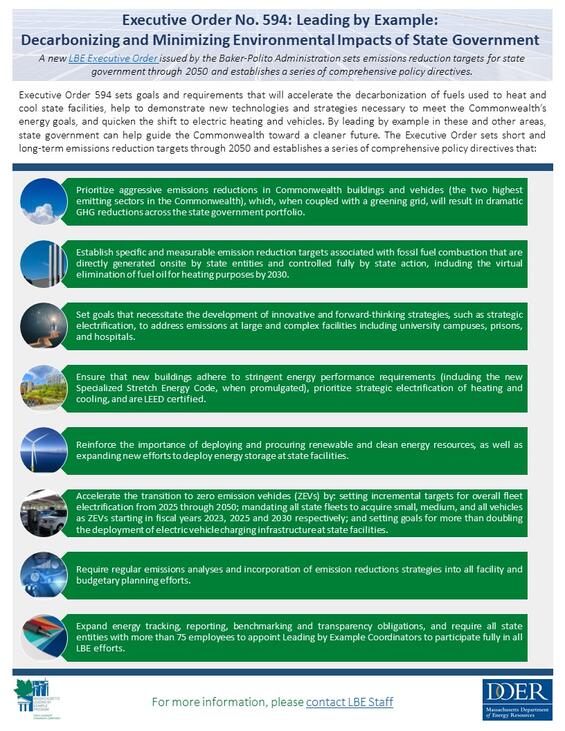
MA Leading by Example Targets
To help guide and measure the collective progress toward meeting these objectives, Executive Order 594 sets specific energy-related targets for Massachusetts state government between 2025 and 2050:
| Objective | 2025 | 2030 | 2040 | 2050 |
|---|---|---|---|---|
| Reduce emissions from onsite fossil fuels* | -20% | -35% | -60% | -95% |
| Zero-emission vehicles (ZEVs) in entire state fleet | 5% | 20% | 75% | 100% |
| Reduce fuel oil use* | -90% | -95% | TBD | TBD |
| Energy use intensity (site EUI) reduction* | -20% | -25% | TBD | TBD |
| EV charging stations at state facilities | 350 stations | 500 stations | TBD | TBD |
New light-duty vehicles: Starting in fiscal year 2023, all acquisitions of vehicles with a Gross Vehicle Weight Rating (GVWR) of 8,500 pounds or less must be ZEVs. New medium-duty vehicles: Starting in fiscal year 2025, all acquisitions of vehicles with a GVWR of 14,000 pounds or less must be ZEVs. New heavy-duty vehicles: Starting in fiscal year 2030, all acquisitions of vehicles with a GVWR of more than 14,000 pounds must be ZEVs. *Over a 2004 baseline | ||||
In addition, Executive Order 594 provides directives related to state government sustainability (including demand management, water conservation, waste minimization, sustainable landscaping, and environmentally preferable purchasing), real-time energy monitoring, and data tracking and reporting.
Click here for key highlights of Massachusetts state government clean energy and sustainability progress to-date.
State Partner Responsibilities
State entities covered by the Executive Order shall provide their full cooperation to the LBE Program and make every effort to support initiatives at their own facilities and collaborate with other agencies to support emissions reduction progress within state government. Specifically, state entities shall:
- Assess and implement strategies to mitigate greenhouse gas emissions and other environmental impacts when planning for and executing projects related to the design, construction, operations, and maintenance of state facilities, and the procurement of goods and services, including vehicles.
- Comply with all applicable directives of Executive Order 594.
- Support efforts to track the energy performance of existing buildings or sites and take concrete steps to reduce building energy use through operational efficiencies.
- Continue to prioritize the deployment of renewable and clean energy resources to be consumed onsite or on the grid.
- Provide energy consumption data and other information as requested by LBE staff.
- Appoint LBE coordinators and participate on the LBE Council.
- Prioritize efforts at facilities located in Environmental Justice populations, when key fiscal, physical, and environmental factors are fundamentally equivalent.
Executive Order Guideline Documents
After a stakeholder comment period, documents here will provide guidance regarding some of the terms of significance and directives of the Massachusetts LBE Executive Order 594.
Executive Order 594 Guidelines and Corresponding Sections
| Guideline Section | Focus Area |
|---|---|
| Section 2 | Targets and Calculating Progress |
| Section 3 | Massachusetts LEED Plus 2.0 Standard for New Construction |
| Section 4 | Requirements for Existing Buildings |
| Section 4D, 5D | Biofuels: Heating Oil and Biodiesel, DOER Leading By Example Renewable Diesel Guideline |
| Section 5A | Zero-Emission Vehicle Acquisition |
| Section 5B | Fleet Efficiency (Fuel Efficiency Standard, Green Fleet Committee) (coming soon!) |
| Section 5C | Electric Vehicle Supply Equipment (see also: Guidance for Publicly Accessible EV Charging Stations) |
| Section 6 | Renewable Energy (coming soon!) |
| Section 7 | Additional Sustainability Priorities |
| Section 9 | Program Administration and Agency Responsibilities |