
1.1 General Terms and Abbreviations
Throughout this guide the following abbreviations will be used:
- MUPC: Massachusetts Uniform Probate Code, G. L. c. 190B
- IP: Incapacitated Person
- PP: Protected Person
- PR: Personal Representative
- SPR: Special Personal Representative
- VPR: Voluntary Personal Representative
Throughout this guide the following terms will be used:
Appointment Proceedings: A proceeding to have a PR appointed.
Testacy Proceedings: A formal determination that decedent died with a will (testate) or with no will (intestate).
The term “court” will be used to refer to a judge of the Probate and Family Court or to the entity of the court but does not refer to a magistrate.
The term “magistrate” will be used to refer to an official of the court designated to act as an MUPC Magistrate pursuant to G. L. c. 190B, § 1-307 and Rule 70 of the Supplemental Rules of the Probate and Family Court.
For ease of the reader, all citations to the Massachusetts Uniform Probate Code, G. L. c. 190B will be: MUPC at § [Article - section number]. All citations to the Massachusetts Uniform Trust Code, G. L. c. 203E, will be: MUTC at § [Article - section number].
1.2 Time Limits for Filing Actions
1.2.1 Statutory References - MUPC at §§:
- 3-108
- 1-106
- 3-303(7)
- 3-412
- 3-1001(c)
1.2.2 General Rule
The general rule is that an informal probate or appointment proceeding or a formal testacy or appointment proceeding must be commenced (i.e. filed) within 3 years of a decedent’s death. MUPC at § 3-108. The time limit does not apply to bar the following proceedings, which may be filed at any time:
- Voluntary Administrations and the appointment of a PR following the filing of a Voluntary Administration Statement
- Actions to Construe a Probated Will
- Determination of Heirs
- Actions by Foreign Fiduciaries
- Appointment of a Successor PR
“Practice Alert: The time limits provided by § 3-108 shall not apply to pre-MUPC deaths (deaths that occurred prior to 3/31/2012). Prior time limits shall control. See generally, G. L. c. 193, §4 (repealed).”
Note: Pursuant to the holding of In the Matter of the Estate of Patricia Ann Slavin, 492 Mass. 551 (2023), a Voluntary Personal Representative may file a petition for appointment of a personal representative outside the three-year limit established in MUPC § 3-108. The Slavin decision does not change the existing time limit imposed by the MUPC for the probate of a will.
After three years have passed from the decedent's date of death and unless a statutory of case law exception applies:
- no one may seek the appointment of a PR.
- no testacy proceeding may be commenced.
- if a will was not offered for probate, there is a presumption of intestacy which is final.
- if a will was informally probated and no formal proceeding to contest the informal probate was commenced within the 3 years, the informally probated will is final.
MUPC at § 3-108 and Comment. See Chapter 4 of this guide for specific requirements to commence a late and limited action authorized by § 3-108(4).
1.2.3 General Exceptions
There are 5 statutory exceptions to the general time limit applying to original proceedings.
1) Doubt About Death Exception
If a previous formal proceeding was dismissed because of doubt about the fact of the decedent’s death, an informal or formal proceeding may be commenced at any time if it is proved that the death occurred before the dismissal of the prior proceeding with no unreasonable delay in commencing the second proceeding.
2) Missing Person Exception
If the estate is of an absentee, disappeared or missing person a formal proceeding may be commenced within 3 years from the date on which the death of the person was established (not from the date of death).
3) Twelve Month Exception
A formal proceeding to contest an informally probated will and to secure appointment of the person with legal priority for appointment may be brought within the later of 12 months from the informal allowance of the will or 3 years from date of death.
4) Late and Limited Exception
If the decedent died on or after March 31, 2012 and no proceedings were commenced within three (3) years from date of death, then a formal proceeding may be brought to:
- admit the decedent’s will to formal probate and determine both the heirs at law and the devisees;
- determine that the decedent died without a will and determine the heirs at law;
- appoint a PR to administer the estate, including a person designated as a public administrator, in a supervised or unsupervised administration.
Any PR appointed under this exception shall have no right to possess estate assets as provided in § 3-709 beyond that necessary to confirm title thereto in the successors to the estate and claims other than expenses of administration shall not be presented against the estate. MUPC at § 3-108(4).
A successor is defined as “persons, other than creditors, who are entitled to the property of a decedent under the decedent’s will or this chapter.” MUPC at § 1-201(49).
“Practice Alert: A late and limited appointed PR may not seek a license to sell real estate of the decedent. The PR’s authority is limited to confirming title to estate assets in the successors and paying expenses of administration, if any. ”
Note: The powers and duties of a personal representative appointed pursuant to In the Matter of the Estate of Patricia Ann Slavin, 492 Mass. 551 (2023) may be broader than the powers and duties of a personal representative appointed pursuant to the statutory late and limited exception in MUPC § 3-801 (4).
See Chapter 4 of this guide for specific requirements to commence a late and limited action authorized by § 3-108(4).
5) Power of Appointment Exception
A formal testacy proceeding may be commenced at any time after three (3) years from the decedent’s death for the limited purpose of establishing an instrument to direct or control ownership of property that passes or is distributable after the decedent’s death from one other than the decedent when the property is to be appointed or its transfer is controlled by the terms of the decedent’s will or is to be distributed as a part of the decedent’s estate.
“Legislative Change: The fourth exception above was revised and the fifth exception was added by Chapter 140 of the Acts of 2012. The first four exceptions permit the appointment of a PR; the fifth exception does not permit a PR to be appointed. ”
1.2.4 Fraud Exception
When fraud has occurred, a proceeding for damages may be commenced within 2 years after the fraud is discovered but not later than 5 years after the fraud is committed. MUPC at § 1-106.
1.2.5 Subsequent Petition Exceptions
- If a devisee or heir at law was omitted from, or not given notice of, a previous formal proceeding, a PR may request as part of a Petition for Order of Complete Settlement that the court determine testacy as it affects the omitted person and confirm or alter the previous formal decree and order of testacy, as it affects all interested persons, in light of the new evidence. MUPC at § 1001(c).
- A devisee or heir at law who was unaware of and given notice only by publication of a previous formal proceeding may file a petition to vacate the previous determination of testacy, including a determination that the decedent left no valid will and determining the heirs at law, prior to the earlier of:
- the entry of any decree on a Petition for Order of Complete Settlement approving the final distribution of the estate;
- six (6) months after the filing of any statement to close the estate;
- three (3) years from the date of death, or
- twelve (12) months from the entry of the formal decree to which the petition to vacate refers.
MUPC at § 3-412.
“Practice Alert: The “entry” of a decree is the date the entry is made on the court’s docket. See Mass.R.Civ.P. 77 and 79; Mass.R.A.P. 4. The court’s docket is now electronic and is referred to as “MassCourts”. ”
1.3 Identifying Heirs at Law
Heirs at law are those individuals who are entitled by statute to the decedent’s property when there is no will (or when the will does not dispose of all assets). For all cases (informal and formal), (MPC 162) Surviving Spouse, Children, Heirs at Law must be completed to identify a decedent’s surviving spouse, children and heirs at law. For step by step instructions on how to complete this form see (MPC 958) Instructions (PDF). Examples (PDF) of completed forms are also available. See also the training materials on new and revised forms
“Practice Alert: Heirs at law are identified as of the date of the decedent’s death. For dates of death on or after March 31, 2012, the MUPC at § 2-101, et seq., should be consulted. See section 1.3.2 of this guide. For deaths prior to that date, see generally Chapter 190 (repealed); see also section 1.3.3 of this guide.”
“Practice Alert: Information regarding the decedent’s children must ALWAYS be listed on form (MPC 162) Surviving Spouse, Children, Heirs at Law even if the decedent’s children are not statutory heirs at law. MUPC at § 3-301.”
1.3.1 Statutory References - MUPC at §§
- 2-102
- 2-103
- 2-105
- 2-106
- 2-107
- 2-108
- 2-113
- 2-114
1.3.2 Heirs at Law under the MUPC
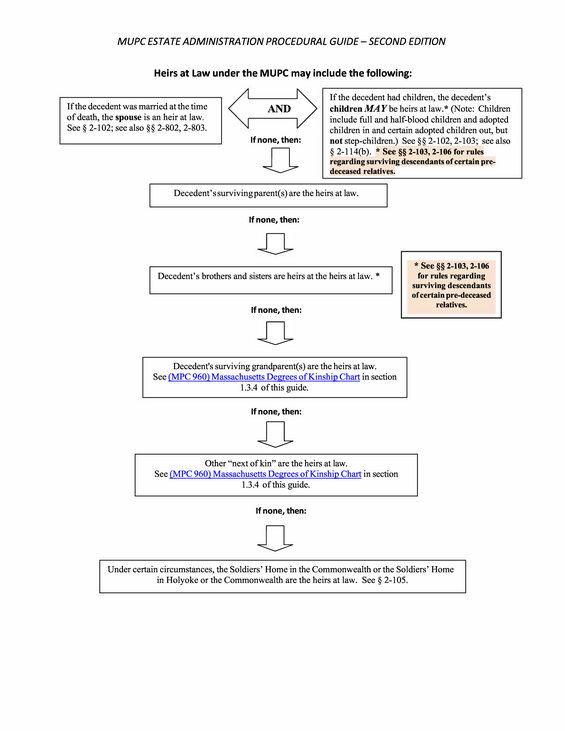
For dates of death on or after March 31, 2012, any part of a decedent's estate not effectively disposed of by will passes by intestate succession to the decedent's heirs at law as follows:
Massachusetts Uniform Probate Code (G.L. c. 1908) Interstate Succession (for dates of death on or after March 31, 2012)
| If the Decedent is survived by: | The interstate estate passes to: |
|---|---|
Spouse and Children (or the descendants of any pre-deceased child) and... all surviving children are also children of the surviving spouse and the surviving spouse has no surviving children who are not children of the decedent. | Spouse only. |
Spouse and Children (or the descendants of any pre-deceased child) and... not all surviving children of the Decedent are also children of the surviving spouse; or... the surviving spouse also has surviving children who are not children of the Decedent. | Spouse and decedent's surviving children (and surviving descendants of any pre-deceased child). |
| Spouse and no children | Spouse only, if no surviving parents; or... Spouse and decedent's surviving parent(s). |
| Children (or descendants of any pre-deceased child) and no spouse | Surviving Children only (and surviving descendants of any pre-deceased child). |
| Parents, and no Spouse and no Children | Surviving Parent(s) only. |
| Siblings (or descendants of any pre-deceased sibling), and no spouse, no children, and no parents | Surviving Siblings only (and surviving descendants of any pre-deceased sibling). |
| Kin and no Spouse, no Children, no Parents, no Siblings | Surviving closest relative according to degrees of kindred (see § 2-103(4)). |
| No Taker | Commonwealth or Soldiers Home (see § 2-105). |
MUPC at §§ 2-101, et seq. See also the chart in section 1.3.5 of this guide.
“Practice Alert: The identity of a decedent’s heirs at law are only adjudicated by the court in a formal proceeding.”
1.3.2.1 Certain Pre-Deceased Relatives; Half Blood Relatives; Marital Status; Adopted Children
When a descendant of the decedent (e.g., the decedent’s child) or a descendant of a parent (e.g., the decedent’s sibling) dies before the decedent, then his or her surviving descendants substitute and should be identified as an heir at law of the decedent. Therefore, grandchildren, great-grandchildren, nieces and nephews, etc., should always be considered when identifying heirs at law in these two categories. MUPC at §§ 2-103, 2-106.
In addition, relatives of half-blood inherit the same as if they were of whole blood, and an individual is the child of his/her natural parents regardless of their marital status. MUPC at §§ 2-107, 2-114. Further, an adopted individual is the child of his or her adopting parents and not of his or her natural parents, but the adoption of a child by the spouse of a parent (e.g., step-parent adoption) has no effect on the right of the child or a descendent of the child to inherit from or through the natural parent. MUPC at § 2-114.
1.3.3 Heirs at Law prior to the MUPC
For dates of death prior to the effective date of the MUPC (March 31, 2012), any part of a decedent's estate not effectively disposed of by will passes by intestate succession to the decedent's heirs at law as follows:
Interstate Succession Pursuant to G.L. c. 190 (for dates of death prior to March 31, 2021)
| If the Decedent is survived by: | The intestate estate passes to: |
|---|---|
| Spouse and Children (or the descendants of any pre-deceased child) | Spouse and decedent's surviving children (and surviving descendants of any pre-deceased child). |
| Spouse and no Children | Spouse only, if no surviving kindred; or... Spouse and decedent's surviving kindred. |
| Children (or descendants of any pre-deceased child) and no Spouse | Surviving Children only (and surviving descendants of any pre-deceased child). |
| Parents, and no Spouse and no Children | Surviving Parent(s) only. |
| Siblings (or descendants of any pre-deceased sibling), and no Spouse, no Children, and no Parents | Surviving Siblings only (and surviving descendants of any pre-deceased sibling). |
| Kin and no Spouse, no Children, no Parents, no Siblings | Surviving closest relative according to degrees of kindred (see Massachusetts Degree of Kinship Chart (MPC 960)). |
| No Taker | Commonwealth, or Soldiers Home |
See generally, G. L. c. 190 (repealed).
1.3.4 Degree of Kinship
Degrees of kinship are used to identify heirs at law in the “next of kin” category only if there are no surviving members in the first four groups of heirs at law: (1) surviving spouse, (2) decedent’s children and their descendants, (3) parents, and (4) decedent’s brothers/sisters and their descendants. MUPC at §§ 2-102, 2-103, 2-106. For degrees of kinship, see (MPC 960) Massachusetts Degrees of Kinship Chart below.
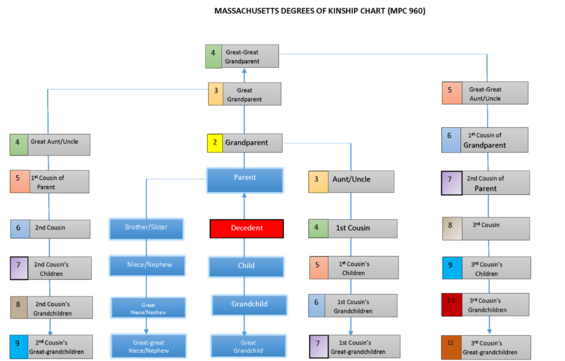
- The numbers above represent the order of nearness in blood to the deceased and are referred to as "degrees of kindred." The lower the degree or number, the closer a relation is to the Decedent.
- When there are multiple relations with the same degree, those who claim through the nearest ancestor are preferred. See G. L. c. § 190B 2-103 (4). For example, if the nearest living relatives are a great-aunt, a great-uncle and two 1st cousins, all are 4th degree relations, but the two 1st cousins inherit because they claim through the grandparents - a closer ancestor than the great-grandparents.
- The nearest living relatives of the lowest degree inherit the estate equally regardless of whether they claim on the mother's side or the father's side of the family. Children of deceased relatives in a class are excluded. See G. L. c. 190B, § 2-103 (4).
- If there are no known heirs at law, see G. L. c. 190B § 2-105. The Attorney General must be provided notice in such cases.
1.3.5 Examples
Examples (PDF) of completed forms are available. See also the training materials on new and revised forms.
For additional assistance in identifying heirs at law under the MUPC, see the chart below.
1.4 Identifying Devisees
Devisees are persons, entities, charitable organizations, or trusts designated in a will to receive the Decedent's personal or real property. In the case of a devise to an existing trust or trustee, or to a trustee or trust established by the will, the trust or trustee is the devise. The beneficiaries are not devisees.
For all cases (informal and formal) seeking to probate a will, (MPC 163) Devisees must be completed to identify a decedent’s devisees. For step by step instructions on how to complete this form see (MPC 959) Instructions (PDF). Examples (PDF) of completed forms are also available. See also the training materials on new and revised forms.
“Practice Alert: An informal or formal proceeding may be used to probate a will that contains a testamentary trust or pours over into an inter vivos trust where the petitioner is also the trustee, even if there may be trust beneficiaries who are minors, incompetent or unascertained. The trust beneficiaries (adult or otherwise) do not need to be listed on an informal or formal petition unless they are otherwise devisees or heirs at law. No GAL need be appointed. See Practice Tip Memorandum, dated May 23, 2012. ”
“Practice Alert: If the trust is named as devisee on (MPC 163) Devisees, the name of the trustee must be listed on any Return of Service to confirm notice on the trust.”
1.4.1 Anti-Lapse; Deceased Devisee; Class Gifts
If a devisee who is a grandparent or a lineal descendant of a grandparent is dead at the time of execution of the will, fails to survive the testator, or is treated as if s/he pre-deceased the testator, the “issue” of the deceased devisee who survive the testator take in place of the deceased devisee and if they are all of the same degree of kinship to the devisee they take equally, but if of unequal degree, then those of more remote degree take per capita at each generation. One who would have been a devisee under a class gift if s/he had survived the testator is treated as a devisee for purposes of this section whether his/her death occurred before or after the execution of the will. MUPC at § 2-603.
“Practice Alert: The anti-lapse section of the MUPC (§ 2-603) differs significantly from the pre-MUPC statute found in G. L. c. 191, § 22 (repealed).”
1.4.2 Examples
Examples of (MPC 163) Devisees (PDF) are available. See also the training materials on new and revised forms.
1.5 Priority of Appointment
1.5.1 Statutory References - MUPC at §§
- 2-803(c)(1)(iii)
- 2-804(b)
- 3-203
- 3-301(3)
- 3-301(4)(ii)
- 3-601
- 5-424(e)
1.5.2 Priority Determination (Priority Ladder)
Priority for appointment is a way of determining the ranking of person(s) who may be appointed PR in an informal or formal proceeding. This is referred to as the “priority ladder.”
Whether the proceedings are informal or formal, a person, or persons collectively, have statutory priority for appointment in the following order: the person with priority as determined by a probated will including a person nominated by a power conferred in a probated will;
- the surviving spouse of the decedent who is also a devisee in the will;
- other devisees in the will;
- the surviving spouse of the decedent;
- other heirs at law of the decedent;
- if there is no known spouse or next of kin, a public administrator appointed.
“Practice Alert: Massachusetts did not adopt the Uniform Probate Code’s version of § 3-203 that grants priority for appointment to a creditor after 45 days from date of death when no person with higher priority petitions for appointment. In order for a creditor to be appointed PR in Massachusetts, the creditor must have a continuing interest in the estate (i.e., the creditor claim period has not expired) and a formal petition must be filed. A creditor cannot petition to be appointed PR in an informal proceeding. All petitions in which a creditor seeks appointment must be presented to a judge.”
“Practice Alert: Pursuant to MUPC at § 5-424(e), after 40 days from the death of a Protected Person, if no one has been appointed as personal representative and no petition for appointment is pending, their conservator may file an informal or a formal petition to be appointed personal representative and to probate the deceased’s will, if any, in order to administer and distribute the deceased’s estate. The conservator must file a new bond as personal representative in order to receive letters of authority. See Chapter 3 and Chapter 4 of this guide.”
Note: A VPR does not acquire priority solely from their status as VPR.
An objection to an appointment can only be made in a formal proceeding. In case of objection, the priorities stated above apply except that:
- If the estate appears to be more than adequate to meet exemptions and costs of administration but inadequate to discharge anticipated unsecured claims, the court on formal petition of a creditor may appoint any qualified person;
- If there has been an objection by an heir at law or devisee appearing to have a substantial interest in the estate to the appointment of a person other than one whose priority is determined by will, the court may appoint someone acceptable to the heirs at law and devisees or, in default of an agreement, any qualified and suitable person. MUPC at § 3-203(b)(2).
1.5.3 Priority of the Domiciliary PR
A PR appointed by a court of the decedent’s domicile has priority over all other persons for appointment in Massachusetts except where the decedent’s will nominates a different person to be the PR in Massachusetts than in the state of domicile. If the decedent’s will does not nominate a different person, the domiciliary PR may nominate another, who shall have the same priority as the domiciliary PR. MUPC at § 3-203(g). See also Chapter 11 of this guide.
1.5.4 Disqualification from Serving
Regardless of his or her priority, no person is qualified to serve as a PR if:
- the nominee is under the age of 18 or under guardianship or conservatorship. See also section 1.5.5 of this guide.
- the court finds in a formal proceeding that the appointment would be contrary to the best interests of the estate. MUPC at § 3-203(f)(2).
- the nominee has feloniously and intentionally killed the decedent. MUPC at § 2-803(c)(1)(iii).
- the nominee is a former spouse of the decedent and/or a relative of decedent’s former spouse, even if nominated in decedent’s will unless the express terms of the will state otherwise. MUPC at § 2-804(b).
Note: Spouses who are separated, but not divorced, retain rights under the MUPC. MUPC at § 2-802.
1.5.5 Minor, Incapacitated Person or Protected Person with Highest Priority
A conservator of the estate of a protected person, or if there is no conservator, a guardian, may exercise the same right to nominate, to object to another’s appointment, or to participate in determining the preference of a majority in interest of the heirs at law and devisees that the protected person or minor would have if qualified for appointment. MUPC at § 3-203(d).
“Practice Alert: A conservator who represents an heir at law or devisee may nominate him or herself to serve as PR in an informal or formal proceeding. If the conservator also has an interest in the decedent’s estate as an heir at law or devisee, the conservator must file an affidavit stating specific facts to warrant a conclusion by the court or magistrate that a conflict of interest does not exist between the conservator and person(s) represented. Failure to submit an affidavit or to state sufficient facts to support the conclusion that a conflict of interest does not exist may result in a denial.”
If a successor PR is necessary because of the incapacity of the appointed PR, the conservator or if none, the guardian of the appointed PR assumes the priority that the appointed PR had, if any. If the incapacitated/protected PR had no priority, then his guardian/conservator has no priority to petition informally for the appointment of a successor PR. The guardian/conservator of an incapacitated/protected PR who had no priority may petition formally for the appointment of a successor PR or for the appointment of a SPR.
“Practice Alert: The MUPC does not permit an attorney in fact under a Durable Power of Attorney to sign an assent or nominate on behalf of an incapacitated principal. For trust actions, see the MUTC at G. L. c. 203E, § 303(3).”
1.5.6 Options for the Person(s) with Highest Priority
The person or persons with highest priority under (2) – (5) on the priority ladder may:
- serve as PR;
- renounce (decline) the right to serve and the right to nominate; or
- renounce the right to serve but nominate another to serve in his/her place.
“Practice Alert: If a nomination is not made, the person renouncing is treated as if s/he is no longer on the priority ladder. If the person renouncing does not share equal priority with others, priority will pass to the person or persons with the next highest priority as determined by the statute. If the person renouncing does share equal priority with others, priority will remain with all persons of equal priority who have not renounced.”
See (MPC 455) Assent and Waiver of Notice/Renunciation/ Nomination/Waiver of Sureties and (MPC 941) Instructions, section II (A) and (B); see also Chapter 3 (Informal Proceedings) and Chapter 4 (Formal Proceedings) of this guide. See section 1.5.7 of this guide when a person with highest priority fails to act.
1.5.6.1 Nomination when One Person has Priority
When the person with highest priority under (2) – (5) on the ladder renounces (declines) the right to serve BUT nominates another to serve in his/her place, the nominee will assume the renouncing person’s priority.
See (MPC 455) Assent and Waiver of Notice/Renunciation/ Nomination/Waiver of Sureties and (MPC 941) Instructions, section II (B); see also Chapter 3 (Informal Proceedings) and Chapter 4 (Formal Proceedings) of this guide. See section 1.5.7 of this guide when a person with highest priority fails to act.
“Practice Alert: Appointment of one who does not have statutory priority, including priority resulting from a renunciation or nomination, may only be made in a formal proceeding. MUPC at § 3-203(e). ”
1.5.6.2 Nominations when More than One Person has Priority
When any person with equal priority under (2) – (5) on the ladder renounces (declines) the right to serve but nominates another to serve in his/her place, all remaining persons with equal priority who have not renounced their right to serve must agree that the nominee may serve with them.
If all agree, they may either all petition jointly for appointment or one may petition for the appointment of all. If they do not agree, a formal petition must be filed.
See (MPC 455) Assent and Waiver of Notice/Renunciation/ Nomination/Waiver of Sureties and (MPC 941) Instructions, section II (C); see also Chapter 3 (Informal Proceedings) and Chapter 4 (Formal Proceedings) of this guide. See section 1.5.7 of this guide when a person with highest priority fails to act.
“Practice Alert: When there is more than one person with equal priority under (2) – (5) on the ladder, ALL persons collectively have priority for appointment. Persons individually do not have priority for appointment.”
“Practice Alert: Appointment of one who does not have statutory priority, including priority resulting from a renunciation or nomination, may only be made in a formal proceeding. MUPC at § 3-203(e).”
1.5.6.3 Exceptions with a Will
If a will nominates a PR and the nominee does not want to serve, the nominee may renounce (decline) the right to serve; and
- If the will contains language which gives the nominee the right to nominate someone else, the nominee can:
- renounce the right to nominate; or
- nominate anyone else to serve (who need not have statutory priority but who assumes the renouncing person’s priority as set forth above); or
- If the will does not contains language which gives the nominee the right to nominate someone else, that person may not nominate someone else and either priority remains with the other persons who shared priority with the person renouncing or, if the nominee was the only person with priority, priority passes to the next named person in the will or if none, the next person with highest priority as determined by the statute.
See (MPC 455) Assent and Waiver of Notice/Renunciation/ Nomination/Waiver of Sureties and (MPC 941) Instructions, section II (A) and (B); see also Chapter 3 (Informal Proceedings) and Chapter 4 (Formal Proceedings) of this guide. See section 1.5.7 of this guide when a person with highest priority fails to act.
1.5.7 Failure of Person(s) with Highest Priority to Act
If the person with highest priority does not seek to serve, and fails to act, any interested person may file a formal proceeding seeking the appointment of any person as PR. Likewise, if all persons with equal priority do not seek to serve, and fail to act collectively, any interested person may file a formal proceeding seeking the appointment of any person as PR.
Before formal appointment of one without priority, the court shall determine that those having priority, although provided notice of the proceedings, failed to request appointment or to nominate another for appointment and that administration is necessary. MUPC at § 3-203(e).
“Practice Alert: Pursuant to MUPC at § 5-424(e), after 40 days from the death of a Protected Person, if no one has been appointed as personal representative and no petition for appointment is pending, their conservator may file an informal or a formal petition to be appointed personal representative and to probate the deceased’s will, if any, in order to administer and distribute the deceased’s estate. The conservator must file a new bond as personal representative in order to receive letters of authority. See Chapter 3 and Chapter 4 of this guide.”
1.5.8 Examples
Example 1
Donna, who was married at her death to Harry, dies with a will that names Donna’s best friend as PR. Who has priority to serve?
Answer
Donna’s best friend named in the will has the highest priority to serve as PR.
Example 2
Donna, who was married at her death to Harry, dies without a will. Who has priority to serve?
Answer
Harry, Donna’s spouse, has highest priority to serve. If he does not want to serve, he can renounce his right to appointment. He may also choose to nominate another to serve for him. If he does not nominate another to act for him, priority passes down the ladder to Donna’s other heirs at law.
Example 3
Donna dies with a will. She is survived by her husband, Harry, and their two children, Andy and Debra. Her will names Harry as PR and Andy, their son, as the alternate PR. Harry declines to serve. Who has priority to serve as PR?
Answer
Andy has priority because he is the alternate named in the will. MUPC at §§ 3-203(a)(1), 3-203(c).
Example 4
Donna dies with a will. Her spouse, Harry, is nominated as PR in her will. Donna and Harry’s son, Andy, is named alternate PR. Harry does not want to serve but wants his friend Fran to serve instead and nominates her. Who has priority to serve?
Answer
Harry, as nominated as PR in a will, cannot nominate another unless the will contains language specifically allowing for the nominated PR to renounce and nominate another. See MUPC at § 3-203(c). If the will does not include specific language, Harry may not nominate Fran. He may only renounce his right to serve and priority passes to Andy as the alternate PR nominated in Donna’s will.
Example 5
Donna dies but does not have a will. She is a widow with three adult living children, Andy, Debra and Mary. Who has priority to serve as or nominate a PR?
Answer
All three children, Andy, Debra and Mary, have equal priority to serve as PR. They can all agree in writing to one or more of them serving as PR. If they cannot agree on who will serve, a formal proceeding must be commenced.
Example 6
Donna dies but does not have a will. She is a widow with three adult living children, Andy, Debra and Mary. None of the children are willing to serve as PR. Who has priority to serve as or nominate a PR?
Answer
The three children, Andy, Debra and Mary, all may agree in writing to renounce the right to serve and nominate another mutually agreeable person to serve as PR. If they cannot all agree, a formal proceeding must be commenced by any interested person.
Example 7
Donna, who has no surviving family, dies with a will that nominates Bob’s Bank to serve as PR. No alternate PR is listed. Four charities are listed as devisees under Donna’s will. After Donna’s death, Bob’s Bank renounces its right to serve as PR and nominates an attorney to serve instead. Who has priority to serve as PR?
Answer
Unless the will contains language specifically allowing for the nominated PR to renounce and nominate another, a nominated PR in a will cannot confer priority onto another nominee. MUPC at § 3-203(c). No successor PR is named in Donna’s will so priority passes down the ladder to the first rung that appears. Since Donna has no family, priority passes down the priority ladder to the “other devisees in the will” rung, which are the four charities. The four charities named in the will have the highest and equal priority to serve as PR. MUPC at § 3-203(a)(3). A devisee who does not wish to serve may renounce the right to serve and either allow the remaining devisees to serve or nominate another to act as PR, provided all remaining devisees agree that the nominated person will serve with them. If all devisees renounce the right to serve and nominate the same PR, the court can appoint that PR. If the charities do not all agree to renounce the right to serve and/or nominate the same PR, a formal proceeding must be commenced to ask for the appointment of a PR who does not have highest priority. MUPC at § 3-203(e).
Example 8
Donna dies with a will which nominates Harry as PR and their son, Andy, as alternate PR. Harry and Donna divorced after she executed her will and the divorce was absolute before she died. Who has priority?
Answer
Andy has priority to be appointed PR. As a result of their divorce, Harry’s nomination as PR in Donna’s will was revoked by operation of law unless the will expressly provided otherwise. MUPC at § 2-804.
Example 9
Donna dies without a will leaving no spouse and two adult children, Andy and Debra. Debra is of parts unknown and cannot be found. Who has priority to serve?
Answer
Andy and Debra have equal priority. If Debra cannot be found, a formal proceeding must be filed because the court must find that all people with equal or higher priority have been notified and have failed to act and that the person being appointed is suitable regardless of his or her priority. MUPC at § 3-203(e).
Example 10
Donna dies without a will. She has no surviving spouse, but has three adult children, Andy, Debra and Mary. Debra predeceased Donna leaving two adult children. Who has priority to serve?
Answer
Donna’s two living adult children, Andy and Mary and Debra’s two adult children are the heirs at law and all have equal priority to serve. MUPC at §§ 3-203(a)(5), 1-201(21), 2-103(1), 2-106(b).
Example 11
Donna dies without a will. At the time of her death, Donna was divorced from Harry and was survived by one child, Mary, who is a minor. Who has priority to serve?
Answer
While Mary has priority to serve, she does not qualify to serve. However, pursuant to §§ 3-203(c) and 3-203(d), Mary’s conservator, or if none, her guardian, may exercise the same rights as Mary to nominate a qualified person to serve as PR. If Harry becomes Mary’s conservator, he may nominate himself or another to act as PR.
Example 12
Donna dies without a will. At the time of her death, Donna was divorced from Harry and was survived by one child, Mary, who is a minor and her brother, Bob. Who has priority to serve?
Answer
While Mary has priority to serve, she does not qualify to serve. If Bob wishes to act as PR, he would need to file a formal proceeding since Mary, who has highest priority, is a minor and does not qualify to serve.
Example 13
Donna died on May 10, 2016 without a will leaving three adult children: Francesca, Michael, and Gus. On August 5, 2016, Gus filed a Voluntary Administration Statement to act as VPR. On September 25, 2020, Gus files a petition for informal probate seeking to be appointed PR under the prior appointment exception to the three-year time limit set forth in the MUPC at § 3-108 (see In the Matter of the Estate of Patricia Ann Slavin, 492 Mass. 551 (2023)). Who has priority to serve?
Answer
Francesca, Michael and Gus have equal priority. Gus does not acquire priority over Francesca and Michael as a result of his status as VPR.
1.6 Venue
Venue means the county where the case must be filed.
1.6.1 Statutory References- MUPC at §§
- 3-201
- 1-303
- G.L. c. 215, § 8A
1.6.2 First Proceeding
Venue for the first informal or formal testacy or appointment proceeding after a decedent’s death is:
- in the county where the decedent was domiciled at the time of death; OR
- if the decedent was not domiciledin Massachusetts, in any county where property of the decedent was located at the time of death. MUPC at § 3-201(d).
To check domicile:
- Does the death certificate identify the county where the decedent lived?
- Does the petition and death certificate match regarding domicile? If not, the petitioner must file (MPC 485) Affidavit of Domicile, to determine proper venue.
For a listing of Massachusetts counties and the cities and towns within, see the Secretary of the Commonwealth of Massachusetts' List of Counties.
1.6.3 Examples
Example 1
Donna dies domiciled in Worcester county. All of her property is located in Worcester county. Where should a petition be filed?
Answer
The petitioner must file in Worcester county. MUPC at § 3-201(a)(1).
Example 2
Donna dies domiciled in Suffolk county. She owns real property in Middlesex county. No other property requires probate. Where should a petition be filed?
Answer
The petitioner must file in Suffolk county. MUPC at § 3-201(a)(1).
Example 3
Donna dies domiciled outside of Massachusetts in Nashua, New Hampshire. All of Donna’s property passes outside of probate except for property she owns in Barnstable county. Where should a petition be filed?
Answer
The petitioner must file in Barnstable county where the property is located. MUPC at § 3-201(a)(2). See also Chapter 11 of this guide.
1.6.4 Subsequent Proceedings
Venue for all subsequent proceedings is in the place where the initial proceeding occurred unless transferred pursuant to § 1-303. If the first proceeding were informal, upon application of an interested person and after notice, the court, finding that venue is elsewhere, may transfer the proceeding and the file to the other division.
1.6.5 Multiple Proceedings; Transfer
Section 1-303 governs the procedure when a proceeding could be maintained in more than one place and/or if proceedings are commenced in more than one court. For transfers under § 1-303(b), see G.L. c. 215, §8A.
1.7 Bonds (MPC 801)
Form (MPC 801) Bond shall be required if the petitioner is seeking the appointment of a PR, SPR, or Successor PR. No bond is necessary if the petitioner is seeking only to probate an original will or apply as voluntary personal representative. All fiduciaries appointed by the court prior to the effective date of the MUPC (i.e., March 31, 2012), continue to have the statutory obligations of their pre-MUPC bonds unless otherwise modified by the court. See section 1.9 of this guide.
“Practice Alert: To confirm his or her appointment under a probated will, a trustee of a testamentary trust shall file a Bond (MPC 801) along with (MPC 275) Statement of Confirmation of Appointment of Testamentary Trustee. The forms shall be filed with the same court where the will was probated. A bond with sureties shall be required unless: (1) sureties are waived by the terms of the trust or (2) found by the court, in a prior formal proceeding, to not be necessary. The filing fee is $75.00 for the bond. There is no separate filing fee for the Statement of Confirmation of a Testamentary Trustee. Upon payment of an attested copy fee of $2.50 per page, the register shall issue an attested copy of the Statement of Confirmation of a Testamentary Trustee provided the bond is examined and approved by the court. Letters no longer issue to a testamentary trustee appointed under the MUTC.”
1.7.1 Statutory References- MUPC at §§:
- 3-603
- 3-604
- 3-606
- G. L. c. 205, §§ 9-35 and as amended §§ 1, 5 & 6A
Note: G. L. c. 205 on bonds has been repealed in part & amended in part.
Prior to receiving Letters, a PR must file a bond with the court. MUPC at § 3-601. Sureties on the bond are required unless:
- the will directs that there be no bond or waives the requirement;
- all of the heirs at law (if intestate) or all of the devisees (if testate) file a written waiver of sureties. See (MPC455) Assent and Waive of Notice/Renunciation/Nomination/Waiver of Sureties and (MPC 941) Instructions.
- the PR is a bank or trust company qualified to do trust business or exercise trust powers in Massachusetts;
- the court concludes that sureties are not in the best interest of the estate.
MUPC at § 3-603.
“Practice Alert: The sole heir at law of an intestate estate that is seeking his or her own appointment as PR must still request to waive sureties on the bond by filing (MPC 455) Assent and Waive of Notice/Renunciation/Nomination/Waiver of Sureties.”
Unless § 3-603 applies, the penal sum on a bond with sureties must be listed. The penal sum must equal the amount of the personal property (dollar for dollar) and no minimal amount is required. However, failure to state a dollar amount subjects the sureties to unlimited liability.
The magistrate may approve a bond in any amount that meets the statutory requirements as the sufficiency of sureties is never determined by the magistrate. The court retains the right to require additional sureties in a formal proceeding. MUPC at § 3-603.
A bond no longer requires a third party to provide an opinion that the sureties are sufficient and instead requires each personal surety certify that they are a resident of Massachusetts and possess sufficient unencumbered assets in Massachusetts in excess of the penal sum.
No bond required to be given shall be sufficient unless it has been examined and approved by the court or a magistrate. See G. L. c. 205, § 10.
Note: After the initial appointment, the PR is obligated to report any change of address to the division. MUPC at § 3-602.
“Practice Alert: The filing of (MPC 360) Demand for Sureties can drastically change the type of bond required by the PR. MUPC at § 3-605. See also section 1.8 of this guide. ”
Note: An Appointment of Agent form for an out-of-state PR is no longer required. By executing the bond, a PR submits to the jurisdiction of any division in Massachusetts on matters involving the estate.
1.8 Demand for Sureties (MPC 360)
If a PR has filed a bond without sureties, a written demand that a PR provide a bond with sureties may be filed by:
- a person having an apparent interest in the estate worth in excess of $5,000; or
- a creditor with a claim against the estate in excess of $5,000.
The demand may be made in either a formal or informal proceeding by completing and filing (MPC 360) Demand for Sureties. MUPC at § 3-605. If the demand is made after the appointment of a PR, the Demand for Sureties must be filed with the division and a copy mailed to the PR.
“Practice Alert: A petition for an informal or formal proceeding must be filed before a Demand for Sureties may be accepted for filing.”
1.8.1 Statutory References- MUPC at §:
- 3-605
1.8.2 Demands Made Prior to the Appointment of a PR
A Demand for Sureties may be filed priorto the appointment of a PR if an informal or formal petition is on file with the division. In an informal proceeding, if the magistrate has not issued an informal order and the PR provides the requested surety bond or an affidavit that the person demanding the bond ceases to be interested in the estate, the magistrate may issue the informal order without deciding the merits of the demand or the affidavit.
If the PR files (MPC 295) Petition to Modify Bond (PDF), the magistrate shall refer the case to the judge assigned to the case. MUPC at § 3-604. Thereafter, the court shall hear the matter and issue (MPC 776) Decree and Order to Modify the Bond, and either refer the case back to the magistrate to issue the informal order or decide the matter in its entirety. A magistrate shall not decide the merits of a contested demand for surety request. A Demand for Sureties filed in a formal proceeding shall be decided by the court unless uncontested.
If 30 days has passed since the filing of the Demand for Sureties and the PR has failed to file a bond with sureties, (MPC 490) Affidavit in Support of Release of Demand for Sureties may be filed to indicate that the person demanding the bond ceases to be interested in the estate the magistrate may deny/decline the informal or formal petition. The fiduciary may also file an affidavit that sureties on the bond have been excused by the court.
1.8.3 Demands Made After the Appointment of a PR
A Demand for Sureties may also be filed after the appointment of a PR. After receiving notice, the PR is prohibited from exercising any powers except as necessary to preserve the estate. Unless the person demanding the surety bond ceases to have an interest in the estate or the bond is excused pursuant to a petition filed under section 3-604, the PR must file the demanded bond within 30 days of receipt of notice or be subject to removal and appointment of a successor PR. MUPC at §§ 3-604, 3-605.
If the PR refuses or neglects to file a bond with sureties, or files a Petition to Modify Bond, the magistrate shall not modify the informal order, but shall refer the case to the judge assigned to the case. Thereafter, the court shall hear the matter and issue an order on the bond and may refer the case back to the magistrate to modify the informal order or decide the case in its entirety. A magistrate shall not decide the merits of a contested demand for surety request. A Demand for Sureties filed in a formal proceeding shall be decided by the court unless uncontested.
“Practice Alert: Once a PR receives notice of the demand, the PR must refrain from acting except to preserve the estate and within 30 days the PR must file the requested suitable bond with sureties. Failure to do so is caused for removal.”
“Practice Alert: Once a Demand for Sureties is filed, no Letters shall issue by the registry until a bond with sureties is filed or an affidavit of the PR stating that the person demanding the bond has ceased to be interested in the estate is filed or the sureties on the bond are excused by a decree of the court.”
1.9 Petition to Modify Bond (MPC 295)
In response to the filing of a Demand for Sureties, a PR must file the requested surety bond with the court and may thereafter seek relief by filing (MPC 295) Petition to Modify the Bond (PDF). A Petition to Modify Bond may request that the court modify the amount of the bond, release or discharge the current surety or sureties, permit the substitution of another bond with the same or different surety or determine the amount of the bond and if sureties are required. MUPC at § 3-604.
All pre-MUPC fiduciaries, including trustees, continue to have the obligations of their pre-MUPC bonds unless modified by the court.
1.9.1 Statutory Reference - MUPC at §:
- 3-604
1.9.2 Modifying the Obligation of a Pre-MUPC Bond
Upon the filing of a Petition to Modify Bond, in order to modify the obligation of a pre-MUPC bond, a citation shall issue which follows the Order of Notice stated on the citation issued in the initial informal or formal petition.
If no citation issued in the initial proceeding, the citation on the Petition to Modify the Bond shall state the Order of Notice that would have been required if a citation on the initial petition had issued.
If a Petition to Modify Bond seeking to modify the obligation of a pre-MUPC bond is brought requesting relief from the prior obligation on the bond, the fiduciary may or may not be required by the court to bring the accounts up to date before the allowance of the petition. See Chapter 10 of this guide.
1.9.3 All Other Petitions to Modify the Bonds
Upon the filing of a Petition to Modify Bond to modify the obligation of a MUPC bond, a citation (MPC 567) on a Petition to Modify the Bond shall issue and notice must be given.
1.10 Guardians Ad Litem (GAL) and Actual/Parental/Virtual Representation
A GAL must be appointed for a spouse, heir at law, or devisee who is an IP, PP or a minor unless any of the following apply:
- The spouse, heir at law, or devisee is represented by a conservator;
- The spouse, heir at law, or devisee is represented by a guardian who is not the petitioner;
- The court (in a formal proceeding) has approved a motion to waive the appointment of a GAL based on parental or virtual representation or for any other reason.
MUPC at §§ 1-403, 1-404.
“Practice Alert: The question of the appointment of a GAL does not apply to proceedings in which no judicial or magisterial action is taken (e.g., voluntary administration statements, closing statements, small estate closing statements, etc.).”
“Legislative Change: Section 1-404 (a) and (d) was revised by Chapter 140 of the Acts of 2012. Section 1-404(d) now allows the conservator of a spouse, heir at law, or devisee who is an IP, PP, or a minor to be the petitioner in an informal or formal proceeding without triggering a mandatory appointment of a GAL. A guardian may represent an interested person under a legal disability but a guardian cannot be the petitioner.”
“Practice Alert: If a GAL must be appointed by the court, a formal proceeding is required. An informal proceeding is unavailable. An informal proceeding is an administrative proceeding that requires that any spouse, heir at law, or devisee who is an IP, PP, or a minor be represented by a conservator, or a guardian who is not the petitioner.”
“Practice Alert: If the conservator of an IP, PP, or a minor also has an interest in the decedent’s estate as an heir at law or devisee, the conservator must file an affidavit stating specific facts to warrant a conclusion by the magistrate that a conflict of interest does not exist between the conservator and person(s) represented in order to proceed administratively on an informal or uncontested formal petition. Failure to submit an affidavit or to state sufficient facts to support the conclusion that a conflict of interest does not exist may result in a denial by the magistrate or court.”
1.10.1 Statutory References- MUPC at §§
- 1-403
- 1-404
- Rule 5 of the Supplemental Rules of the Probate & Family Court
1.10.2 Actual, Parental, and Virtual Representation
Actual Representation
If a spouse, heir at law, or devisee is an IP, PP, or a minor and is represented by a conservator or, if none, a guardian who is not the petitioner, no GAL is necessary. MUPC at § 1-403 (2)(ii).
Parental Representation
If no guardian or conservator has been appointed for a minor heir at law or devisee, a parent may represent a minor child in a formal proceeding if there is no conflict of interest. MUPC at § 1-403 (2)(ii).
The determination of whether parental representation is adequate (i.e. that the parent has no conflict of interest in representing the minor child) is one made by the court. See Practice Alerts below. There can be no parental representation or GAL appointment in an informal proceeding. If either is involved, a formal proceeding must be filed.
Virtual Representation
Virtual Representation (VR) permits a party to whom notice has been given to represent the interests of unborn or unascertained parties with a substantially identical interest in the proceeding who are not otherwise represented. MUPC at § 1-403(2)(iii).
The determination of whether virtual representation is adequate (i.e. that the adult party with a substantially identical interest can represent the unborn or unascertained parties) is made by the court. See Practice Alerts below. There can be no VR or GAL appointment in an informal proceeding. If either is involved, a formal proceeding must be filed.
MUPC at § 1-403. See also section 10.7 of this guide.
“Practice Alert: To waive the appointment of a GAL and request parental or virtual representation, a motion must be filed and supported by an affidavit of the parent or virtual representative setting forth sufficient facts for consideration by the court. An affidavit from counsel for the petitioner is not sufficient. A motion to waive a GAL supported by an affidavit may be allowed without a hearing in the discretion of the court; provided, however, that the filer shall be given an opportunity to be heard before such motion is denied.”
“Practice Alert: If an heir at law or devisee of a decedent’s estate is since deceased (i.e. died after the death of the decedent), a personal representative must be appointed to represent that estate in order to proceed informally to probate a will or appoint a PR. Notice of the informal proceeding must be provided to the appointed personal representative. If no personal representative is appointed to represent the since deceased’s estate, a formal petition must be filed.”
“Practice Alert: In a proceeding for allowance of an account or a Petition for Order of Complete Settlement, if an heir at law or devisee is deceased at the time court proceedings are commenced, notice must be given to the PR of the since deceased person’s estate. MUPC at §§ 1-201(24), 3-1001. If no PR has been appointed, publication is required. Assents of the presumptive heirs at law are NOT sufficient. In addition to notice by publication, the court may appoint a GAL or take other appropriate action. See Chapter 10 of this guide.”
1.11 MUPC Magistrates
A MUPC magistrate (“magistrate”) is an official of the court designated to perform certain actions authorized by the MUPC or Rule 70 of the Supplemental Rules of the Probate and Family Court (2012).
A magistrate may act only on matters in which no hearing is required or requested.
A listing of MUPC magistrates by county is available.
1.11.1 Magistrate’s Role in Informal Proceedings
In an informal proceeding, a magistrate may:
- admit the decedent’s will to probate;
- appoint a PR with priority; AND
- approve a bond regardless of the amount of the penal sum.
1.11.2 Magistrate’s Role in Formal Proceedings
A magistrate may perform the following administrative duties, all as exercised under the supervision of the first justice of the division where he or she serves, unless otherwise ordered by the court:
- Admit a valid and unrevoked will under § 3-409 to probate and determine the heirs at law, if assented to in writing, or if there is no objection to such admission or determination by any interested person;
- Appoint a PR with priority for appointment in an unsupervised administration, determine the heirs at law and approve any bond of the PR, if assented to in writing, or if there is no objection to such appointment by any interested person;
- Enter orders and decrees on accounts, including a decree and order for complete settlement of the estate, if assented to in writing, or if there is no objection to the entering of such order by any interested person; and
- Perform such other acts as the court may authorize as necessary or incidental to the conduct of informal and uncontested formal proceedings.
See generally, Rule 70 of the Supplemental Rules of the Probate and Family Court (2012).
Note: Even if assented to in writing, or even if there is no objection to it, a formal petition requesting the appointment of a creditor as PR may not be allowed by a magistrate but must be adjudicated by a judge.
Note: A formal Late and Limited petition may be approved by a magistrate if assented to in writing, or if no objection to it has been filed.
1.12 Letters of Authority
Letters of Authority are evidence of a PR or SPR’s appointment and proof of authority to act on behalf of the estate and shall issue only if a PR or SPR is appointed and a bond is approved. See Letters of Authority for Personal Representative (MPC 751) or Letters of Special Personal Representative (MPC 752) (hereafter referred to as “Letters”). The register for each division is responsible for authorizing the issuance of Letters. G. L. c. 217, § 22.
If the magistrate or court appoints a PR, the magistrate or court shall forward the file to the registry to issue the appropriate Letters. An informal order may only authorize the issuance of Letters for a PR. Letters for a SPR may only issue by formal order of the court.
“Practice Alert: Letters shall not issue to a PR or a SPR unless a bond is on file and approved. MUPC at § 3-601.”
1.12.1 How to Issue Initial Letters of Authority
Registry staff shall complete all “fillable” fields on Letters, by cross referencing the data contained in the order or decree making the appointment to indicate:
For Letters of Authority for PR:
- Whether or not the administration is supervised or unsupervised;
- The date of the appointment; AND
- Any restrictions placed on the authority of the PR.
For Letters of Authority for SPR:
- The date of appointment;
- The expiration date of appointment; AND
- Any restrictions or expansion of the authority of the SPR.
Note: Any order appointing a SPR shall state the duration of the SPR’s appointment which shall be no longer than 90 days unless the court orders otherwise. See section 6.7 of this guide. See also (MPC 650) Order Appointing a SPR (PDF).
“Practice Alert: Pursuant to § 3-108(4), the Letters for any PR appointed on a Petition for Late and Limited Formal Testacy and/or Appointment must indicate that the PR’s authority is limited. See Chapter 4 of this guide.”
Once completed, the original Letters shall be signed by the register and stamped with the court seal over the division information in the caption box as an official record of the court. A copy of the Letters shall be kept in the file. The date the Letters are issued by the magistrate or the court shall be on the docket. The appropriate fee shall be charged for each certified letter that is issued.
1.12.2 Supervised PRs
The Letters must indicate that the PR is supervised. Any restrictions on the power of a PR which were ordered by the court shall be endorsed on the PR’s Letters. If they are not, the restrictions are ineffective as to persons dealing in good faith with the supervised PR. MUPC at § 3-504.
If a PR had previously been appointed in an informal proceeding or in a formal proceeding without supervised administration, new Letters must be issued to the supervised PR indicating that the PR is now supervised.
1.12.3 Other Restrictions on the Powers of a PR
Only a judge can restrict the powers of a PR. Any restrictions on the power of a PR which are ordered by the court on a formal decree MUST be endorsed on the PR’s Letters.
“Practice Alert: A Petition for Late and Limited Formal Testacy and/or Appointment may be approved by a MUPC magistrate if assented to in writing, or if no objection to it has been filed. The limited authority of a PR appointed under the § 3-108(4) exception must be endorsed on the PR’s Letters.”
1.12.4 How to Re-Certify Letters
Letters do not expire, but third parties may require Letters to have been certified within the past 90 days. If updated or certified Letters are requested, the registry must confirm that the informal order or formal decree is still in effect to issue new Letters. The above procedure to issue initial Letters shall be followed and the date of the re-certified Letters shall be made part of the docket. The appropriate fee shall be charged for each certified letter that is issued.
“Practice Alert: Any post-appointment modification of a PR’s authority must be endorsed on Letters issued thereafter. If the PR’s appointment has been terminated by resignation, removal, death, incapacity, change in testacy status, or because one year has passed from the filing of a Small Estate Closing Statement, no additional Letters shall issue. See Chapter 7 of this guide. ”
1.13 Determination of Testacy
“Testacy” refers to the general status of a decedent in regards to wills. It includes the possibility that a decedent left no valid will, and any question about which of several instruments is the valid will. A determination of testacy is a determination that the decedent died with or without a valid will regardless of whether or not a PR has been appointed.
1.13.1 Statutory References- MUPC at §§
- 3-108
- 3-401
- 3-412
- 3-414
- 3-612
- 3-1001(c)
1.13.2 A Change of Testacy after an Informal Proceeding
A change of testacy may occur when:
- The court previously issued an informal order appointing a PR in an intestate estate and later a decree is entered in a formal proceeding to probate a will or on a Petition for Order of Complete Settlement in which a testacy status determination is requested. MUPC at § 3-1001.
- The court previously issued an informal order probating the decedent’s will, with or without the appointment of a PR, and later a decree is entered in a formal proceeding to adjudicate intestacy or probate a will, or on a Petition for Order of Complete Settlement in which a testacy status determination is requested.
MUPC at § 3-612.
“Practice Alert: A formal petition to change testacy status must be commenced within 3 years from decedent’s date of death unless an exception applies. See section 1.2 of this guide. ”
1.13.3 A Change of Testacy after a Formal Proceeding
A change of testacy may occur after the court previously issued a formal decree adjudicating testacy and later a formal decree is entered on a petition requesting to vacate (in whole or in part) the previously issued formal decree and a subsequent formal decree is entered on a formal petition to probate a later-offered will or to re-determine heirs at law. MUPC at § 3-412.
1.13.4 Effect of Change of Testacy on a Previously Appointed PR
Upon the filing of a formal proceeding which seeks a change in testacy status, the petitioner may request confirmation of the acting PR’s appointment or seek the appointment of a different PR.
During the pendency of the formal proceeding, the power of the previously appointed PR to make further distributions is suspended pursuant to § 3-401. A petitioner may request orders further restraining the PR from exercising any other powers and may request the appointment of a SPR. See Chapter 6 of this guide.
If a change of testacy determination results in the appointment of a different PR, the prior PR’s appointment is terminated. See Chapter 7 of this guide.
If a change of testacy determination does not result in the appointment of a different PR or if the appointment of the prior PR was not confirmed and no request for appointment of a different PR is made within thirty (30) days after expiration of the appeal period, the prior PR may confirm his appointment and restore any powers suspended during the pendency of the change in testacy proceeding by filing a statement of confirmation with the division. See Chapter 7 of this guide.
1.13.5 Examples
Example 1
Sue, Donna’s second spouse, is appointed PR informally over Donna’s estate in an intestacy proceeding. Several months later Andy, Donna’s son, finds a will naming him as PR. May Andy file a petition for formal probate of the will requesting the court determine that the will is valid and appoint him PR?
Answer
Yes. Andy may file (MPC 160) Petition for Formal Probate of Will/Adjudication of Intestacy/Appointment of a Personal Representative requesting a formal testacy determination and request his appointment as PR. Because there is a pending petition for formal probate of the will requesting the appointment of a different PR, Sue’s authority as PR is suspended except to preserve the estate. If Andy is appointed, Sue’s authority is terminated without further action.
Example 2
Sue, Donna’s second spouse, is appointed PR informally over Donna’s estate in an intestacy proceeding. Several months later Andy, Donna’s son, finds a will naming him as PR. May Sue file (MPC 160) Petition for Formal Probate of Will/Adjudication of Intestacy/Appointment of a Personal Representative without requesting the appointment of Andy as PR?
Answer
Yes. If no PR is appointed in the formal proceeding, thirty days after the expiration of the appeal period, Sue may confirm her appointment and restore any power suspended during the pendency of the change in testacy proceeding by filing a statement of confirmation with the division.
Example 3
Donna dies with a will leaving her estate to her second spouse, Sue. The will is formally probated and Sue is formally appointed PR over Donna’s estate. Thereafter, Andy, Donna’s son discovers a later dated will leaving Donna’s estate equally to Sue and to Donna’s children, Andy, Debra and Mary. May Andy file a formal petition to probate the second will requesting that the court determine the second will to be valid?
Answer
No, because the earlier dated will was formally probated Andy may not now file (MPC 160) Petition for Formal Probate of Will/Adjudication of Intestacy/Appointment of a Personal Representative. Andy may file a petition requesting the court vacate the previously issued formal decree. He will need to meet the burden of proof and the time requirements of § 3-412.
1.14 Execution of a Will
An individual 18 or more years of age who is of sound mind may make a will. MUPC at § 2-501. A conservator may be authorized by the court to make, amend or revoke a protected person’s will. MUPC at § 5-407(d)(7).
Pursuant to § 2-502(a), a will must be:
- in writing;
- signed by the testator or in the testator’s name by some other individual in the testator’s conscious presence and by the testator’s direction; and
- signed by at least two individuals, each of whom witnessed either the signing of the will as described in paragraph (2) or the testator’s acknowledgement of that signature or acknowledgement of the will.
Note: A will also may be self-proved either when it is executed or at any time thereafter by the acknowledgment of the testator and affidavits of the witnesses on a form as set out in §2-504 for a self-proved will.
“Practice Alert: There is no requirement under the MUPC that a will be self-proved in order to admit a will to informal or formal probate. MUPC at § 2-504.”
Note: Intent that the document constitute the testator’s will can be established in a formal proceeding by extrinsic evidence. MUPC at § 2-502(b).
1.14.1 Who May Witness
Pursuant to § 2-505:
- An individual generally competent to be a witness may act as a witness to a will.
- The signing of a will by an interested witness shall not invalidate the will or any provision of it except that a devise to a witness or a spouse of such witness shall be void unless there are 2 other subscribing witnesses to the will who are not similarly benefited thereunder or the interested witness establishes that the bequest was not inserted, and the will was not signed, as a result of fraud or undue influence by the witness.
MUPC at § 2-505.
1.14.2 Requirements in Informal Proceedings
In an informal proceeding, a will which appears to have the required signatures and which contains an attestation clause showing that requirements of execution under § 2-502 have been met shall be probated without further proof. In cases without the attestation clause, a magistrate may assume execution if the will appears to have been properly executed. MUPC at § 3-303(c).
“Practice Alert: A written will is valid if executed in compliance with § 2-502 or if its execution complies with the law at the time of execution of the place where the will is executed, or of the law of the place where at the time of execution or at the time of death the testator is domiciled, has a place of abode, or is a national. MUPC at § 2-506.”
1.14.3 Requirements in Formal Proceedings
In a formal proceeding, the following apply:
Uncontested Cases
Without Self-Proving Affidavit
An attestation clause that meets the requirements of § 2-502 is prima facie evidence of due execution, even if the will is not self-proved. A formal probate may be completed on the strength of the pleadings. MUPC at § 3-405, official UPC Comment.
If there is no attestation clause that meets the requirements of § 2-502, evidence concerning execution of the will may be necessary. The affidavit or testimony of any attesting witness to the instrument is sufficient. See (MPC 480) Affidavit of Witness. If the affidavit or testimony is not available, execution of the will may be proved by other evidence or affidavit. MUPC § 3-405.
With Self-Proving Affidavit
If the will is self-proved, compliance with signature and other requirements of execution are presumed. See generally, MUPC at § 3-406.
Contested Cases
Without Self-Proving Affidavit.
If evidence concerning execution of an attested will which is not self-proved is necessary in contested cases, the testimony of at least one of the attesting witnesses, if within Massachusetts, competent and able to testify, is required. Due execution of a will may be proved by other evidence. MUPC at § 3-406(a).
With Self-Proving Affidavit
A self-proved will creates a rebuttable presumption of compliance with signatures and other requirements of execution, without the testimony of any attesting witnesses, unless there is proof of fraud or forgery effecting the self-proving acknowledgement or affidavit. MUPC at § 3-406(b).
Note: Rule 12 of the Supplemental Rules of the Probate and Family Court, Depositions of Witness to Will, is repealed and Rule 27A of the Supplemental Rules of the Probate and Family Court, Depositions and Discovery, now governs. See also G. L. c. 233, § 25.
1.14.4 Tangible Personal Property Memorandum
A will may refer to a written statement or list to dispose of items of tangible personal property not otherwise specifically disposed of by the will, other than money. To be admissible as evidence of the intended disposition, the writing shall be signed by the testator and shall describe the items and the devisees with reasonable certainty. The writing may be referred to as one to be in existence at the time of the testator's death; it may be prepared before or after the execution of the will; it may be altered by the testator after its preparation; and it may be a writing that has no significance apart from its effect on the dispositions made by the will. MUPC at § 2-513.
Note: The tangible personal property memorandum, while potentially useful to interested parties, is NOT admitted to probate as part of a will proceeding. Its use may arise later in a formal proceeding, if any, concerning the testator’s intent regarding the distribution of such property.
| Date published: | June 1, 2016 |
|---|---|
| Last updated: | September 23, 2026 |