
The Process
Mr. Nooraee and his consultant, Dr. Catherine Gibbes, then detailed every step in the cleaning and rug restoration process for OTA. Noor Oriental Rugs employs traditional cleaning methods, and uses naturally-derived materials for all steps in the process with one exception, where a specific material is not available in the United States. For example, to wash silk rugs, Noor uses a mixture of choobi (powder from sawing a type of tree grown in Isfahan), vinegar and lukewarm water, which creates a delicate foam sponged on the silk rug by hand.
Rug cleaning is typically a seven-step process that is performed by hand, as opposed to machine washing. Employees are carefully trained to ensure the process is gentle to the rug, and to themselves. Even though harsh chemicals are avoided, protective equipment such as supplied-air masks, gloves and glasses are provided to prevent exposure to dust and fiber particles.
At the beginning, the rug is carefully analyzed for damage. The quality of the foundation, the condition of the pile (the yarns that stand up from the foundation), the fringe, the dyes, the condition of the wool itself, the presence of odors, stains, mold, and the need for reconstruction are carefully evaluated. After a plan for maintenance or restoration is established, the rug is thoroughly “dusted” manually. Noor notes that “thirty percent of all rugs we clean are brought to us because dusting has been inadequate or overlooked”. If a rug is inadequately dusted, the dirt becomes mud during a washing, muting the colors, and abrading and destroying fibers.
After dusting, the rug is evaluated for color-fastness, and then hand-washed with water and natural herbal shampoos. A small area of the rug is test washed first to assess the reaction, modify the solution and determine softness of brush to be used. The shampoos are the same plant-based products used for generations, except for one, a lotus-based soap that is not available in the U.S. due to an embargo on Iranian products. To find a replacement for this shampoo Mr. Nooraee tried seven products claiming to be green, over a period of five years. Only one performed satisfactorily. The Material Safety Data Sheet of that product, Encap Green, claims that it has “over 99.6% readily biodegradable ingredients at use dilution” and “does not contain any petroleum distillates, butyl, ammonium hydroxide, enzymes, phosphates, etc. The technical bulletin shows an HMIS hazard rating of 1, and states that the product is ‘Non-Toxic --- Carcinogen-Free’.”
Researching Ingredients
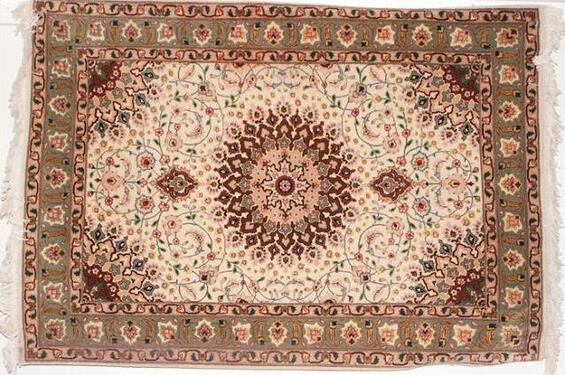
Tabriz rug, Iran
On behalf of Noor, OTA contacted the maker of Encap Green to learn more about the product, noting that although the information provided addresses many concerns, some questions remained. For example, a biodegradable ingredient could be toxic, the claim of the technical bulletin that the product is nontoxic could perhaps be unsubstantiated, and although a number of constituents of concern were stated not to be present, others of concern could be. Encap’s maker responded by supplying OTA with information on the ingredients, relying on OTA’s promise of confidentiality. OTA noted that the ingredients were almost all essential oils and other plant-based products, many food-grade, with the exception of two constituents.
The company owner replied that one of the constituents was a common component of several products certified as environmentally preferable by Green Seal 2 , considered to be a reliable green certification because its standards are scientific, its processes are open, and its certifications are verified. He stated that the other constituent was listed in CleanGredients3 as a recommended green constituent. He stated that one of the ingredients had a zero health rating on the MSDS from its supplier. OTA noted that although one of the constituents is commonly referred to as an environmentally preferable ingredient, if used in large enough amounts it could pose exposure hazards to workers. The maker of Encap responded that the constituent was present in very small amounts. In use it would be diluted at 4 ounces per gallon of water, and then distributed over 300 to 400 square feet. After hearing about his efforts to develop a green product, OTA asked the company’s president why he did not certify his own product as green. The company president stated that the cost of obtaining them was prohibitive for his small company and particularly for this small product line. He said “If necessary, I can disclose what that product is to you, but I would rather not. It is not well known by my competitors and I certainly do not want to help them out.”
Using Natural Ingredients
After hand-washing and thorough rinsing, the rugs are dried naturally, with no artificial heat applied, to avoid alteration of natural dyes or shrinkage. Noor states that subjecting rugs to heat “can cause distortion and shrinkage, manifested as surface ripples and curling edges.” Wool rugs are treated with lanolin, the natural oil of wool, to restore luster and suppleness of fiber and increase the longevity of the rug. Moth proofing, deodorizing, and disinfection are performed using natural products such as eucalyptus oil, bicarbonate of soda, and vinegar, and by carefully monitored exposure to natural sunlight. All dyeing for restoration work is performed using the same natural mineral or vegetable dyes as have been used traditionally. No synthetic chemical dyes are used. Noor’s website provides examples:
“For instance, the villages of Hamadan, Lilian, and Sarouk in central Persia (Iran) are known for their sublime pinkish dye, which dominates their rugs and is produced by boiling madder root with yogurt. Lavar is known for its indigo dye. In some places such as Baluchistan, where dyestuffs are scarce, weavers have become highly skilled at combining yarns with different natural coloration. Most dyes from natural sources need a “mordant”, or fixative, in order to bind to the yarn. Common sources of red dyes are madder root and cochineal (exudate from insects feeding on plant sap). Blues are often derived from indigo or possibly aubergine skin. Yellows may come from the flowering native plant called isparak, or from saffron, turmeric, apricot leaves, or wild pistachio trees. Orange may be derived from grass root, plum tree bark, poplar leaves, or willow leaves; green from walnut leaves, olive leaves, or sweet violet; browns and blacks from tea, tobacco, mud, walnut bark, or wild pistachio leaves.”
Authentic restoration is performed using the highest quality wool or silk preferably sourced from the place the rug was created. After carefully evaluating every step in the process of cleaning OTA was able to report to Noor that it possessed substantiation for making the claim that its process is “greener” than those that use machine-washing, petroleum-derived soaps and dyes, and industrial disinfectants, deodorizers, and moth-repellants. Noor has taken steps to ensure its claims are as carefully and thoroughly sourced as the products it uses to repair and maintain fine rugs. The Noor website notes that “A fine Oriental rug is far more than a decorative floor covering or an exceptional work of craftsmanship; it can be a depiction of paradise itself, inspiring us to dream of a better world. That longing has inspired Mr. Nooraee also, who believes that, like the weavers who slowly and laboriously tie each knot as they work toward paradise, we too can craft a better world, and that everyone deserves such a hope.”
Download
Published 2013