
Read the Report
Executive Summary
Full Report
-
ResilientMass Finance Strategy Report, Open PDF file, 7.38 MB (English, PDF 7.38 MB)
Appendix A: Project Management Team and Finance Advisory Committee Participation
-
ResilientMass Finance Strategy Appendix A, Open PDF file, 133.02 KB (English, PDF 133.02 KB)
Appendix B: Investment Assessment Technical Appendix
-
ResilientMass Finance Strategy Appendix B, Open PDF file, 1.09 MB (English, PDF 1.09 MB)
Appendix C: Resilience Finance Roadmap Technical Appendix
-
ResilientMass Finance Strategy Appendix C, Open PDF file, 347.02 KB (English, PDF 347.02 KB)
*Translations of the Full Report and appendices available upon request
What is ResilientMass?
ResilientMass is Massachusetts' statewide commitment to reducing risks and building resilience to natural hazards and the local impacts of climate change. It brings together all of our state's planning, programs, and partnerships focused on climate adaptation and resilience.
Understanding the ResilientMass Finance Strategy
The Investment Assessment
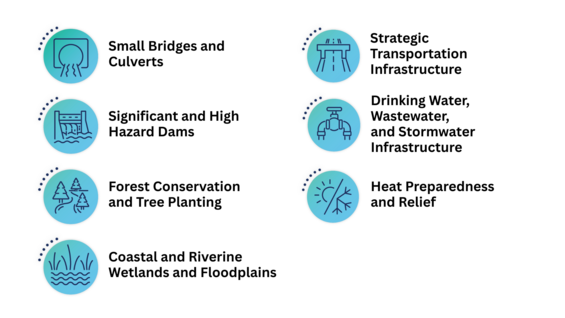
The investment assessment estimates the investment need and resilience value of seven key resilience measures. These measures are high-impact strategies that protect our roads, natural areas, and public services. They are actionable and achieve climate resilience benefits across several sectors: human health and wellbeing, governance, infrastructure, natural environment, and the economy.
The Key Resilience Measures are:
- small bridges and culverts
- significant and high hazard dams
- forest conservation and tree planting
- coastal and riverine wetlands and floodplains
- strategic transportation infrastructure
- drinking water, wastewater, and stormwater infrastructure
- heat preparedness and relief
Resilience value is the return on our investment. It describes the avoided costs and the major social, environmental, and economic benefits that result from these resilience measures. The investment need is a rough order of magnitude estimate of the costs that may be needed.
Roadmap: Building Capacity for Action
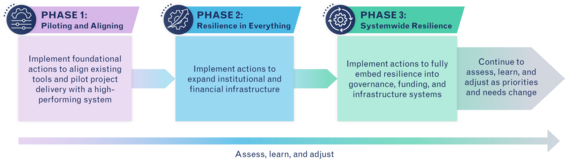
The Roadmap is EEA’s plan to guide and speed up continued investment in climate resilience actions across Massachusetts. The purpose is to connect public and private funds with actions that will do the most to reduce risk, protect our infrastructure and natural systems, and support community health and safety. The Roadmap is structured in three phases that we will continue to assess, learn from, and adjust as priorities and needs change:
- Phase 1: Piloting and Aligning - Implement foundational actions to align existing tools and pilot project delivery with a high-performing system
- Phase 2: Resilience in Everything - Implement actions to expand institutional and financial infrastructure
- Phase 3: Systemwide Resilience - Implement actions to fully embed resilience into governance, funding, and infrastructure systems.
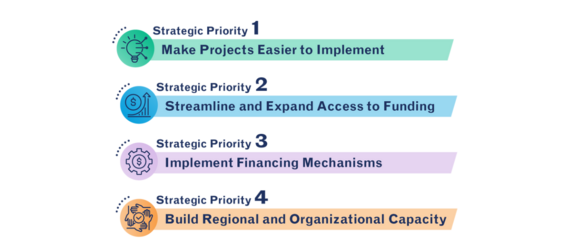
The Roadmap is built around four main priorities:
- Make projects easier to implement,
- Streamline and expand access to funding,
- Implement financing mechanisms, and
- Build regional and organizational capacity.
These priorities act as pathways to guide our decisions, investments, and how we structure our systems now and for the future. The approach is focused on delivering practical results: it will make sure our money and resources align, our systems improve, and we build the capacity to make an impact for years to come. While this roadmap lays out the state's role, the public sector cannot solve this challenge alone. The private sector and philanthropy both have important roles to play in supporting the implementation of actions that build resilience.
Our Public Engagement
We believe that building climate resilience across Massachusetts will require strong collaboration. That’s why we included many communities and partner organizations in the development of this work.
ResilientMass Finance Advisory Committee
The committee was comprised of over 30 members representing municipalities, Tribes, foundations, planning commissions, and other partners. A full list is available in Appendix A. Five Advisory Committee meetings were held between September 2024 and June 2025.
Learn More About State-led Climate Resilience Action
ResilientMass
ResilientMass is the Commonwealth’s overarching initiative for building statewide capacity for climate change adaptation and resilience. It provides funding, localized climate change science and data, and decision support tools to help local planners, practitioners, policymakers, and the public take action to enhance climate resilience.
Climate Resilience Playbook
The Climate Resilience Playbook provides implementation guidance and resources for Massachusetts municipalities to prepare their communities for the impacts of climate change. The playbook is a guide full of ideas, tools, and example approaches from other communities to assist municipal governments and community partners.
Environment and Climate One Stop
EEA's Environment and Climate One Stop is a unified access point for Commonwealth climate resilience and nature-based solutions funding. The platform is designed to help municipalities and other applicants more easily identify, understand, and apply for available grants by consolidating program information, aligning timelines, and reducing administrative burden.
Mass Ready Act
On June 24, 2025, Governor Healey filed the Mass Ready Act to strengthen and protect Massachusetts communities. This legislation proposes a new Resilience Revolving Fund that was inspired through the development of the ResilientMass Finance Strategy.