
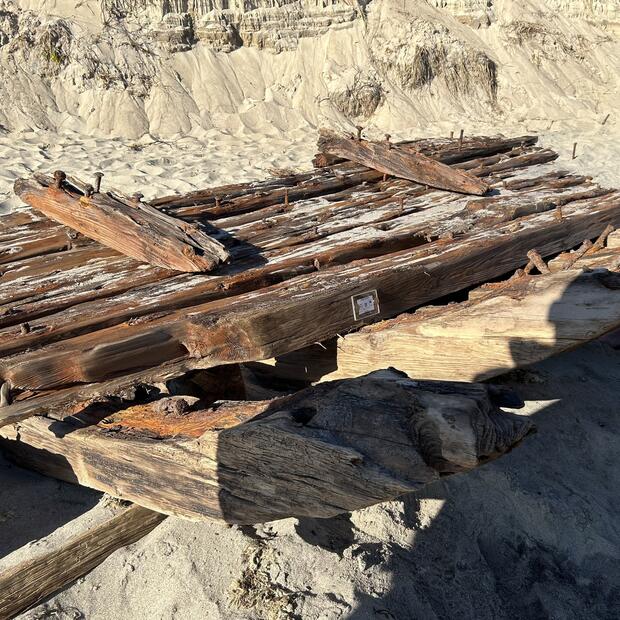
Importance of Monitoring Shipwreck Remains
More than 3,500 historical vessels are estimated to have wrecked off the Massachusetts coast. These sites and the artifacts they contain represent a nonrenewable scientific resource—statements left by time to be preserved through their documentation for public study and benefit. When submerged and buried in undisturbed, wet sand and other sediments, shipwreck remains can be very well preserved for thousands of years. Natural shoreline movements and human-made alterations to the coast and seafloor, however, can uncover and disturb these sites, causing ancient timbers and other artifacts to be exposed temporarily and redeposited on shore. Increasingly, climate change-induced sea level rise has exacerbated erosion and storm damage and now poses a growing threat to coastal cultural resources.
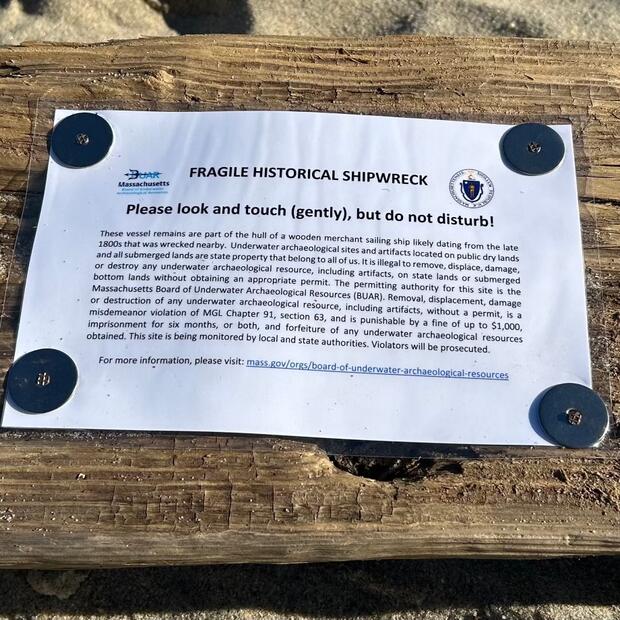
BUAR’s 2025 adoption of STAMP is part of its proactive adaptive management strategy to address this threat and better engage and encourage the public to assist BUAR in the discovery and reporting, as well as preservation and protection, of underwater archaeological resources in the Commonwealth.
These important archaeological resources are constantly on the move and are covered and uncovered by sediment. Tagging the shipwrecks and their displaced timbers and tracking their movement allow archaeologists to better understand how shipwreck sites degrade and are impacted by storms and a changing climate.
Please note that all underwater archaeological artifacts are public resources. While everyone is welcome to visit, photograph, and touch these exciting finds, it is illegal to disturb, destroy, or collect material.
Tracking with STAMP Tags and Finding Untagged Material
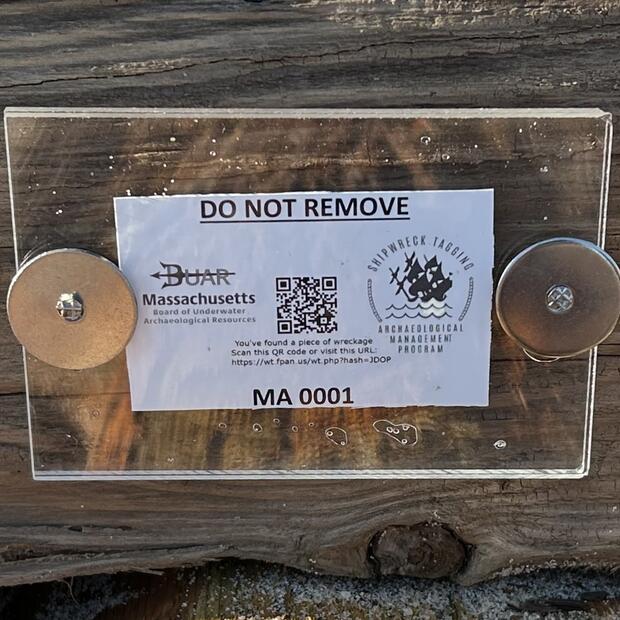
Plexiglass-covered STAMP tags are attached to shipwreck timbers with stainless-steel nails. In Massachusetts, STAMP tags are attached by BUAR staff assisted by trained volunteers.
Once the STAMP tags have been attached to artifacts, the tracking can begin! Everyone is encouraged to be on the lookout for these tags. If you find a shipwreck or a displaced hull timber with one, please scan the QR code with your phone, fill out the form that pops up, and submit a photo if possible.
Often, shipwrecks and other types of underwater archaeological resources have been reported through a companion BUAR program—Shoreline Heritage Identification Partnerships Strategy (SHIPS). So, if you find something that looks like a shipwreck or displaced ship timber or other type of artifact that does not have a STAMP tag, please leave the item where it is and report it to BUAR with the SHIPS Reporting Form.
Thanks to Our Partners!
A comprehensive statewide STAMP would not be possible in Massachusetts without the leadership of the Florida Public Archaeology Network (FPAN) and BUAR’s partnership with the National Park Service at the Cape Cod National Seashore, who work collaboratively with BUAR to integrate the federal and state STAMPs.
BUAR would also like to extend a special thanks to Drs. Dan Houlihan and Calvin Mires of the Diver Archaeological Reconnaissance Cooperative (DivARC), a program that involves combat veterans in maritime archaeology-focused, mission-based, citizen-science efforts as part of the process of returning to civilian life after departing military service. DivARC has long-been an active and interested supporter of bringing STAMP to Massachusetts, as another opportunity for involving its cohort of veteran volunteers in activities of purpose that are of public benefit. In addition, they secured a $3,600 grant from the Regis College Virginia Pyne Kaneb Faculty Scholars Program to fund the purchase of the necessary supplies to make BUAR’s STAMP tags used in the program.
Contact Information
David S. Robinson, Director
Board of Underwater Archaeological Resources
100 Cambridge Street, Suite 900
Boston, MA 02114
Telephone: (617) 845-7961
Email: david.s.robinson@mass.gov