
After viewing reflection activity #1
- After viewing the film ask students to take a moment to write their thoughts and questions.
- Lead students in a discussion about the film.
- What surprised them?
- What moved them?
- What made them rethink their assumptions?
- What questions did the film raise?
- What images from the film stood out?
- If this is part of a longer curricular project, collect the written responses to the film to help you develop subsequent activities and/or lead in-depth discussions about topics of particular interest to your students
Prompt questions for discussion
- What qualities, traits, and experiences do you think a justice of the court should have?
- Justices in the film spoke about the importance of a constitutional democracy.
- Do you think a constitutional democracy protects our rights? If so, how? If not, how does it fall short?
- Did the Declaration of Rights in the Massachusetts Constitution of 1780 initially apply to everyone? If not, who was left out? Since the State’s Constitution was ratified, how has the SJC sought to expand fundamental rights to all?
- Justices in the film emphasized the critical nature of an independent judiciary. John Adams believed that judges should be appointed for life, to ensure their independence from outside influence. Presently, judges in Massachusetts are appointed by the Governor (after a lengthy selection process) and must retire by age 70. In some other states, judges must run for election, as politicians do.
- Are you in favor of appointing justices or having them run for election? What are the possible advantages and disadvantages of either method?
- Based on the film, which Massachusetts court decisions advanced the cause of equal justice? How? Were there court decisions explored in the film that you thought were unjust? Why?
- How have decisions rendered by the Massachusetts SJC affected the nation? What major challenges do the State’s courts face today?
After viewing reflection activity #2
- Direct students’ attention to the three large pieces of paper they wrote their comments and questions on prior to viewing the film.
- Ask students to partner with the same person they worked with prior to seeing the film. Students can refer to their initial notes and discuss if and how their perceptions have changed.
- Provide markers to the students. Ask them to revise and add to the comments and questions they wrote before watching the film. As with the pre-film activity, if a student writes a comment or question that other students agree with, they can add a star next to it instead of adding it.
- “What We Know” – If students have discovered new information, they can add comments to this sheet. Conversely, if they now think something they wrote is inaccurate, they can cross it out. If they wrote something they’re no longer sure about, they can cross it off this sheet and add it to the “What We Think We Know List.”
- “What We Think We Know” – If they wrote something on this sheet they now believe is true, they can cross it of this sheet and add it to “What We Know List.” If they now believe something they wrote isn’t true they can cross it off.
- “What We Want to Know” – If a question they wrote on this sheet was answered (in the film, through research, or in discussion), they can cross it off and add a comment to the “What We Know” sheet. Encourage students to add questions they hadn’t thought of before, but are now curious about.
- Once students are done writing, divide students into three groups, and have each group stand in front of one of the sheets. Starting with “What We Know” sheet, ask students to take turns reading each comment until all comments have been heard. Repeat this for both the “What we Think We Know” and “What We Want to Know” sheets.
- (optional activity) Assign, or have students select, questions from the “What We Want to Know” sheet to research and report back to the class
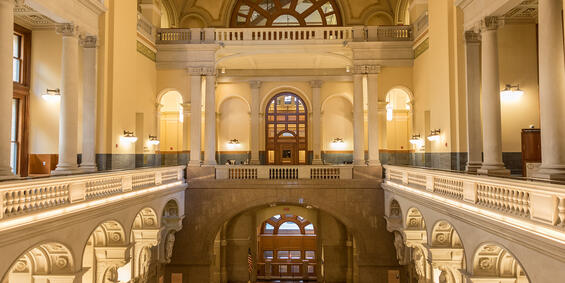
The Great Hall of the John Adams Courthouse
Contact
Phone
Supreme Judicial Court main phone:
Call John Adams Courthouse Contact Information, Supreme Judicial Court main phone: at 617-557-1000
Hours: Mon. - Fri., 8:30 a.m. - 4:30 p.m.
Appeals Court main phone:
Call John Adams Courthouse Contact Information, Appeals Court main phone: at 617-725-8106
Hours: Mon. - Fri., 8:30 a.m. - 4:30 p.m.
Social Law Library main phone:
Call John Adams Courthouse Contact Information, Social Law Library main phone: at 617-226-1500
Hours: Mon.-Fri. 8:30 a.m.- 4:30 p.m.
For information on emergency or weather-related closures and delays call:
Call John Adams Courthouse Contact Information, For information on emergency or weather-related closures and delays call: at 617-557-1000
Address
1 Pemberton Square, Boston , MA 02108