
Phase I Assessment
Waterbodies in Berkshire County
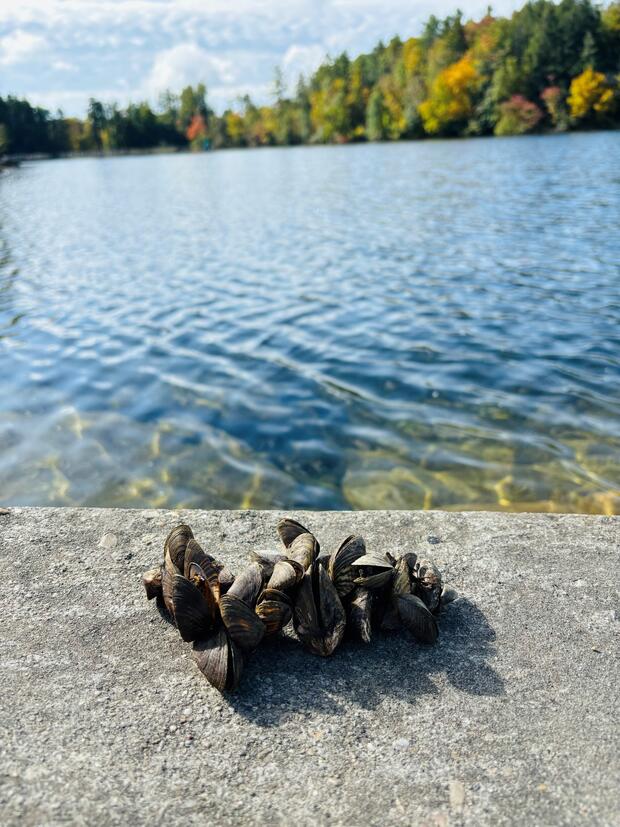
In early fall of 2009, following the discovery of zebra mussels in Laurel Lake (Lee and Lenox, Massachusetts), Biodrawversity LLC was hired to conduct a Phase I Assessment of 17 Berkshire County lakes and the mainstem Housatonic River for the presence of zebra mussels (Dreissena polymorpha) and the potential of these waterbodies to support zebra mussels based on physical, chemical, and biological parameters.
Fieldwork was conducted between September 8 and October 23, 2009. The Massachusetts Department of Conservation and Recreation (DCR) Lakes and Ponds Program performed similar studies at three additional lakes. Data were collected at two to six sites per lake (84 total sites) and 31 sites in the Housatonic River including a continuous 0.5-mile reach downstream of Laurel Brook.
Data collection included some combination of the following at each site: Secchi depth, water temperature, vertical profiles for dissolved oxygen and temperature, water chemistry (dissolved oxygen, pH, alkalinity, calcium, total nitrogen, total phosphorus, total suspended solids), adult zebra mussels, zebra mussel veligers, substrate, and the species composition and abundance of submerged aquatic plants, snails, and native freshwater mussels.
The pH of waterbodies ranged from 6.79 to 8.55, alkalinities ranged from 4.0 to 162.0 mg/L, and calcium concentrations ranged from 2.0 to 44.0 mg/L. Calcium and pH are widely considered the most critical parameters in assessing the susceptibility of a waterbody to zebra mussel survival and reproduction. Low-risk waterbodies usually have pH below 7.4 and calcium below 12 mg/L, whereas high-risk waterbodies usually have pH above 8.0 and calcium above 20 mg/L. The 21 waterbodies surveyed for this report, were divided into three categories based on their susceptibility to successful colonization by zebra mussels:
- Low Risk (seven waterbodies): Benedict Pond, Big Pond, Center Pond, Goose Pond, Otis Reservoir, Thousand Acre Pond, and Windsor Pond
- Medium Risk (four waterbodies): Ashmere Lake, Shaw Pond, Lake Garfield, and Plunkett Reservoir
- High Risk (ten waterbodies): Cheshire Reservoir, Housatonic River (Great Barrington to Pittsfield), Lake Buel, Lake Mansfield, Laurel Lake, Onota Lake, Pontoosuc Lake, Prospect Lake, Richmond Pond, and Stockbridge Bowl
Zebra mussel adults and veligers were detected in Laurel Lake, Laurel Brook, and the Housatonic River. Adult zebra mussels were encountered in the Housatonic River along a nearly one-mile reach downstream of Laurel Brook, and a single mature adult was found in Stockbridge, 6.95 miles downstream of the Laurel Brook confluence. Veligers are reaching the Housatonic River from Laurel Brook and the broken water pipe that runs from Laurel Lake to the Eagle Mill Building (Laurel Lake Water Power, LLC) alongside the Housatonic River in Lee. The size distribution of adult zebra mussels in Laurel Lake and the Housatonic River indicate that these populations may have been established for one to three years. The establishment of a self-sustaining zebra mussel population in the Housatonic River, and the rate at which they spread downstream, may be limited by the physical and chemical conditions present in a small and dynamic river environment.
A total of 37 aquatic plant species, 15 snail species, and five native mussel species were encountered during the project. Species richness was calculated and compared across lakes to look for trends. Biological indicators with high correlation to “High Risk” lakes included presence of the submerged aquatic macroalgae muskgrass (Chara sp.), high species richness of aquatic snails, and two of the more calcium-dependent snail species.
In summary, this study confirms zebra mussels in Laurel Lake and documents adult zebra mussels in the Housatonic River for the first time. It also identifies High Risk lakes throughout Berkshire County where landowners, anglers, and boaters should carefully follow established decontamination procedures (DCR 2009) and assist with early detection of new populations.
Phase II Assessment
Waterbodies in the Connecticut River Watershed
In summer of 2010, Biodrawversity LLC assessed 26 lakes and reservoirs and four rivers in the Connecticut River watershed to determine presence of zebra mussels (Dreissena polymorpha) and to evaluate the potential for these waterbodies to support zebra mussels based on physical, chemical, and biological parameters.
Fieldwork was conducted during May and June of 2010. Data were collected at one to five sites per lake (40 total sites), six sites in the Connecticut River, and one site each in the Westfield River, Deerfield River, and Chicopee River.
Most of the following parameters were recorded for each waterbody: secchi depth, water temperature, water chemistry (dissolved oxygen, pH, alkalinity, conductivity, calcium, total nitrogen as N, total phosphorus as P, and total suspended solids). Presence of adult zebra mussels or veligers, physical habitat characteristics, and species composition and abundance of submerged aquatic plants, snails, and native freshwater mussels were also documented.
This report also uses data from the Acid Rain Monitoring (ARM) Project of the University of Massachusetts Water Resources Research Center and the Phase I Zebra Mussel Assessment in Berkshire County (Biodrawversity 2009) to provide a comprehensive risk assessment for 166 waterbodies (including multiple sites along the mainstem Housatonic and Connecticut Rivers) in central and western Massachusetts. This included 108 waterbodies in the Connecticut River watershed and 58 waterbodies in the Housatonic River and Hudson River watersheds of Berkshire County.
Neither zebra mussel adults nor veligers were detected during the survey, although the physical and chemical suitability of waterbodies for zebra mussels varied considerably and four lakes showed characteristics somewhat favorable for zebra mussel colonization, reproduction, and growth. A total of 56 aquatic plant species, 14 snail species, and seven native mussel species were documented during the study.
Among the waterbodies sampled, species richness of aquatic snails ranged from zero to seven (average = 3.0), and three lakes considered most susceptible to zebra mussel invasion contained a higher average species richness of aquatic snails (combined average = 6.0) than low-risk lakes (combined average = 2.4). Species richness of native freshwater mussels ranged from zero to six (average = 1.4) among the waterbodies and showed no trend with regard to water chemistry. Lakes and ponds usually contained only one or two mussel species, whereas six mussel species were documented in the Connecticut River.
Known biological indicators of an aquatic ecosystems’ vulnerability to zebra mussel invasion (e.g., presence of the submerged aquatic macroalage muskgrass (Chara sp.)and calciphilous aquatic snails) were not observed in this study although muskgrasshad been documented in Congamond Lakes prior to this study. A non-native bivalve, the Asian clam (Corbicula fluminea), was encountered in the Connecticut River (Easthampton), Aldrich Lake (Granby), Congamond Lakes (Southwick), and Five Mile Pond (Springfield).
Research suggests that zebra mussels are not likely to become established in waterbodies with pH below 7.4 and calcium below 12.0 mg/L. Higher pH and calcium levels are more suitable for this species. The following water chemistry thresholds were used to determine susceptibility to zebra mussels:
- Low Risk: pH <7.4, Calcium <12.0 mg/L, Alkalinity <20.0 mg/L
- Medium Risk: pH 7.4-8.0. Calcium 12.0-20.0 mg/L, Alkalinity 20.0-65.0 mg/L
- High Risk: pH >8.0, Calcium >20.0 mg/L, Alkalinity >65.0 mg/L
For waterbodies in the Connecticut River watershed, including those monitored as part of the ARM Project, pH ranged from 4.9 to 8.7 (average = 6.7), and calcium concentrations ranged from 0.4 to 27.0 mg/L (average = 6.6 mg/L). These pH and calcium values indicated a very low risk that zebra mussels could become established in the region; only nine of 109 (8.3 percent) waterbodies assessed were considered to have medium or high risk of zebra mussel establishment based on water chemistry parameters.
Moreover, several small and eutrophic ponds in the highly urbanized Springfield area (Watershops Pond, Porter Lake, Silver Lake, and Harts Pond) had pH and calcium levels near or within the optimal range for zebra mussels, but physical and biological parameters of these urban ponds made them less suitable than the chemistry data indicated.
Based on the dual role of water chemistry and physical habitat, only four of the waterbodies assessed in the Connecticut River watershed are considered susceptible to zebra mussel invasion, including Pequot Pond (Westfield), Congamond Lakes (Southwick), Ashfield Lake (Ashfield), and Wrights Pond (Holyoke). All but the latter experience moderate to heavy recreational use (boating and angling) that increases the likelihood of zebra mussel introduction.
Although there are a small number of lakes in the Connecticut River watershed that might support zebra mussels, none are considered optimal for this species, and they generally lack many of the strongest biological indicators of high-risk lakes that were documented in Berkshire County. Nevertheless, Pequot Pond has higher pH and calcium levels than several other waterbodies in the Northeast where zebra mussels are already established and should be considered at high risk. Congamond Lakes and Ashfield Lake may be less suitable for zebra mussels than Pequot Pond but might still be vulnerable. Anglers and boaters should carefully follow established decontamination procedures when visiting or leaving the Congamond Lakes, Pequot Pond, and Ashfield Lake. Signage and boat ramp monitoring are recommended. Periodic aquatic surveys are recommended to increase chances of early detection.
Phase III Assessment
Waterbodies in the Merrimack River Watershed
In summer of 2014, ESS Group, Inc. assessed 28 waterbodies in the Merrimack River watershed for their risk of susceptibility to invasion by dreissenid mussels. The zebra mussel (Dreissena polymorpha) was the primary target of the assessment but other invasive species, including the quagga mussel (D. bugensis), Asian clam (Corbicula fluminea) and various other mollusks, crustaceans and aquatic plants were also opportunistically documented.
Field surveys were completed primarily in June 2014 and included collection of key water quality parameters, visual assessments for adult dreissenid mussels and collection of dreissenid veliger (planktonic larvae) tow net samples. Physical habitat and presence of other mollusks was also noted.
No dreissenid mussel adults were encountered during this assessment. Suspected dreissenid veligers (larvae) were found in plankton tow samples from Lake Pentucket in Haverhill. However, the identification of these organisms could not be confirmed. Detailed SCUBA surveys were conducted by experienced Lakes and Ponds Program staff at Lake Pentucket to search for adult dreissenid mussels. However, these surveys found no evidence of dreissenid mussels in the lake.
Several other non-native aquatic species were documented in the waterbodies assessed during this study, including Asian clam (both adult and veliger life stages), Chinese mystery snail (Cipangopaludina chinensis), banded mystery snail (Viviparus georgianus), fanwort (Cabomba caroliniana), variable watermilfoil (Myriophyllum heterophyllum), Eurasian watermilfoil (M. spicatum), curlyleaf pondweed (Potamogeton crispus) and water chestnut (Trapa natans). However, no biological indicators of supportive water chemistry (i.e., mollusk or macrophyte calciphiles) were observed at any of the waterbodies visited during this assessment.
Water chemistry at the assessed locations was generally not highly supportive of dreissenid mussels. Calcium ranged from low (2.72 mg/L) to high (29.3 mg/L) and pH ranged from low (6.3) to high (9.1) in the assessed waterbodies. Alkalinity ranged from low (<2 mg/L) to moderate (45 mg/L). Based on these key water chemistry analytes 18 locations were classified as being at Medium Risk for dreissenid mussel invasion and 10 were found to be at Low Risk. None of the assessed waterbodies were classified as being at High Risk.
Most of the 28 locations assessed experience significant recreational boating or fishing pressure, which increases the risk of introduction through contaminated bait buckets, bilge water, boat trailers or other equipment. The documented presence of aquatic invasive species at 23 of the 28 locations suggests that these dispersal vectors have already had a significant impact.
Presence of a waterbody in a large watershed (i.e., multiple upstream sources) and more intense recreational pressure are also likely to increase the true risk of zebra mussel infestation by providing more opportunities for introduction. Waterbodies with extensive public parking and large boat ramps would generally be expected to attract more recreational attention. Lake Cochituate, Whitehall Reservoir and Hopkinton Reservoir are prime examples. Of these, the greatest concern for infestation would be at Lake Cochituate, where water chemistry is more clearly aligned with the biological requirements for zebra mussels.