
- Scientific name: Calopteryx amata
Species of Greatest Conservation Need (MA State Wildlife Action Plan)
Description
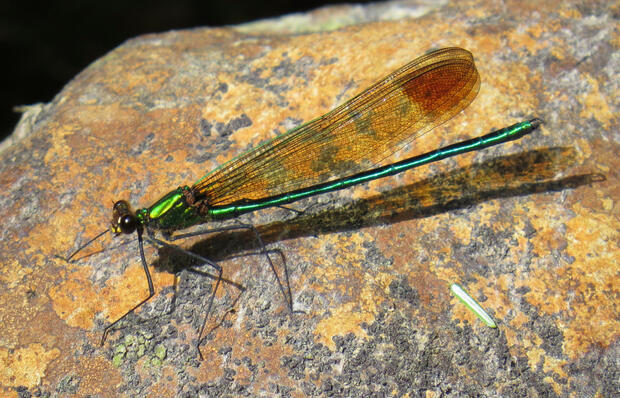
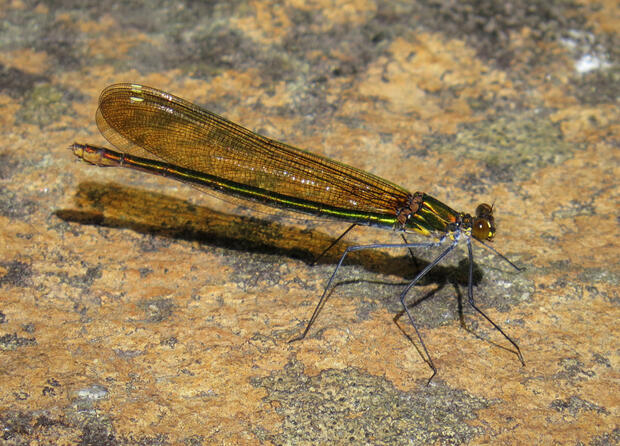
The superb jewelwing is a small, semiaquatic insect of the order Odonata, suborder Zygoptera (the damselflies), and family Calopterygidae (broad-winged damselflies). Superb jewelwings have large eyes on the sides of the head, short antennae, and four heavily veined wings, which are kept closed when at rest. The male’s thorax (winged and legged section behind the head) and abdomen are iridescent green and can appear blue in various light. The wings have an amber tint with darker tips on the hindwings. The female is similar with more bronzy thorax and abdomen color and no dark tips on the hindwings. In both males and females, legs are long, black, and spiny and the wings are long and narrow. Superb jewelwings range from 48-61mm (1.9-2.4 inches) in length and is the largest Calopteryx (jewelwings)in Massachusetts.
Four other species of Calopteryx have been recorded in Massachusetts and species can be identified by examination of the wing size, shape, and color patterns (Lam 2004, Nikula et al. 2007). Superb jewelwing is most similar to river (C. aequabilis) and sparkling (C. dimidiate) jewelwings, but possess longer and narrower wings, and male forewings lack dark tips and hindwing tips tend lighter in color (i.e., not black) than other two species.
Life cycle and behavior
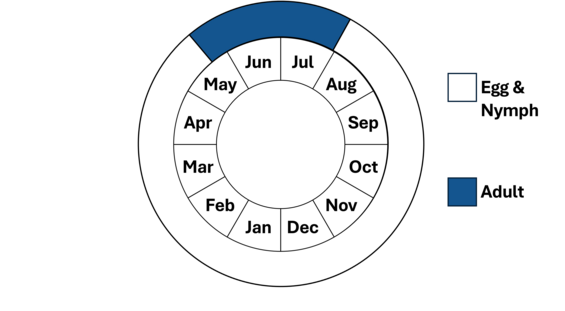
Note, nymphs are present year-round.
Although little has been published specifically on the life history of superb jewelwing, it is likely similar to other, better-studied species in the genus. All odonates have three life stages: egg, aquatic nymph, and flying adult. The nymphs are slender with three leaf-like appendages extending from the end of the body which serve as breathing gills. They have a large, hinged lower jaw which they can extend forward with lightning speed. This feature is used to catch prey, the nymph typically lying in wait until potential prey passes within striking range. They feed on a wide variety of aquatic life, including insects and worms. They spend most of their time clinging to submerged vegetation or other objects, moving infrequently. They transport themselves primarily by walking, but are also capable of swimming with a sinuous, snake-like motion.
Superb jewelwings likely have a 2-3 year life cycle. The eggs are laid in summer and may hatch in the fall. The nymphs develop over the winter and spring, undergoing several molts. In early to mid-summer after at least two years, the nymphs crawl out of the water on vegetation or other substrates and transform into adults. This process, known as emergence or eclosion, typically takes a couple of hours, after which the newly emerged adults (tenerals) fly weakly off to upland areas where they spend a week or two feeding and maturing. The young adults are very susceptible to predators, particularly birds, ants, and spiders; mortality is high during this stage of the life cycle. The adults feed on a wide variety of smaller insects which they typically catch in flight.
When mature, the males and females return to streams where males defend small territories along the stream. Males perform courtship displays to attract females by fluttering his wings and even dropping into the stream and floating temporarily. If the female is receptive, she allows the male to grasp her behind the head with his terminal appendages, then curls the end of her abdomen up to the base of the male’s abdomen where his secondary sexual organs (“hamules”) are located. This coupling results in the heart-shaped tandem formation characteristic of all odonates. This coupling lasts for a few minutes to an hour or more. The pair generally remains stationary during this mating but, amazingly, can fly, albeit weakly, while coupled.
Once mating is complete, the female begins laying eggs (oviposits) in submerged vegetation by using the ovipositor located on the underside of her abdomen to slice into the vegetation to deposit eggs. Although the female occasionally oviposits alone, in most cases the male is flying nearby guarding the female from other males. This form of mate-guarding is thought to prevent other males from mating with the female before she completes egg-laying. The adult’s activities are almost exclusively limited to feeding and reproduction, and their life is short, probably averaging only three to four weeks for damselflies. The flight period ranges from late May to July.
Distribution and abundance
The superb jeweling has a northeastern distribution that ranges from the mountains of North Carolina and West Virginia, north and east to New England and Canada. In Massachusetts, superb jewelwing has been observed in the Middle Connecticut, Millers, and Chicopee watersheds mostly at relatively higher elevations. The status of superb jewelwing remains uncertain in Massachusetts. The species has been haphazardly documented at six streams and may occur in other streams in central and western Massachusetts watersheds.
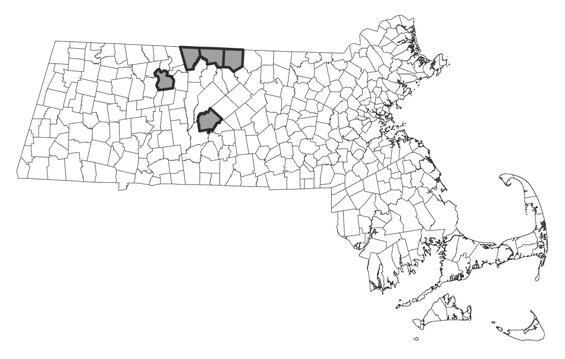
Distribution in Massachusetts.
1999-2024
Based on records in iNaturalist, Odonata Central, and Natural Heritage databases.
Habitat
Superb jewelwing inhabits small cool to cold-water streams of low to moderate gradient with abundant aquatic vegetation. Nymphs inhabit these streams often found clinging to submerged aquatic vegetation and structure. Adults are often seen over riffles or rapids bordered by shrubs or forest riparian and nearby forested uplands.
Healthy habitats are vital for supporting native wildlife and plants. Explore habitats and learn about conservation and restoration in Massachusetts.
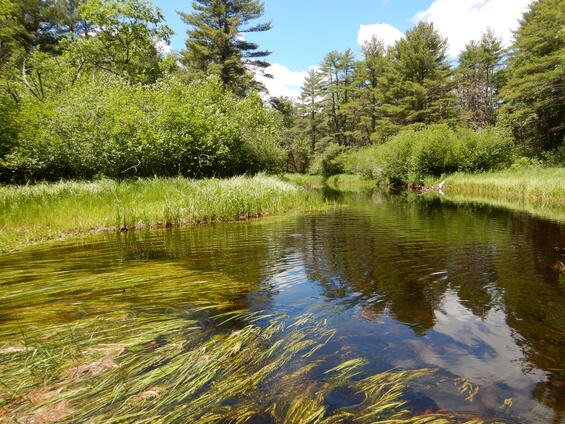
Small cold stream with abundant vegetation suitable for superb jewelwing.
Threats
Degradation of water quality and alteration of streamflows are potential major threats to superb jewelwing. Threats to water quality include industrial pollution and salt and other run-off from roadways. Altered streamflows from stream damming, water diversion projects, and hydropeaking may cause mortality during eclosion and teneral stages. Additional threats include deforestation of upland habitats adjacent to nymphal streams, illegal or accidental industrial discharge, and hardening of channel banks and siltation that creates unstable stream habitat. Warming stream temperatures from climate change is projected to reduce superb jewelwing habitat in Massachusetts (Collins and McIntyre 2017).
Conservation
Survey and monitoring
Standardized and targeted surveys for superb jewelwing is needed to determine its status in Massachusetts. Standardized surveys should target historical and new stream sites to determine species occupancy and population status. Surveys for adults are likely to be more effective for detection compared to nymph or exuvia as this life stage is extremely difficult to find and identify. Adult surveys should target stream and streambank habitats during their flight period during standardized weather and time windows to maximize species detection. Multiple site visits (e.g., ≥3) may be required to detect this species. Routine monitoring of prioritized sites is needed estimate occupancy trends overtime.
Management
Upland and stream protection is critical for the conservation of superb jewelwing. Degraded water quality and water quantity are primary concerns for the species. Protection of forested upland borders of these river systems are critical in maintaining suitable water quality and are critical for feeding, resting, and maturation. Development of these areas should be discouraged, and the preservation of remaining undeveloped uplands should be a priority. Alternatives to commonly applied road salts should be tested to minimize freshwater salinization. Altered streamflows from dam operations should minimize rapid flow increase during emergence time to prevent mortalities. Hardened and channelized stream segments should be restored to promote natural sediment dynamics.
Research needs
Through standardized surveys, effort is needed to define habitat requirements, distribution, relative abundance, and potential breeding sites. Research effort is needed to estimate detection and occupancy rates and how other environmental variables (e.g., sample timing, weather) affect these rates. Other needed research efforts include projections of species distribution under climate change scenarios and climate vulnerability analysis, since this species tends to occupy cool and cold-water streams.
References
Collins S.D., and N.E. McIntyre. “Extreme loss of diversity of riverine dragonflies in the northeastern U.S. is predicted in the face of climate change.” Bulletin of American Odonatology 12,1 (2017):7-19.
Lam, E. 2004. Damselflies of the northeast. Biodiversity Books, Forest Hills, New York, 96 p.
Nikula, B., J.L. Ryan, and M.R. Burne. 2007. A Field Guide to the Dragonflies and Damselflies of Massachusetts. Massachusetts Natural Heritage and Endangered Species Program.
Paulson, D. 2011. Dragonflies and damselflies of the east. Princeton University Press, Princeton, NJ.
Walker, E.M. 1953. The Odonata of Canada and Alaska, Vol. I. University of Toronto Press.
Westfall, M.J., Jr., and M.L. May. 1996. Damselflies of North America. Scientific Publishers.
Contact
| Date published: | March 26, 2025 |
|---|