- Division of Marine Fisheries
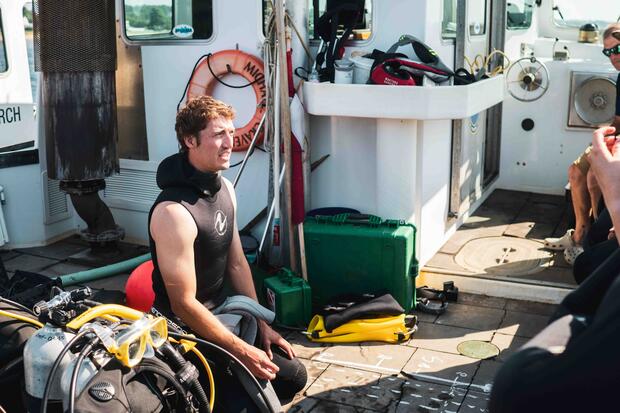
The last whisps of fog gave way to the powerful rays of the midsummer sun, already high in the sky at 8:30am on July 29, as two DMF divers from the Habitat Program, Dr. Forest Schenck and Iris Seto, climbed up the swim ladder and back onto the deck of the R/V Alosa. Cool beads of seawater from Salem Sound dripped off their dive gear and from the handful of eelgrass shoots Forest held aloft to show project co-lead Jill Carr of the MassBays National Estuary Partnership, who assisted as topside support on this effort. These are reproductive shoots (or repros), which can grow to over six feet at this location, their length and bright chartreuse coloring distinguishing them from their smaller emerald-colored vegetative kin. Each repro boasts numerous peapod-like structures about the length of a pinky-finger, called spathes, many of which are on the cusp of bursting under the strain of containing 10–15 seeds. The seeds, green to brown in color, are the size and shape of a grain of rice with ribbing down their sides. Collecting these tiny packets of new life, which also represent new hope for eelgrass restoration in Massachusetts, was the team’s objective.
In Massachusetts, self-sustaining, resilient eelgrass meadows are among the most important—but also the most imperiled—coastal marine ecosystems: they create habitat for numerous marine species including commercially and recreationally important fish and invertebrates, store carbon, filter water, buffer the coastline from wave energy, and stabilize the seafloor. Alarmingly, in the last 30 years, eelgrass has disappeared from half of the areas where it used to thrive, a loss of roughly 18,000 acres. Planting eelgrass seeds, tens of millions of them year after year, may be the best hope for counteracting these losses.
An hour earlier, in the cool gloom of a thick fog bank, Forest and Iris splashed into the water and descended to the kaleidoscopic green hues of lush eelgrass meadow that blankets the seafloor in this area of Salem Sound. They used stakes and rope to steadily and carefully bring order to this wild watery world of undulating grass, schooling russet pollock, and skittering crustaceans. When they finished, the ropes formed twenty parallel lanes along the seafloor in a rectangular area the size of two Olympic swimming pools. Soon these lanes would host an aquatics competition of sorts—a race to collect eelgrass seeds.
Information on how many seeds eelgrass meadows produce in Massachusetts and how many can be collected sustainably (to avoid damaging the remaining meadows) is scarce. By precisely controlling and documenting a collaborative experimental eelgrass seed collection effort in Salem Sound, DMF and partners at MassBays and Salem Sound Coast Watch sought to address these knowledge gaps.
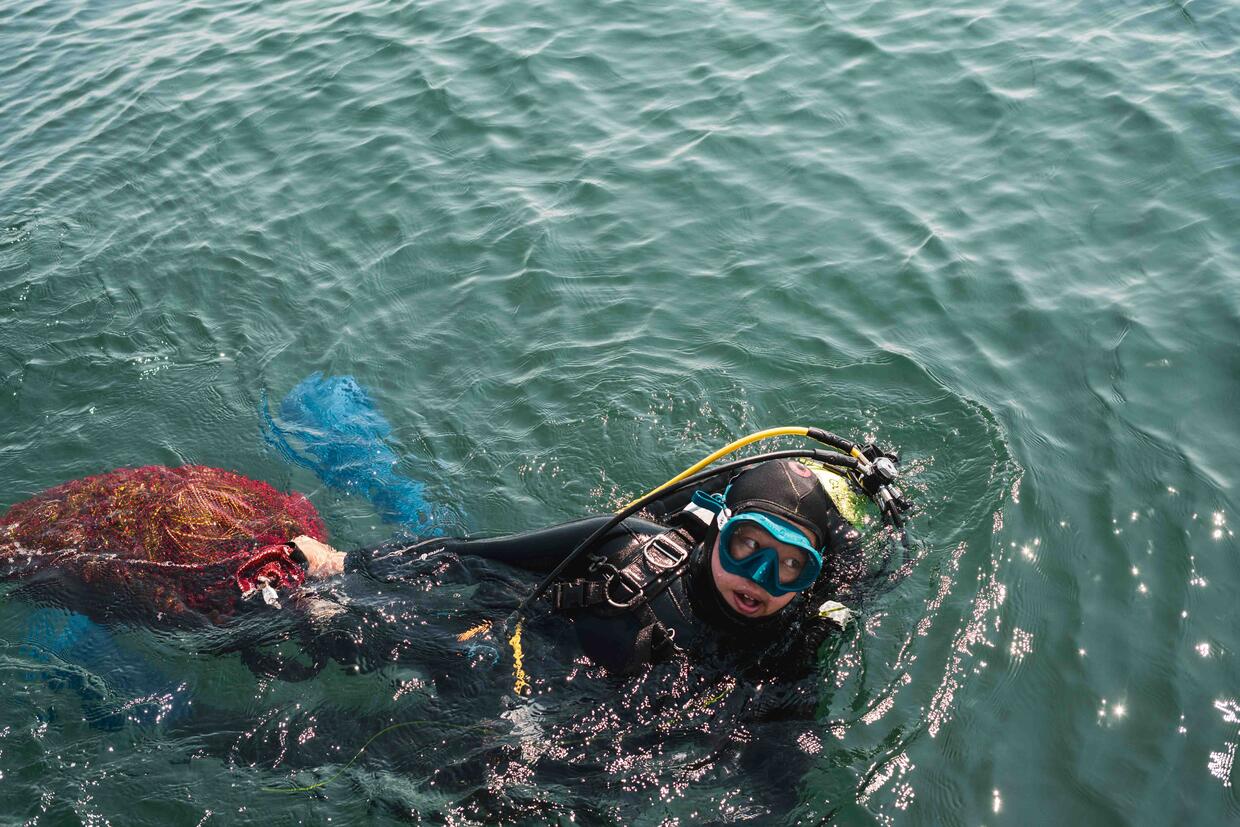
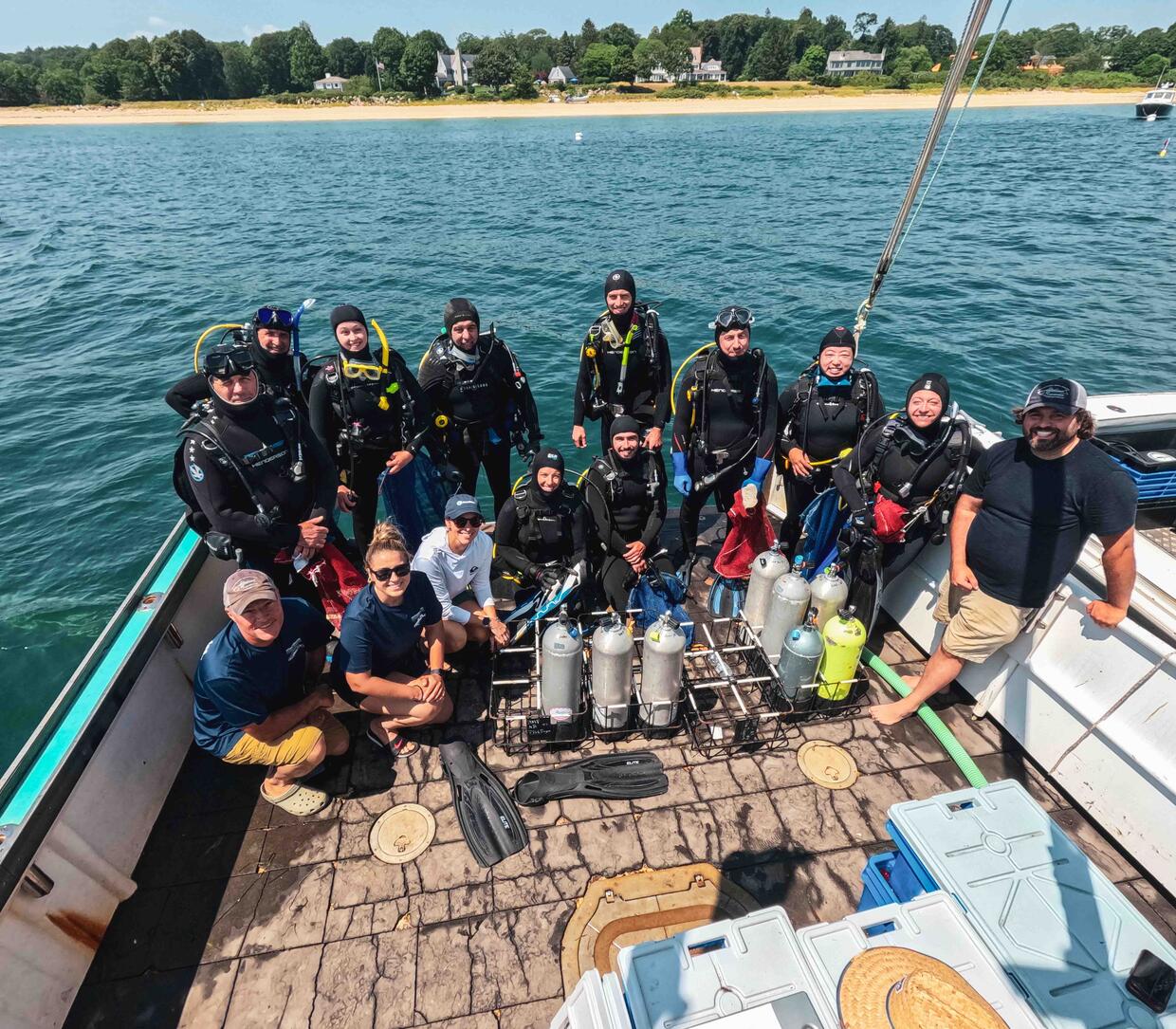
Back in Salem Sound, the R/V Alosa was joined by a second DMF research vessel, the R/V Michael Craven, filled with additional scuba tanks, fish totes, and more divers. By 11am, a total of ten divers, organized into five buddy pairs, began a series of two, hour-long dives to hand collect eelgrass seeds. Seven of the eight divers joining Forest and Iris were from DMF’s Dive Team including additional members of DMF’s Habitat Program (Kate Frew and Mark Rousseau), Invertebrates Program (Laura Tomlinson and Jacob Dorothy), Shellfish Program (Terry O’Neil and Alex Boeri), and Dive Safety Officer Ashley ‘Peach’ Bueche. The tenth diver was Dr. Phil Colarusso, a marine biologist and eelgrass expert from the U.S. Environmental Protection Agency. In addition to Jill, the divers are supported topside by Captain Bill Hoffman and Bart DiFiore of DMF’s Fisheries Research and Monitoring Program, Brooke Dejadon of DMF’s Shellfish Program, and the Massachusetts Department of Fish and Game’s Communications Director, Julia Hopkins, who photo-documented the effort.
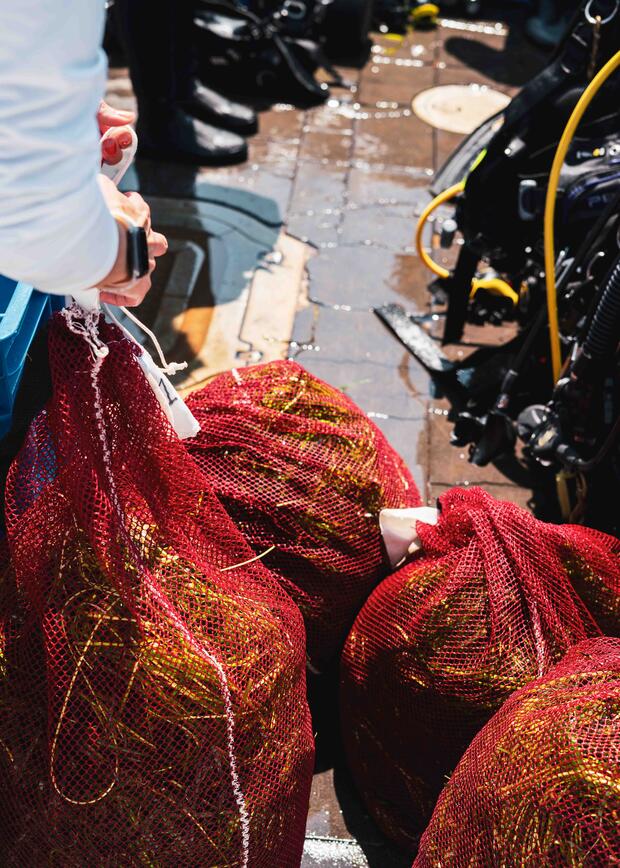
Forest used the repros collected during his earlier dive to brief the divers, who had varying experience levels working with eelgrass, on what they would look for underwater. Search image committed to memory, each diver was given a large mesh bag, assigned a 40-meter-long by 2-meter-wide lane, and instructed to collect as many seed-bearing shoots as possible. Some friendly back and forth ensued among the divers regarding who will collect the most repros as they completed their final safety checks.
Underwater, with divers ready at the start of their respective lanes, the beep of the hydrophone signaled the divers to start collecting. The hydrophone would beep every fifteen minutes to pace the diver’s movement, evenly distributing their collection effort along their lane. Quickly the mesh bags began filling with the buoyant eelgrass repros. By looping the straps on their collection bags around the underwater lane lines the divers slid their haul along with them as they moved, keeping their hands free to pluck out repros laden with seeds from the meadow while being careful not to disturb the eelgrass rhizomes anchoring the plants into the sediment below or accidentally collect vegetative shoots. Curious pollock hovered and flit around the bags suspended in the water column above the divers, grabbing micro-fauna dislodged from the eelgrass during collection for an easy meal.
All told, the divers collected over 11,000 eelgrass repros, holding around 1,000,000 seeds. A crane was used to lift totes full of eelgrass from the deck of the R/V Craven into the back of a DMF pickup truck. Forest and Jill then drove the eelgrass to DMF’s Cat Cove Laboratory where it would be held in tanks of seawater for six weeks to allow the seeds to release naturally from the spathes and fall to the bottom of the tank. The seeds were then separated from the plant material and stored for planting or research. Given their small size (five hundred seeds per teaspoon) and hardiness, the seeds are ideal for distributing to partners for restoration and research. Ultimately, this collection effort in Salem Sound yielded over 200,000 seeds suitable for planting, enough to support five pilot eelgrass seeding restoration efforts in communities from Plymouth to Gloucester.

What does this all mean for the feasibility and sustainability of seed-based restoration in Massachusetts? Careful monitoring by DMF’s dive team prior to and after the collection effort on July 29 revealed that the divers collected just shy of 50% of the seed-bearing eelgrass shoots present in the designated collection area. Zooming out, the collection area targeted represents just 0.01% of the 400+ acre continuous eelgrass meadow mapped by the MA Department of Environmental Protection in this area of Salem Sound. By extrapolating the density and productivity of repros from the surveys across the meadow, a conservative estimate is that this meadow produces upwards of one billion eelgrass seeds annually. Using existing eelgrass restoration guidelines to limit seed collection from wild populations to 10% of the total seeds produced results in a suggested cap on seed collection from the meadow in Salem Sound of 100,000,000 seeds annually. This is more than enough to support large-scale eelgrass restoration efforts in the region. In fact, at the collection rate managed on July 29 (one million seeds in a day) it would take ten divers 100 days to collect 100,000,000 seeds—meaning DMF collection capacity limits will be reached well before the sustainability threshold is approached.
DMF’s work in Salem Sound suggests at least some natural eelgrass meadows in Massachusetts are capable of sustainably supporting large-scale seed-based eelgrass restoration. However, complementary surveys of eelgrass meadows conducted in other estuaries reveal inconsistent levels of seed production across the state, suggesting site-specific monitoring may be needed to set sustainable seed collection limits. Further, only one in five seeds collected on July 29 were successfully recovered following processing at DMF’s Cat Cove Laboratory. To address the bottleneck in suitable seed processing infrastructure in Massachusetts, DMF plans to renovate the seawater system at Cat Cove to improve the Laboratory’s ability to operate as an Eelgrass Seed Restoration Facility. DMF hopes these upgrades will provide a pathway for more groups to pursue eelgrass conservation and restoration throughout the state. The seeds of restoration are growing in Massachusetts. Now we must find the hands to sow them.
By Dr. Forest Schenck, Marine Fisheries Habitat Specialist, and Mark Rousseau, Habitat Program Manager