

- Operational Services Division
When the COVID-19 pandemic reshaped the way we work, it also reshaped the spaces where we work. For the Interior Planning and Design Management (IPDM) unit of the Division of Capital Asset Management and Maintenance (DCAMM), the shift to hybrid work wasn’t just an operational challenge — it was an opportunity to radically rethink how state agencies use space, furniture, and materials. The result is a model for sustainable, people-centered workplace design that is both environmentally responsible and fiscally smart.
Future of Work Built on Reuse
With the launch of the Future of Work (FoW) initiative in mid-2020, DCAMM’s Office of Planning, Office of Design and Construction, Office of Leasing, and IPDM worked with an outside design consulting firm to establish design principles and space standards for the FoW model. Using these guidelines, the IPDM team, working with Statewide Contract Vendors on the OFF52 Office, School, Library Furniture contract, leads the planning and execution of a hybrid work model for interior furnishings for Executive Agencies.
“With fewer employees on-site each day, agencies needed less physical space,” explains Jane Wang, Director at IPDM. “But rather than replacing existing furniture with new products, our team took a circular approach to consolidate office space and transformed thousands of existing workstations into modern, flexible, healthier environments.”
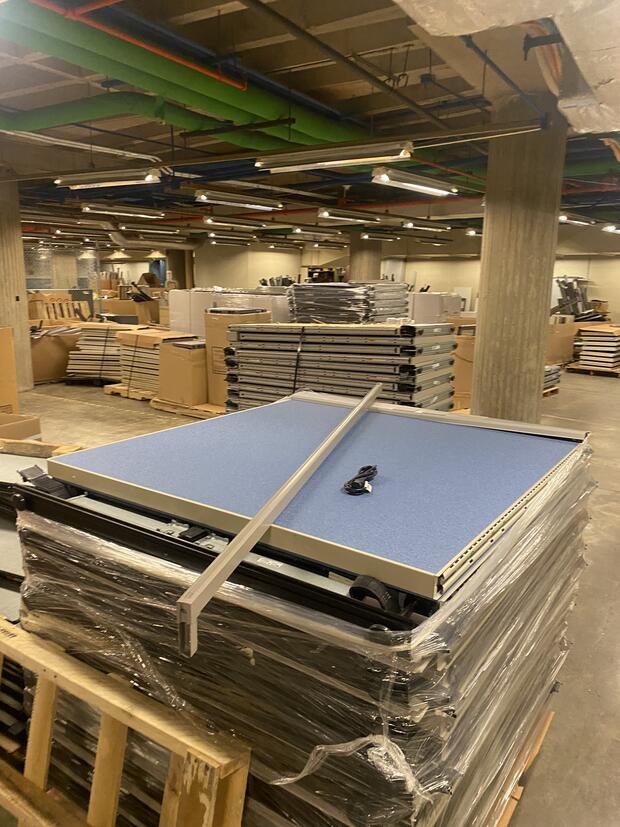
The IPDM team identified thousands of workstations and private office components across state-owned and leased buildings that could be harvested, refabricated, and reused. At an estimated 500 pounds per workstation, this strategy kept more than 841 tons of material out of the landfill, and thousands of linear feet of demountable wall systems that were salvaged and repurposed.
Designing Inclusive, Modern Work Environments
The FoW open-office concept prioritized daylight, ergonomics, and inclusivity. Salvaged workstations were stripped down and rebuilt. Tall, outdated panels were cut to lower heights, allowing natural light to permeate the workspace. Worn or dated panel fabrics were replaced. Reclaimed worksurfaces were converted into height-adjustable desktops. Private office desks and worksurfaces were reconfigured into height-adjustable workstations, and damaged or stained seat cushions were replaced with durable, environmentally preferable materials.
Jane notes, “This approach allowed IPDM to transform older workstations into modern, flexible systems that support unassigned seating and hybrid schedules, without buying new.”
Sustainability at the Core
Although IPDM had embraced furniture reuse, the post-COVID landscape galvanized the unit’s efforts. In addition to reusing 3,364 workstations between 2022 and 2025 and 1,456 linear feet of movable wall systems between 2023 and 2025, the team also developed Fabric and Furniture Selection Guidelines to support sustainable choices and healthy environments.
The guidance provides criteria to choose Basic, Better, and Best fabric and furniture selections, backed by a list of approved certifications/standards. Examples include selecting fabrics and finishes that avoid harmful chemicals; prioritizing textiles and materials with recycled content, biobased components, and solution-dyed fibers; and awareness of important environmental considerations when purchasing furniture, guidance that aligns with the in-depth environmental specifications built into the OFF52 Furniture Statewide Contract.
These Fabric and Furniture standards have been shared with furniture vendors, fabric and furniture manufacturers, and design consultants used by IPDM to ensure their projects reflect desired environmental standards and product quality.
“Our project managers and three Statewide Contract Vendors from the OFF52 Furniture contract, Creative Office Resources, Environments at Work, and W.B. Mason, were extraordinary in this effort,” explains Jane. “Their expertise and guidance helped us downsize agencies responsibly, while supporting new hybrid work arrangements.”
Environmental Payoff
The numbers tell a compelling story of sustainability in action:
System Furniture Reuse (between 2022 and 2025)
Reused 3,364 workstations, avoiding approximately 841 tons of waste from going to landfills
- Effort spanned 56 space-renovation projects across five major state-owned office buildings, along with leased sites
These figures do not include the significant amount of loose furniture reused during this period.
Projected System Furniture Reuse (between 2026 and 2027)
- Expect to reuse 814 workstations, preventing an estimated 203.5 tons of waste from entering landfills
- Projection currently includes seven projects, with additional projects anticipated
- Projected totals exclude the considerable volume of loose furniture expected to be reused
Movable Wall System Reuse (between 2023 and 2025)
- Reused more than 1,456 linear feet of movable wall systems, avoiding an estimated 38 tons of waste going to the landfills
- Effort spanned four major state office buildings
Blueprint for the Future
IPDM’s innovative reuse strategy and environmentally preferable fabric and furniture guidelines did more than save money and prevent waste — it created healthier, brighter, more flexible office environments that support Executive Departments. By transforming thousands of outdated cubicles into modern, ergonomic, environmentally responsible workspaces, IPDM also transformed the future of work to a future of reuse, restoration, and resilience.
