- Executive Office of Energy and Environmental Affairs
- Department of Fish and Game
Media Contact
Julia E. Hopkins, Communications Director
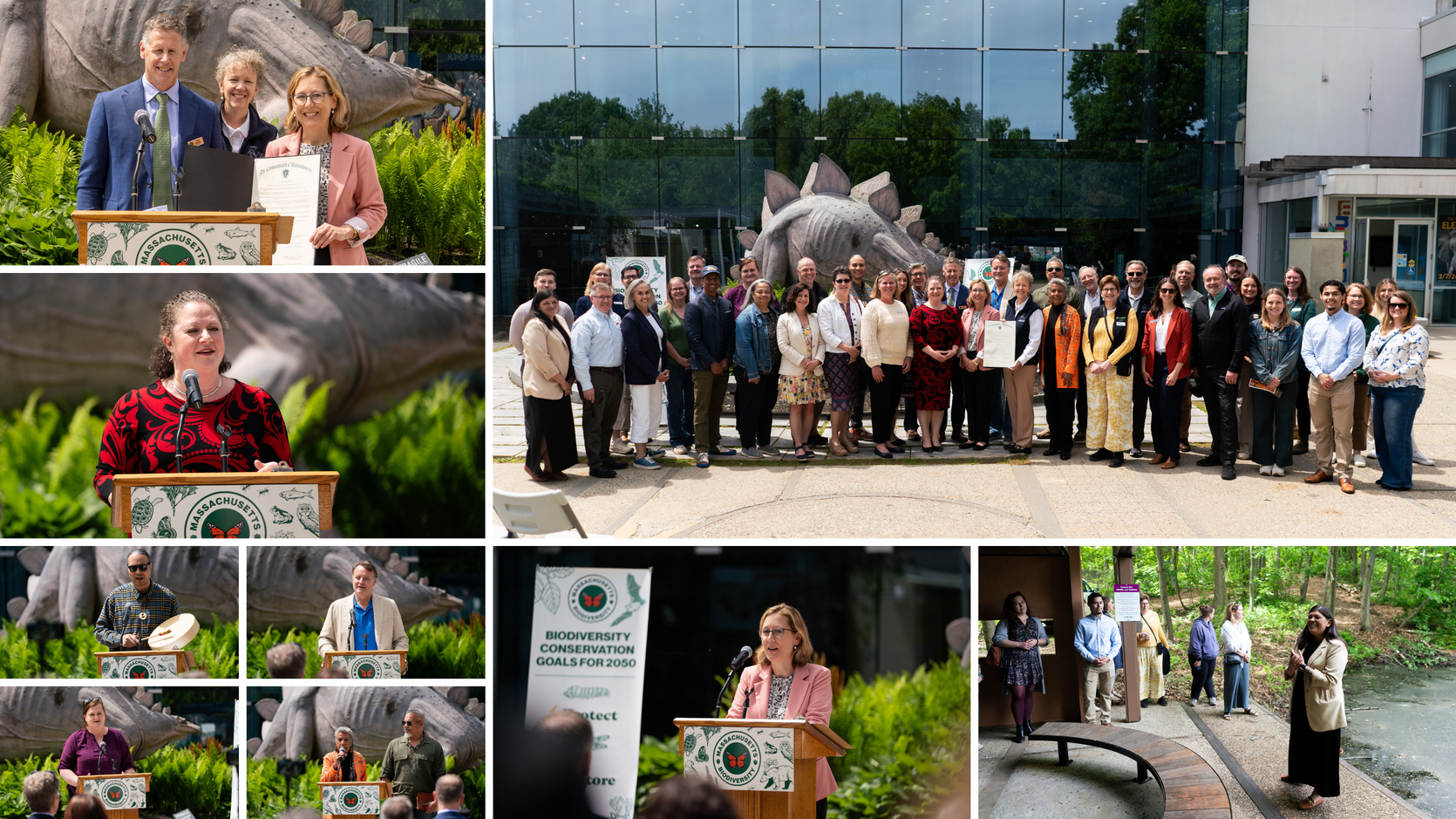
WORCESTER — Today, the Healey-Driscoll Administration joined local leaders, community partners, and the public to declare May 22 as Massachusetts Biodiversity Day. Aligned with International Day for Biological Diversity, this event celebrates our state’s incredible biodiversity, highlights partnership towards the Massachusetts Biodiversity Goals, and encourages all to take action to appreciate and steward nature in their everyday lives.
“Nature is our first line of defense against the impacts of climate change,” said EEA Secretary Rebecca Tepper. “Conserving biodiversity is a priority to make our lands, waters, and cities more resilient to extreme storms, flooding, and heat waves. By supporting local efforts, we make our state as a whole better prepared for what’s to come.”
“We are proud to celebrate the first Massachusetts Biodiversity Day, alongside our many partners and the public, in the heart of Worcester, our state's second largest city, said DFG Commissioner Tom O’Shea. “Each and every one of us has a role to play in conserving our state’s irreplaceable biodiversity! You can take action–right at home, in your backyard, in your neighborhood, in your community. Whether you plant a garden for pollinators, join a community effort to grow local food, clean up a park or local stream, or turn the lights off at night for insects and birds—small actions add up to make a big difference.”
From the Berkshires to Cape Cod, thousands of plants, animals, birds, bees, fish, fungi, and other organisms call our state home. This is biodiversity—all the species, habitats, and complex interactions that make up the astonishing web of life. Biodiversity anchors our history, heritage, and culture, sustains our health and well-being, food security, and economy, and enriches our lives. Despite its critical value, biodiversity is in crisis, both globally and right here in Massachusetts. Over 450 species are listed by the Massachusetts Endangered Species Act (MESA) and hundreds more are at risk.
In 2025, Governor Maura Healey established the Massachusetts Biodiversity Goals, an ambitious, whole-of-government approach to rebuild biodiversity and invest in nature to sustain our health and well-being, food security, economy, and way of life. The plan sets four key goals—Protect, Restore, Sustain, and Connect—each with specific strategies for action for 2030, 2040, and 2050. Because of this leadership, Massachusetts recently became the first state, alongside California, to join the International Union for Conservation of Nature, a global network of more than 1,400 governments and organizations working together to protect biodiversity.
"We all must do our part to preserve local habitat and all the plants and wildlife that call it home and we applaud this historic day that recognizes the importance of biodiversity in the Commonwealth," said David O'Neill, Mass Audubon President & CEO. "We fully support Gov. Healey and MassWildlife for this inaugural Biodiversity Day and will continue to work together to protect the nature of Massachusetts."
“The Healey-Driscoll administration’s declaration of Massachusetts Biodiversity Day demonstrates a commitment to better outcomes for people and nature,” said Steve Long, Director of Policy & Partnerships for the Nature Conservancy in Massachusetts. “We applaud the Commonwealth’s nation-leading Biodiversity Plan which integrates people, nature, and the economy with a clear framework: protect, restore, sustain, and connect. Commissioner O’Shea and the Department of Fish and Game are essential partners in this effort. Their work keeps nature healthy, functioning, and resilient—and protects the biodiversity that defines our natural heritage.”
Hosted by the EcoTarium, this year’s celebration featured local projects, educational activities for visitors, and an honor song by Larry Spotted Crow Mann, founder and director of Ohketeau Cultural Center and citizen of the Hassanamisco Nipmuc Tribe. Additionally, the event highlighted the Administration’s recent investment in twelve local projects to conserve biodiversity through the Massachusetts Department of Fish & Game’s Community Biodiversity Grants program. This program supports municipalities, state agencies, Tribes, non-profit organizations, and academic and cultural institutions to implement community-based projects and build statewide capacity to protect and restore biodiversity and connect people with nature through education and awareness. This is supported by the Healey-Driscoll Administration’s proposed Mass Ready Act, which includes $20 million dedicated to advancing the Massachusetts Biodiversity Goals.
In particular, the event featured two projects in Worcester. With support from the Community Biodiversity Grants program, the EcoTarium Museum of Science and Nature is leading an ecological assessment and biodiversity strategy for the 55-acre museum property, resulting in a plan to improve wildlife habitat and enhance the educational experience for all visitors. This project will create an educational pathway with interpretive signage focused on freshwater and forest habitats and biodiversity in the Museum's Lower Pond and Kalil Pavillion. The EcoTarium offers a number of programs to educate the public and engage in participatory science to support the identification of local species and preserve the important biodiversity found in Massachusetts. The Kalil Pavilion and Lower Pond trail will expand and enhance biodiversity-focused programming at the museum.
“The EcoTarium is grateful for this funding and partnership with Massachusetts Department of Fish & Game to expand our biodiversity programming both inside and outside the museum to help more visitors connect with nature and become lifelong stewards and advocates for conservation,” said the EcoTarium President and CEO Noreen Johnson Smith. “Every person can become more aware of the environment and make small changes in life to help care for the land and waters around us. Outdoor adventures at the biodiversity pavilion and on our trails will offer families opportunities to forge meaningful connections with the wildlife and nature found right here in the city and in their own backyards."
Regional Environmental Council, a non-profit food justice organization based in Worcester, is leading a schoolyard and community garden pollinator habitat initiative. This project will plant more than 40 native perennial species at 15 locations across the city to increase biodiversity, sustain pollinator populations, improve soil health, strengthen urban ecosystem resilience, and connect communities to nature. This will increase beneficial plants by 50%, add 1,500+ square feet of pollinator habitat, and engage at least 300 community members—mostly students from Worcester Public Schools—in hands-on environmental education and stewardship. REC is working with Worcester based farms, Lady Fern Farm and ReWild Habitat Gardens, to source plants hyper-locally and to support garden design and installation. Garden installations have already begun and will continue through the end of the 2026 school year.
“As pollinator populations decline and access to green space remains uneven across the city, the Regional Environmental Council and Worcester Public Schools are launching a citywide effort to bring pollinator habitats directly into schoolyards,” said Regional Environmental Council Associate Executive Director Grace Sliwoski. “We are grateful for the funding to expand 10 existing pollinators and install 5 new gardens, transforming underutilized spaces into thriving habitats for bees, butterflies, and essential pollinators.”
“Adding pollinator spaces to school gardens can help improve the overall health and productivity of the garden, attract diverse wildlife, and help students develop their own sense of environmental stewardship," said Regional Environmental Council School Gardens Coordinator Eliza Lawrence. “There are also many opportunities to connect these spaces with curriculum covered in the classroom where students are learning about ecosystems, weather patterns, and parts of plants.”
The Massachusetts Community Biodiversity Grants program is now accepting applications for an additional round of funding. The program seeks proposals for projects that drive on-the-ground progress towards the Massachusetts Biodiversity Goals and will award grants between $20,000 and $150,000 to support biodiversity conservation and bring nature to every neighborhood. Applications are due by Wednesday, June 24, 2026.
###