- Division of Marine Fisheries
Division of Marine Fisheries (DMF) biologists have dedicated substantial time and effort to studying horseshoe crab populations in Massachusetts waters. This is a species that many in the public have taken a keen interest in and its long-term conservation. DMF is not alone in studying horseshoe crab populations. We work with federal and state biologists along the entire eastern seaboard to assess the status of the stocks. Thanks to the last 25 years of management under the Interstate Fishery Management Plan, the stocks are responding and the increases in abundance are evident. We see it here in Massachusetts in the results of three surveys that we use to monitor the abundance of horseshoe crabs in state waters: the DMF Trawl Survey, the volunteer-based Massachusetts Horseshoe Crab Spawning Survey, and the DMF Seine Survey. All three surveys are showing positive signs, which leads to greater confidence that horseshoe crab populations in the state are indeed increasing!
DMF Trawl Survey
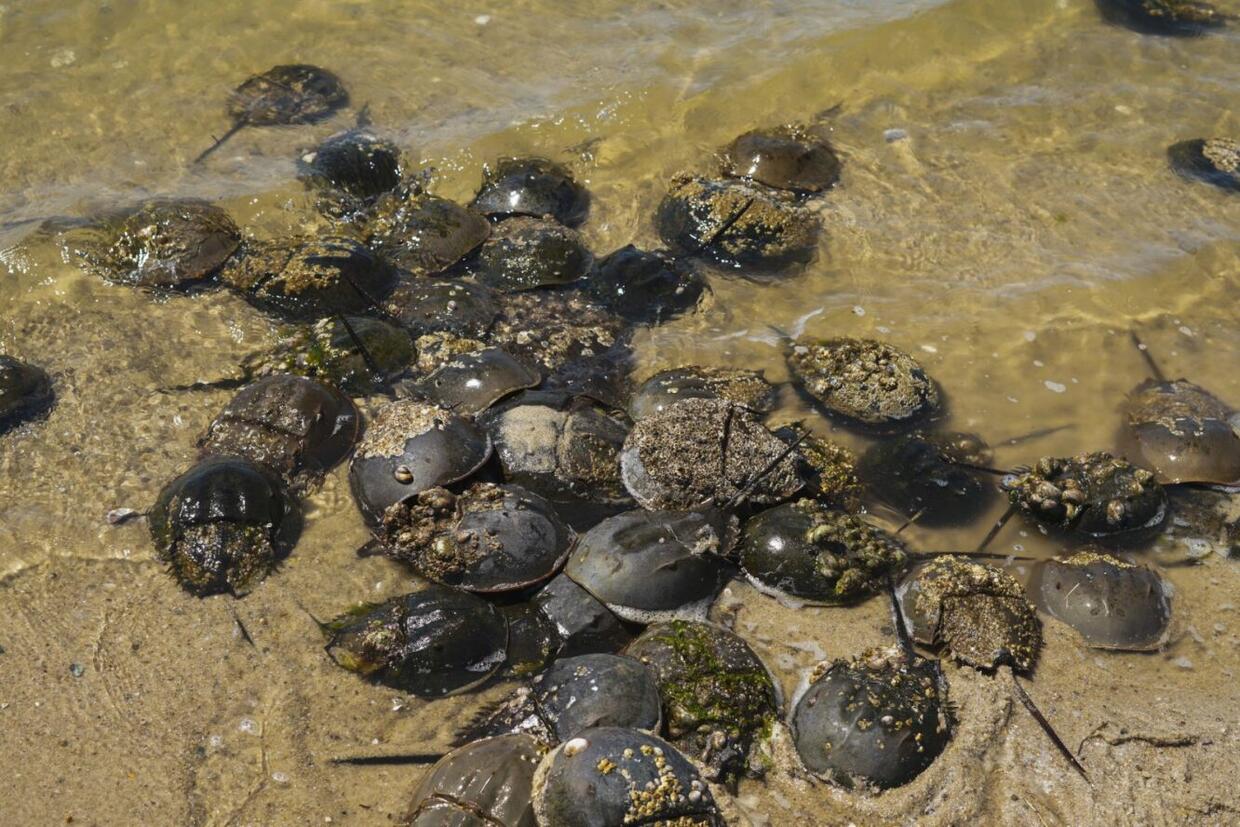
Since 1982, DMF has monitored horseshoe crabs along with many other species in our spring and fall trawl surveys. This twice annual survey uses a 72-foot vessel that drags a net (known as an “otter trawl”) behind the vessel for 20 minutes at each survey station (Figure 1). The net drags along the bottom to capture fish and invertebrates, including horseshoe crabs, that live on or near the sea floor. The survey occurs throughout state waters and follows a scientific design that allows biologists to estimate the relative abundance of each species caught. We use these data to examine how the abundance of each species changes over time.
Declining horseshoe crab abundance trends were observed in this survey until around 2010, but since then, the trend has reversed. Recently, the survey has seen record high numbers of horseshoe crabs. The strongest increasing trends are coming from the region south of Cape Cod. In spring 2025, more female crabs were caught south of Cape Cod than any other point in the survey’s history.
Massachusetts Horseshoe Crab Spawning Beach Survey
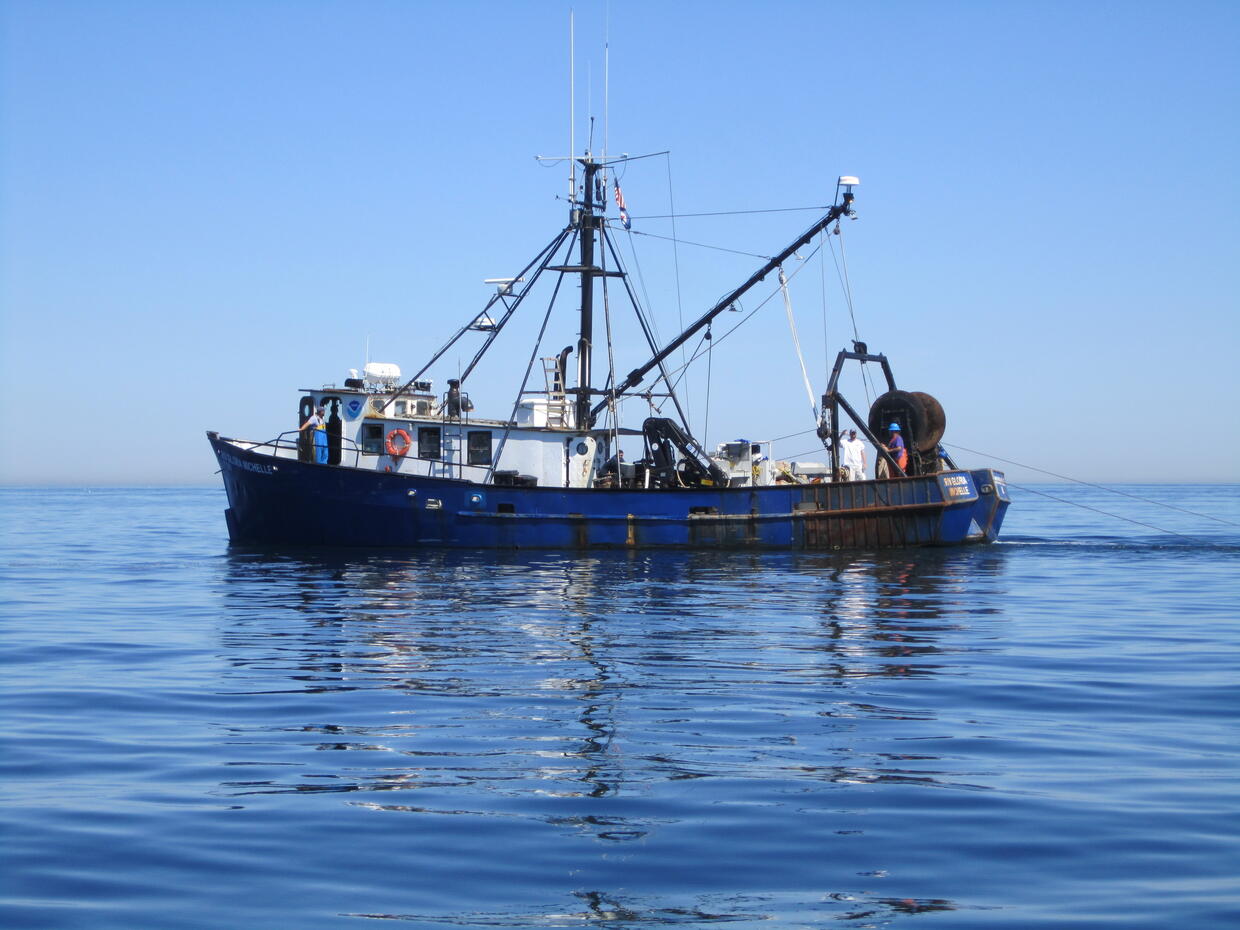
The Massachusetts Horseshoe Crab Spawning Beach Survey relies on partner organizations, including Mass Audubon, North and South Rivers Watershed Association, Southeastern Massachusetts Pine Barrens Alliance, Maria Mitchell Association, Nantucket Conservation Foundation, and many dedicated volunteers. In 2025, over 300 volunteers participated in the survey!
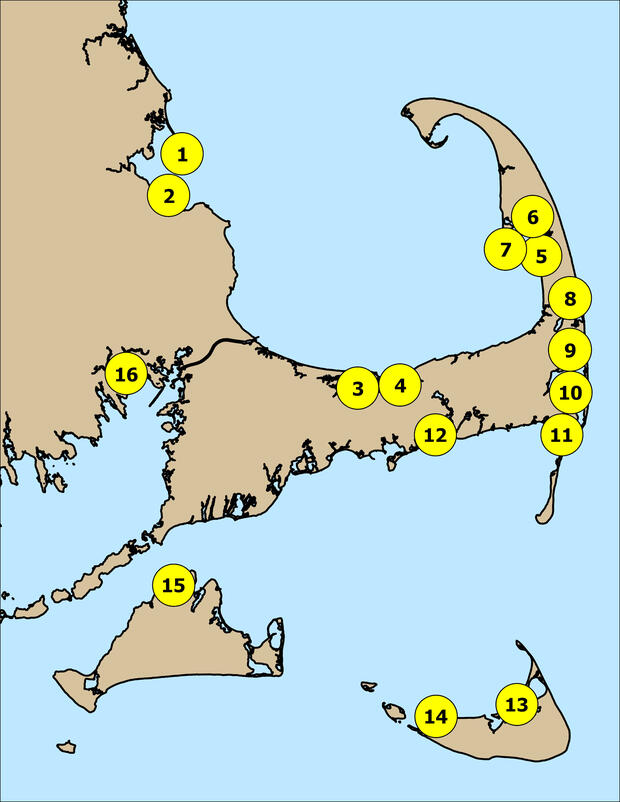
The spawning beach surveys are conducted at high tide two days prior, the day of, and two days after the new and full moons of May and June at 16 different locations, mostly across the Cape and Islands (Figure 2). Day and night surveys are conducted at most locations. Since survey start times are based on the time of high tide, volunteers may be surveying at two in the afternoon, or two in the morning. Those are some dedicated volunteers!
This survey is also showing positive trends. Ninety percent of the surveys conducted show increasing trends over the last 10 years. Several surveys have recently set new record highs for the number of crabs observed at a given beach, such as Stage Harbor in Chatham, where 125 horseshoe crabs were counted in a single 5 x 5-meter survey quadrat this spring. Survey sites in areas with the most commercial horseshoe crab harvest, such as Nantucket Sound and Pleasant Bay, are showing the strongest positive trends.
| Survey Number | Beach | Town |
|---|---|---|
| 1 | Duxbury Beach | Duxbury |
| 2 | Long Beach | Plymouth |
| 3 | Millway | Barnstable |
| 4 | Long Pasture | Barnstable |
| 5 | Sanctuary Beach | Wellfleet |
| 6 | Indian Neck | Wellfleet |
| 7 | Great Island | Wellfleet |
| 8 | Priscilla’s Landing | Orleans |
| 9 | Marsh 2-3 | Orleans |
| 10 | Erica’s Beach | Orleans |
| 11 | Stage Harbor | Chatham |
| 12 | Bass River | Dennis |
| 13 | Monomoy Beach | Nantucket |
| 14 | Warren’s Landing | Nantucket |
| 15 | Tashmoo | Tisbury |
| 16 | Swifts Beach | Wareham |
DMF Seine Survey
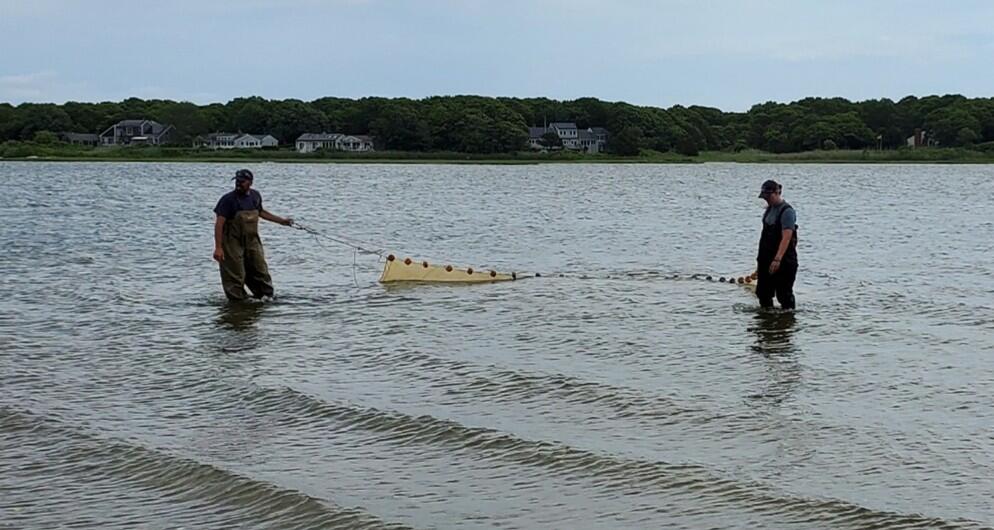
Since 1984, DMF has consistently counted horseshoe crabs through its seine survey. The seine survey takes place in six different bays on the south side of Cape Cod. For this survey, DMF staff use a 21’ wide by 8’ high beach seine (Figure 3).
The number of horseshoe crabs observed in the DMF Seine Survey has been increasing steadily and has been above average for the last 11 years. In 2025, DMF recorded the third highest number of horseshoe crabs in the survey’s 42-year time series, behind only 1988 and 2023.
Response to regulatory actions
In areas with little to no horseshoe crab harvest (e.g., north of Cape Cod), populations are generally stable. The areas showing the strongest positive trends are south of Cape Cod (e.g., Nantucket Sound, Pleasant Bay) and are also where nearly all the commercial horseshoe crab harvest in Massachusetts occurs. These positive trends are likely the result of stronger regulatory protections provided to spawning horseshoe crabs.
In 2010, Massachusetts adopted lunar closures, which prohibited horseshoe crab harvest for five-day periods around the new and full moons from late April through June. To provide even more protection for spawning crabs, in 2024, DMF strengthened protections by instead enacting a spawning closure from April 15 through June 7, which prohibits harvest during about 90% of the spawning season. Similar to the lunar closures, the intent of the spawning closure is to boost horseshoe crab populations by allowing more crabs to deposit eggs in the sand without fishing pressure.
Because horseshoe crabs take nine to eleven years to reach sexual maturity, we have yet to document the full benefits of this most recent action to protect spawning crabs. It takes about a decade for increased egg production to result in more adults on spawning beaches. So, while we are likely already seeing the results of the lunar closures that were enacted in 2010 in our surveys, we won’t see the full positive impact of the 2024 spawning closure for several more years. However, we are confident the population will continue to increase based on the success of the lunar closures.
What the experts are saying
There are two groups of scientists that assess horseshoe crab populations: the Atlantic States Marine Fisheries Commission’s (ASMFC) Horseshoe Crab Stock Assessment Committee and the International Union for the Conservation of Nature’s (IUCN) Horseshoe Crab Specialist Group. The ASMFC Stock Assessment Committee is made up of state, federal, and academic horseshoe crab biologists and statisticians. They analyze data sets from along the Atlantic Coast and provide a report on the status of Atlantic horseshoe crab populations roughly every five years. These reports are reviewed by all state and federal horseshoe crab specialists on the U.S Atlantic Coast. The IUCN Specialist Group also provides reports on the status of horseshoe crabs, often using the same data sets used in the ASMFC horseshoe crab stock assessments. The IUCN reports are written by academic and federal horseshoe crab biologists.
Earlier reports from the IUCN and ASMFC reported horseshoe crab populations were generally declining, but that has now changed. The most recent report from the IUCN, published in 2025, affirms that horseshoe crab populations are recovering, largely due to management actions to protect this important species. The IUCN report specifically notes that horseshoe crab abundance in the northeast region, which includes Massachusetts, has been increasing. The last two ASMFC horseshoe crab stock assessments, conducted in 2019 (PDF) and 2024 (PDF), have agreed that horseshoe crab abundance in Massachusetts is increasing.
The evidence is clear; positive changes are happening for Massachusetts horseshoe crab populations. DMF is dedicated to continued population monitoring, scientific study, and conservation of this unique species.
By Derek Perry, Senior Marine Fisheries Biologist & Dr. Tracy Pugh, Invertebrate Fisheries Program Manager