- Division of Marine Fisheries
North Atlantic right whales have been known to aggregate in high numbers in Cape Cod Bay in the early spring for centuries. An annual occurrence that once prompted whaling efforts now attracts researchers aiming to better understand this critically endangered species, currently numbering around 380 individuals. While research and conservation measures have often focused on Cape Cod Bay during this time of year, acoustic monitoring tools along with the expansion of visual survey effort in time and space have provided a new perspective on Massachusetts waters for the 2025/2026 season.
Near real-time acoustic monitoring
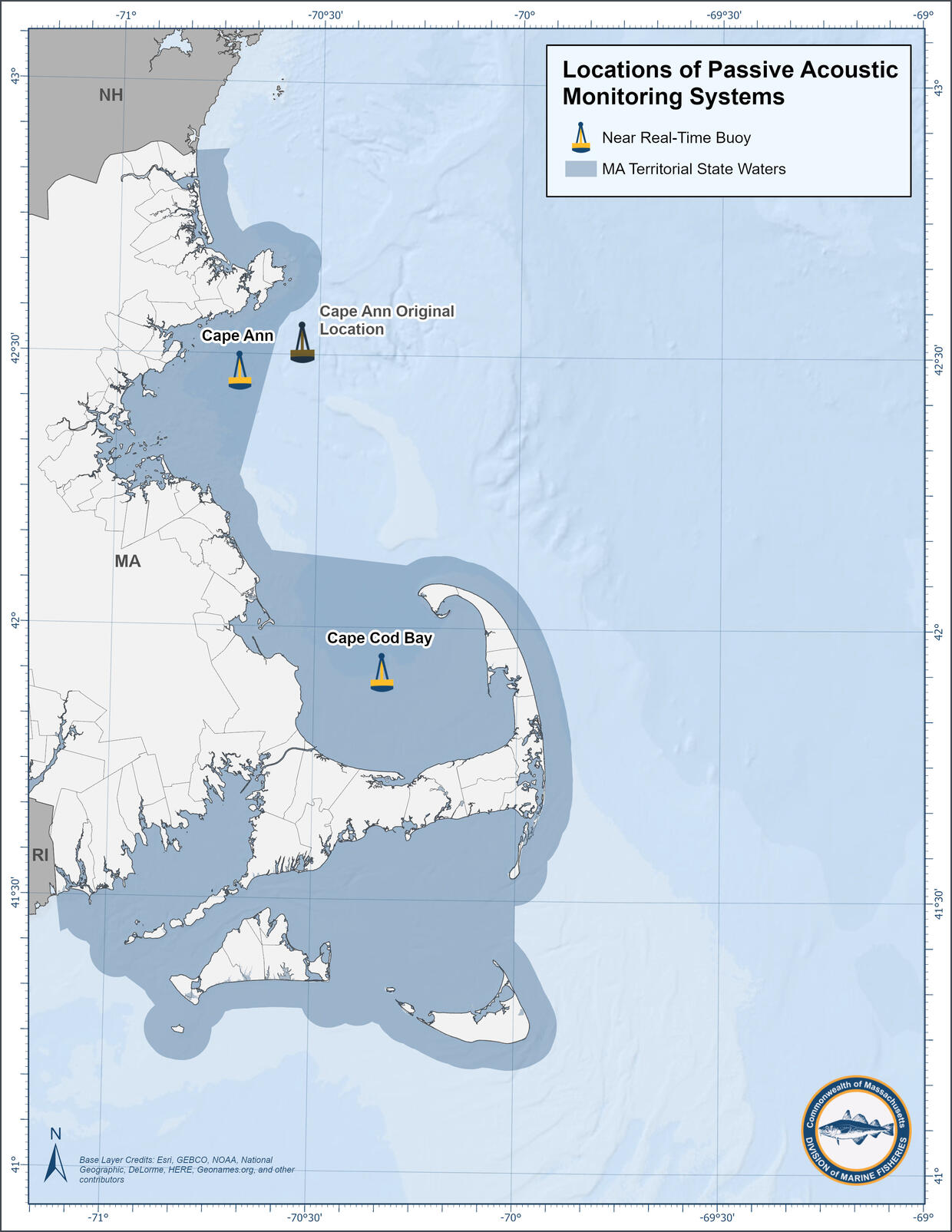
In late February 2025, the Massachusetts Division of Marine Fisheries (DMF) in collaboration with the Woods Hole Oceanographic Institution launched two near real-time acoustic monitoring systems: one in Cape Cod Bay and one southeast of Cape Ann (Fig. 1, see previous article). In August 2025, DMF opted to relocate the northern system into state waters just outside Salem Sound directly south of Cape Ann. The 2025/2026 right whale season was the first to have this near real-time acoustic monitoring platform active between autumn and the following spring; however, the Cape Cod Bay buoy system was briefly offline from the beginning of February to mid-March 2026.
Visual survey
DMF again partnered with the Center for Coastal Studies (CCS) to conduct aerial surveys in Massachusetts waters during the 2025/2026 season. Throughout our almost 30-year collaboration, much of the survey effort has occurred in Cape Cod Bay between January and May. In the last few years, however, we have expanded survey effort north while also conducting a few surveys each month in November and December. This past season, the first aerial survey occurred on November 3, 2025, and overall, survey effort occurred on 39 days including 23 days in Cape Cod Bay, 15 days in Massachusetts Bay, six days on the Eastern Outer Shore, and one day each on Wilkinson Basin, Jeffreys Ledge, and East of Cashes Ledge.
Right whale detections 2025/2026
Sightings of right whales in Massachusetts Bay or Cape Cod Bay in the summer are not very common, and after last season’s end in May 2025, right whales were not detected again in the area until autumn. On September 28, 2025, there was an acoustic call that was possibly from a right whale, and then on October 26, 2025, the first right whale sighting was reported from Race Point Beach by a member of the public. The CCS aerial surveys first sighted right whales in Massachusetts Bay on November 19, 2025, and in Cape Cod Bay on November 24, 2025. The near real-time acoustic monitoring system in Cape Cod Bay started detecting right whales more consistently at the end of November whereas the first possible right whale detection at the Cape Ann monitoring system occurred on December 22, 2025.
There are records of right whales north of Cape Cod in the autumn and early winter going back to at least the early 1600s. While not an unusual occurrence per se, the first right whale sighted in Massachusetts Bay this season was an individual with an unusual and sparse sighting history. Having only been previously sighted in July 2024 in Donegal Bay, Ireland, right whale #5499 was sighted November 19, 2025, amongst humpback whales on the Northeast Corner of Stellwagen Bank. As the season continued to unfold in Cape Cod Bay, 14 individuals were sighted in December followed by a January where 39 were sighted, including 33 individuals sighted on January 10, 2025, which is the most the survey has ever sighted on a single day in January. Similarly, right whales were positively detected on the Cape Cod Bay near real-time acoustic monitoring system on 75% of days in December and all days in January.
As the season continued in Cape Cod Bay, 57 individuals were sighted in February and 83 were sighted in March; during this time, the near real-time acoustic monitoring system was down. As it turned out, March was the busiest month of the season in Cape Cod Bay. In April, only 40 right whales were sighted and were acoustically detected on around 75% of the days within the month, a deviation from the high numbers usually observed in April. Many right whales were instead observed north of Cape Cod Bay in April, including in Massachusetts Bay (49 individuals), and also on Jeffreys Ledge and offshore of Massachusetts north of Cape Ann (14 individuals). The final right whale acoustic detections of the season occurred on May 1 and May 4 on the Cape Ann and Cape Cod Bay near real-time acoustic systems, respectively, whereas the last visual sighting in Massachusetts coastal waters was on May 7 north of Cape Ann.
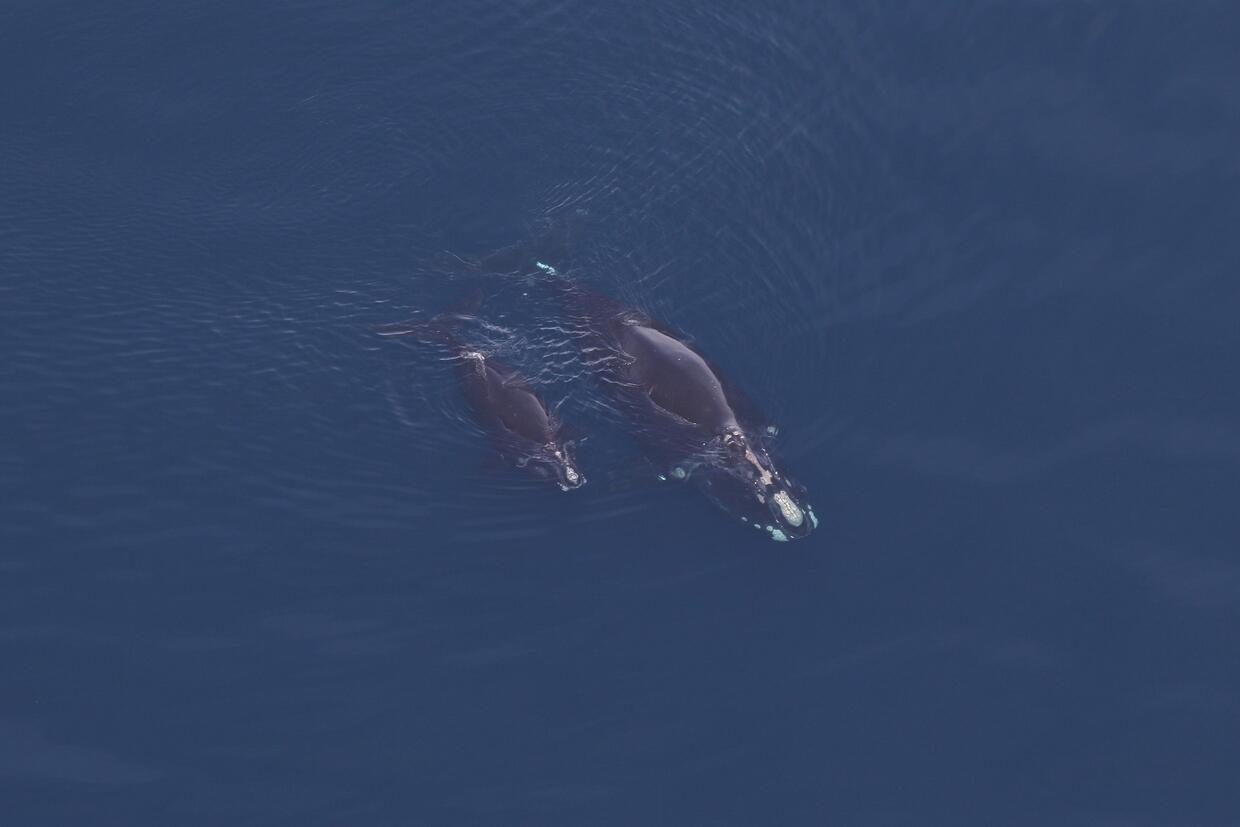
Overall, right whales were detected in coastal Massachusetts waters between autumn 2025 and early May 2026. During the 2025/2026 season, the Center for Coastal Studies aerial survey team sighted and identified 188 North Atlantic right whale individuals, including 17 mother/calf pairs (see Fig. 2 for a photograph of one of these pairs), in Cape Cod Bay (155 individuals), in Massachusetts Bay (63 individuals), and north of Cape Ann including on Jeffreys Ledge (16 individuals). Visual and acoustic detections in coastal Massachusetts prompted the initiation of eight separate federal Slow Zones as these detections occurred in time and/or space when federal vessel speed zones were not active. In state waters, MA state fishing closures were lifted dynamically for the season on May 9 in response to the lack of detections around that time (refer to advisory).
At this point, it is challenging to surmise whether patterns observed this season are a sign of future trends, a result of specific environmental conditions occurring this year, or even a reflection of habitat use in the past that we were not able to observe. The aerial survey will begin again in autumn 2026 to search for right whales in our coastal waters. Until then, the near real-time systems, along with our archival acoustic monitoring project , are listening and recording sound continuously year-round to provide greater insight into right whale occurrence.
By Leah Crowe, PhD (Science & Monitoring Lead, Protected Species)