- Division of Marine Fisheries
The Massachusetts Division of Marine Fisheries (DMF) was proud to be one of several partners to aid the Massachusetts Shellfish Officers Association (MSOA) in offering the first ever hybrid Shellfish Officers Training Course during the 2026 spring semester. Massachusetts is a “home rule” state, meaning that under state law, each coastal municipality is granted authority to govern certain shellfish within its jurisdictional waters by appointing a shellfish constable responsible for permitting, propagation, enforcement, and maintaining healthy coastal ecosystems. These roles vary widely—from small towns with limited resources to major shellfishing hubs like Wellfleet, Barnstable, Chatham, and Ipswich—making standardized training of shellfish constables both essential and challenging.
For decades, the mandatory training was accomplished through an intensive two-week, in-person course held at Massachusetts Maritime Academy. Many described the 80 hours of lectures as “PowerPoint purgatory,” though it reliably certified 20–30 constables every few years. The COVID-19 pandemic forced the course online in 2022, shifting to three weeks of daily virtual sessions. While more accessible, the rigid schedule still posed challenges for constables juggling multiple responsibilities.
Recognizing the need for modernization, the MSOA Board of Directors with assistance from DMF and the Massachusetts Environmental Police (MEP), began rethinking the course’s future. Feedback from seasoned and newly appointed constables made clear that a hybrid model with flexibility, self-paced learning, and continued opportunities for professional growth was the preferred path forward. To bring this vision to life, MSOA partnered with Cape Cod Cooperative Extension (CCCE), Woods Hole Oceanographic Institution (WHOI) Sea Grant, and Cape Cod Community College (CCCC), whose expanding workforce training programs were a natural fit.
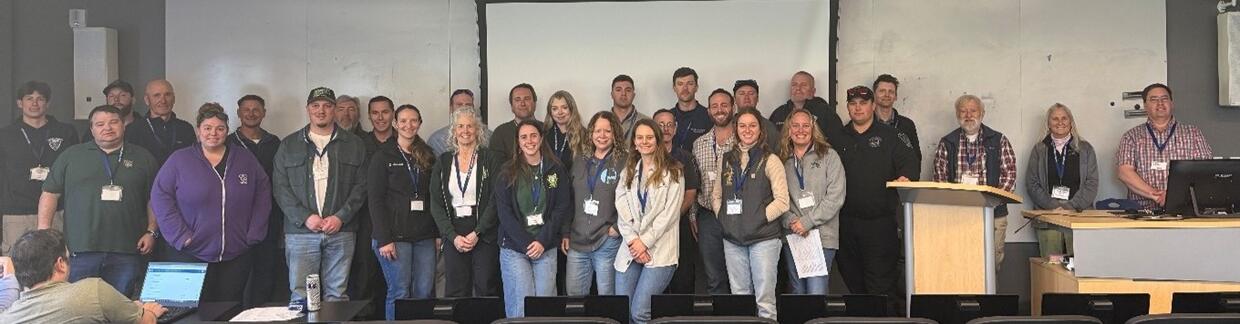
Beginning in 2024, representatives from MSOA, DMF, MEP, CCCE, and CCCC met regularly to design a fully restructured course, specifically a 14-week, semester-length, hybrid class that preserved the value of in-person learning while maximizing flexibility. This new format included three mandatory in-person sessions: an opening orientation, a law enforcement focused midpoint, and a final presentation day. Weekly online modules covered topics such as restoration, aquaculture, permitting, and harmful algal blooms. Students engaged through discussion boards and optional office hours with subject-matter experts, helping build a cohort experience despite the hybrid structure.
The inaugural hybrid MSOA Constable Class launched in January 2026 with 42 students. The first in-person day included shellfish biology and harmful algal bloom lessons, dissections, and an introduction to the course layout. Online modules and discussion boards for weeks 2 through 8 covered agency overviews, aquaculture, water quality, lab analysis, shellfish restoration, finfish and other marine invertebrates. Week 9 was the second in-person day where students received numerous presentations from environmental police officers ranging from report writing to search and seizure as well as a presentation from the Massachusetts Department of Public Health (DPH) on Hazard Analysis Critical Control Point protocols and food safety. Weeks 10-14 included more online modules and discussions covering response agencies, policy updates, habitat changes, recreational fishing and propagation, and real-world experiences from veteran constables. The final in-person day was held on May 1 where students were asked to deliver a 5-minute presentation on a topic of their choosing from the prior weeks, and their fellow students were asked to list important takeaways from each presentation.
Students were surveyed at the end of the 14-week training course, and they all stated they learned something new, gained information that they will bring back to their work within the next year, and appreciated the flexible format of the class. Cape Cod Community College plans to offer the training course again during the spring 2027 semester. For additional information or to register for the 2027 spring semester training course, please reach out to MSOA or Cape Cod Community College.
More than 20 DMF staff members contributed 23 presentations for this course, as well as 12 from MSOA members, eight from MEP, six from CCCE/WHOI Sea Grant, two from DPH, two from MA Department of Environmental Protection, two from industry, one from MA Coastal Zone Management, one from the International Fund for Animal Welfare, and one from the US Food and Drug Administration. It took a team of people across multiple disciplines and agencies to develop the 2026 MSOA Constable Training Course, demonstrating that cooperation indeed leads to collaboration and ultimately, success. This was one of the most important takeaways for Shellfish Constables to learn as they return to their municipalities and their roles in protecting the shellfish resources in their town.
By Matt Camisa, Regional Shellfish Supervisor, and Rachel Hutchinson, Cape Cod Cooperative Extension