
Overview
Due to the spread of aquatic invasive species throughout the state, DCR has a Boat Ramp Monitor Program. The goals of the program are to:
- Prevent pristine water bodies from becoming infested.
- Reduce further spread of invasive species from infested areas.
- Educate boaters about invasive species and the steps they can take to protect our lakes and ponds.
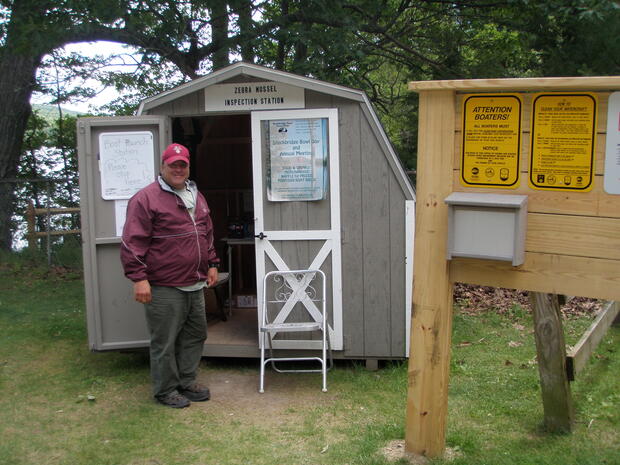
Boat ramp monitors have been placed at both infested and un-infested lakes and ponds statewide. Their goal is to inspect every boat entering or leaving to make sure that no plant fragments are attached the boat, trailer or gear. Boaters are given an informational brochure, asked to participate in a voluntary boat inspection and complete a brief survey. Boat ramp monitors are the first (and potentially best) line of defense to prevent the spread of aquatic invasive species. Education and awareness can prevent the spread of aquatic invasive species before it happens.
Boat ramp monitor programs are becoming more common throughout the United States and are also available in nearby northeastern states.
What to expect when you meet a boat ramp monitor
Upon arriving at a boat ramp, the monitor will greet you and inquire if you’re willing to participate in a boat inspection to ensure that you are not transporting aquatic plant or organism material on your equipment that could infest the waterbody you are about to enter. If material is found, it will be removed and disposed of properly. The boat ramp monitor will ask you the survey questions, which are focused on the purpose of your visit to the waterbody, where your boat was used last, if it was properly decontaminated after its last use, and if it has been recently inspected. All data collected is completely anonymous and used to understand how aquatic invasive species are spreading around Massachusetts and neighboring states.
Interested in starting a boat ramp monitoring program?
DCR’s survey, which is completed on a tablet through the Survey123 platform, is now available for use by lake associations, municipalities or other applicable groups! By allowing other groups to utilize the same survey, data can be collected on a statewide scale for future analysis and better understanding of how aquatic invasive species are being spread throughout the Commonwealth. If you are interested in using this survey, please contact Program staff at dcr.lakesandponds@mass.gov. DCR staff will provide further details on the participation requirements and will supply the informational brochures to be handed out to boaters.
Basic boat ramp monitor guidelines
- Always present yourself professionally, be friendly, and wear logo clothing if possible. You should be stationed as close to the boat launch as possible. If there is no structure in place, we recommend bringing a chair and shade tent (E-Z UP or similar) to stay out of the weather and to look professional. Make sure to approach every boater over the course of your shift. This includes canoers and kayakers.
- Introduce yourself as the boat ramp monitor and present a summary of your job and the topic of aquatic invasive species.
- Ask the boater if they are willing to participate in a survey and inspection. Our past data shows greater than 98% participation.
- Survey the boaters using an iPad or other tablet equipped with Survey123 software. The exact survey DCR utilizes is available for use upon request.
- Visually inspect the boat, trailer, and vehicle to identify any evidence of aquatic invasive species (plants, mussels, mud, or anything else that would indicate contamination).
- Check that all drain plugs are pulled and there is no standing water in the boat. If you can’t tell, ask the boater if their live well, bilge, ballast, and cooling systems are empty and dry. Take this opportunity to explain proper decontamination techniques and hand out the informational brochure.
- If the boat appears to be contaminated with visual evidence or if the boater’s answers indicate they’ve been in infested waters and have not decontaminated appropriately, explain to them that it is illegal for them to launch their vessel (MGL C. 21 S. 37 B and 302 CMR 18).
- If the boater refuses the program or launches in violation, you should call the local Harbormaster or Environmental Police at 1-800-632-8075. Do not physically stop a boater or ever put yourself in a confrontational situation.
- After completing your survey and inspection, thank the boater for their time and give them educational materials (brochures, key float, etc.).