

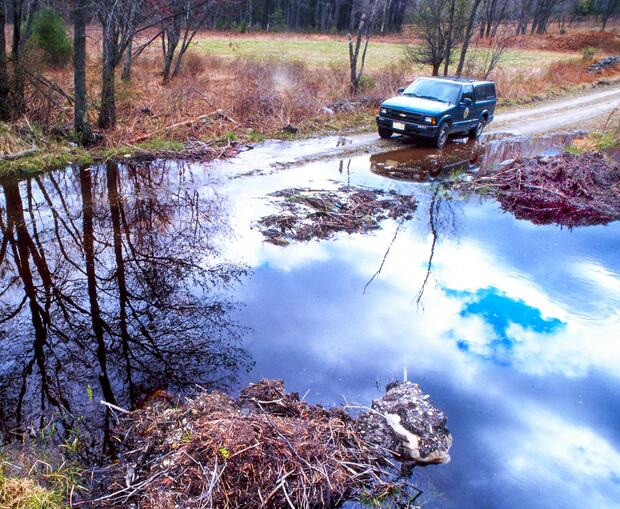
City and town Boards of Health (BOH) are statutorily responsible for assessing complaints regarding beaver-caused property damage and determining whether the situation constitutes a threat to public health and/or safety (MGL ch.131, s.80A).
Individuals experiencing property damage, including but not limited to the flooding of homes, basements, wells, septic systems, driveways, roads, and agricultural land, may be eligible for emergency permits to help mitigate the issue. These permits allow for trapping beaver, breaching beaver dams, and installation of water-level control devices. Emergency permits are issued by municipal BOH and Conservation Commissions (ConCom). Vegetation damage alone does not qualify a person for an emergency permit. Learn how to protect your trees and shrubs from beaver damage.
How to apply for emergency permits
If you are experiencing flooding caused by beaver dams, contact your municipal BOH and ConCom to apply for a 10-day Emergency Permit. If the BOH determines that the beaver flooding constitutes a human health and safety threat, they are required to issue an emergency permit. The BOH Emergency Permit allows for the trapping of beaver and the use of restricted traps that are otherwise illegal. If you want to breach a beaver dam, you need an additional permit issued by the municipal ConCom. You must obtain the BOH Emergency Permit for the ConCom to permit the breaching of the dam. Emergency permits are valid for 10 days, so it is recommended to contact the BOH and ConCom concurrently so the necessary permits can be issued at the same time.
With an emergency permit, any licensed trapper, including Problem Animal Control agents, can be hired to trap beaver to help resolve your problem. Contact your BOH or local MassWildlife office if you need help finding a trapper. In addition to trapping, the beaver dam may be breached to alleviate flooding. The ConCom will set conditions as to how the dam can be breached. It is not recommended to breach beaver dams without trapping the beaver, otherwise the beaver will immediately rebuild the dam. Repeated breaching of the dam can cause damage to the wetland and harm species that live there.
If your application for an emergency permit is denied by the BOH because they determined that the problem does not constitute a threat to human health and safety, you can appeal the decision by contacting the Department of Public Health at (617) 624-5757 within 10 days of the BOH denial. If the BOH denied your permit because they determined the problem is not caused by beaver activity, you can appeal the decision by contacting your local MassWildlife office within 10 days of the BOH denial.
Water-level control devices or beaver deceivers
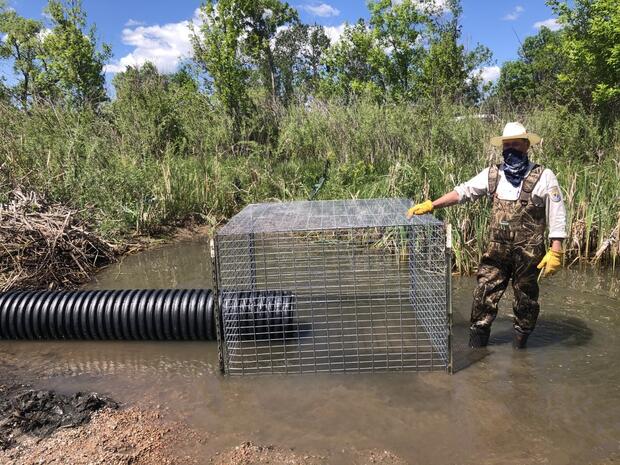
In some situations, the presence of beaver can be tolerated and dam building and flooding can be mitigated with the installation of a non-lethal water-level control device, also known as a beaver deceiver. These devices, consisting of piping and fencing installed in a breach in the dam, help to maintain water flow through the dam and keep an acceptable water level. A BOH Emergency Permit and permits from the ConCom are required to install a water-level control device. Water-level control devices do not work in all situations. The configuration of the wetland or stream system, local topography, and other factors can determine if a flow device will prevent flooding.
If the beaver flooding situation cannot be resolved in 10 days, you can apply to the BOH for a 10-day Extension Permit. The BOH can issue up to two Extension Permits. When applying for an Extension Permit, you should also contact your local MassWildlife office about obtaining a 30-day Extension Permit and development of a long-term management plan.
Who is responsible for solving problems associated with beaver flooding?
The property owner incurring the damage is responsible for obtaining the necessary permits and paying for services required to resolve the beaver flooding issues. If the beaver dam is located on a neighboring property, it is still the responsibility of the property owner incurring the damage to address the problem. The owner of the neighboring property where the dam is located is only responsible for granting access to their property so that the situation may be resolved.
Permits issued by the BOH, ConCom, and MassWildlife do not allow permittee(s) or their authorized agent to trespass on private property. If beavers or dams are not located on your property, you must obtain the property owner’s permission to access their land.
Contact your local MassWildlife office
First contact your local BOH if you are experiencing property damage from beavers. Call your local MassWildlife office if you need a 30-day Extension Permit, if you need help finding a licensed trapper, or if the BOH denied your emergency permit application because they determined the problem is not caused by beaver activity.
- Western District, Dalton (413) 684-1646
- Connecticut Valley District, Belchertown (413) 323-7632
- Central District, West Boylston (508) 835-3607
- Northeast District, Ayer (978) 772-2145
- Southeast District, Bourne (508) 759-3406
- Field Headquarters, Westborough (508) 389-6300