
Project Details
Project Title
Wellington Park and Mill Brook Corridor
Municipality or Organization
Town or Arlington
MVP Region
Greater Boston
Award Year
FY2018
Grant Award
$399,490
Project Overview
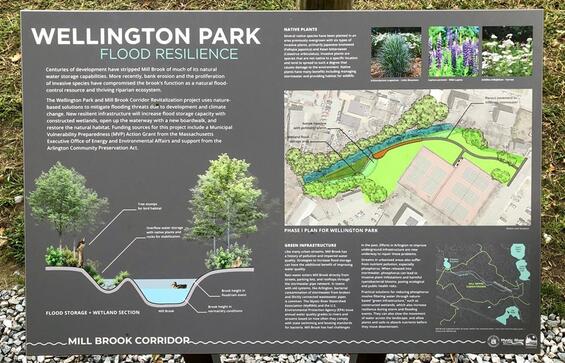
The Town of Arlington partnered with the Mystic River Watershed Association to implement a green infrastructure demonstration project along Mill Brook at Wellington Park. The project addresses recurring flooding, improves ecological conditions, and creates new opportunities for residents to access and enjoy the brook.
Building on an existing Community Preservation Act-funded initiative to establish a linear park along Mill Brook, the project incorporates flood storage, native plantings, invasive species removal, and accessible pedestrian infrastructure. These improvements demonstrate how communities can integrate climate resilience into public open spaces while providing environmental and recreational benefits.
Educational signage at the park.
The Challenge
Arlington is located approximately six miles northwest of Boston and lies primarily within the Mystic River watershed. The town faces several climate-related hazards, including extreme heat, heavy rainfall, flooding, drought, and severe storms. Mill Brook has experienced recurring flooding, particularly near Wellington Park. The large amount of impervious surface in the surrounding drainage area contributes to stormwater runoff, increasing flood risks for nearby homes, apartment buildings, businesses, and public spaces. Before the project, Wellington Park also had limited access to the brook. A chain-link fence and dense stands of invasive Japanese knotweed restricted visibility and public enjoyment of the waterway. Arlington identified the Mill Brook corridor as an opportunity to address these challenges through nature-based solutions that reduce flood impacts while improving the surrounding environment.
Project Goals
The project was designed to advance three primary goals:
- Increase climate resilience. Implement recommendations from Arlington's Municipal Vulnerability Preparedness Community Resilience Building Workshop to reduce vulnerability to climate change.
- Demonstrate green infrastructure. Develop a project along Mill Brook that increases flood storage, reduces downstream flooding, and educates residents about sustainable stormwater management.
- Improve public access and ecological health. Expand an existing linear park initiative by creating accessible pedestrian connections, removing invasive species, and restoring native vegetation along the brook.
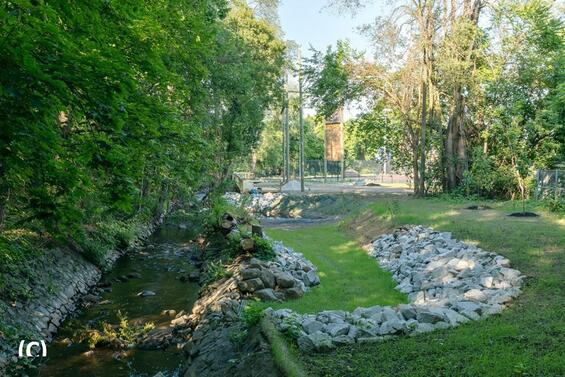
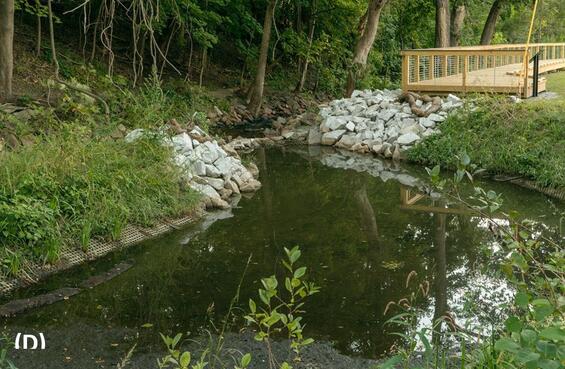
Overflow channel designed to capture stormwater (C & D), thereby reducing downstream flooding.
The Solution
The Town of Arlington, Mystic River Watershed Association, and engineering consultant Weston & Sampson collaborated to develop a project that integrates flood mitigation with ecological restoration and recreational improvements. The project introduced an overflow channel to create additional flood storage along Mill Brook. This green infrastructure feature helps manage stormwater while providing a visible demonstration of climate adaptation strategies that residents can apply to their own properties.
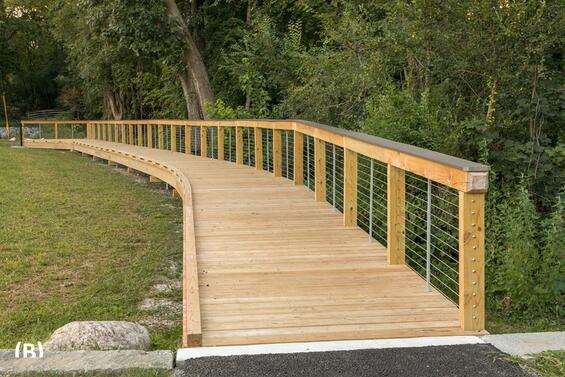
Additional improvements included a porous asphalt pathway that transitions into an elevated, ADA-compliant boardwalk. The new pedestrian infrastructure brings park visitors closer to Mill Brook and improves access to an area that was previously underutilized.
The project also removed invasive Japanese knotweed and deteriorating fencing along the brook. Native shrubs and herbaceous plants were installed to improve the ecological condition and appearance of the corridor.
Educational signs were added to help visitors understand the project's environmental and climate resilience benefits.
Results and Benefits
The project delivered measurable improvements to Wellington Park and the Mill Brook corridor:
- 70 cubic yards of additional flood storage
- 7,000+ square feet of invasive Japanese knotweed removed
- 250+ linear feet of deteriorating chain-link fence removed
- 400+ native plants including shrubs and herbaceous species installed.
Additional project outcomes included:
- Construction of a porous asphalt pedestrian pathway.
- Installation of an elevated, ADA-compliant boardwalk.
- Installation of three educational signs, including one highlighting climate resilience features.
- Improved visibility of and public access to Mill Brook.
- Ecological enhancements that support a more natural and welcoming park environment.
Together, these improvements demonstrate how green infrastructure can provide multiple community benefits, including stormwater management, habitat restoration, recreation, and environmental education.
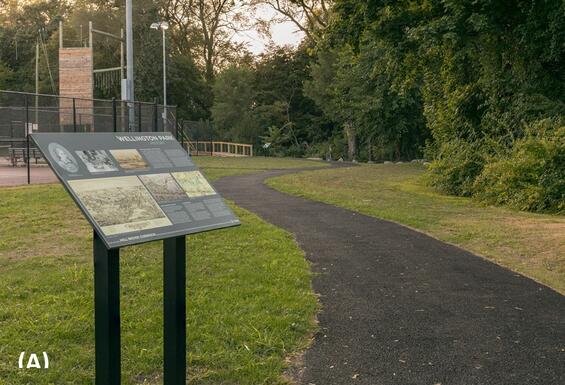
Porous asphalt pathway (A) with educational sign leading to elevated boardwalk (B), which increases and improves access to Wellington Park and to Mill Brook.
Lessons Learned
The Mill Brook Corridor project highlighted several considerations for municipalities implementing climate resilience projects.
Establish measurable performance goals early
Defining metrics during the grant application and initial project planning process is essential for evaluating success. Although the additional flood storage is expected to provide some reduction in downstream flooding, the project did not include monitoring gauges or equipment to measure its precise effectiveness.
Maintain communication with grant administrators
Construction projects often operate under tight grant timelines. Regular communication with the Executive Office of Energy and Environmental Affairs helped the project team address unexpected issues and maintain progress.
Ensure active municipal project management
The Town of Arlington played a central role in coordinating the project architect, contractor, budget, and grant requirements. Active oversight helped the project team manage simultaneous activities, resolve challenges, and meet project deadlines.
Project Partners
The project was made possible through collaboration among municipal staff, nonprofit partners, design professionals, and contractors.
- Town of Arlington served as the project manager and property owner, overseeing project decisions, budget tracking, contractor coordination, and communication with grant administrators.
- Mystic River Watershed Association (MyRWA) served as project co-manager and built on earlier community outreach and planning for a linear park along Mill Brook. MyRWA helped expand the initiative to incorporate climate resilience and recreational improvements.
- Weston & Sampson provided feasibility assessment, project design, permitting assistance, and construction administration. The firm's earlier work on the Mill Brook corridor helped establish the foundation for the MVP-funded improvements.
- RAE Contracting constructed the project improvements, completing construction activities in less than two months.