
Project Details
Project Title
Horseshoe Pond Acquisition Project
Municipality
Berlin
MVP Region
Central
Award Year
FY2023
Grant Award
$874,268
Project Length
One Year
Community Overview
- Berlin is a town in Worcester County, Massachusetts, United States. The population was 3,158 at the 2020 census.
- Berlin is nestled in the low range hills between the Nashua River and Assabet River valleys.
- Due to Berlin’s proximity to I-495 and I-290, the town faces significant development pressure. According to data gathered by the Central Massachusetts Regional Planning Commission, Berlin’s population increased more than 32.5% from 2000 to 2020 and is projected to increase another 18% by 2040.
- While Berlin does not contain any designated Environmental Justice (EJ) areas, the population skews older than the average Massachusetts community, with 27% of its population age 65 and over. Thirteen percent of seniors in town are considered to be below the poverty level.
Project Description and Goals
- Where was the project located?
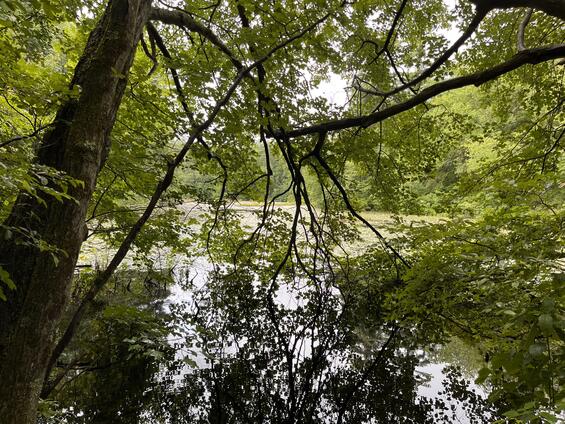
- The Horseshoe Pond Acquisition Project included the purchase of three properties, 19 Lyman Road, 0 Lyman Road, and 0 Linden Street, for the purposes of habitat conservation, climate resilience, and passive recreation purposes. The property had long been a priority for protection as part of the Mt. Pisgah conservation area, which extends into Northborough and attracts thousands of visitors each year, through all seasons. Two of the three properties, 19 Lyman Road and 0Linden Street, are directly connected to Mt. Pisgah conservation area. The project added an additional 100 acres of conservation land to Mt. Pisgah conservation area.
- What climate change impacts did the project address?
- The top four hazards that were identified through MVP Planning were flooding, drought, winter storms, and wind events. Unfragmented forests are crucial in establishing a climate change resilient ecosystem. Protecting large swaths of natural areas helps with carbon storage, climate mitigation, air and water quality, and resilience against extreme weather. Forested landscapes can act as natural flood controls and wind breaks. These natural benefits will aid the Town of Berlin in becoming more resilient to severe storms brought on by climate change for current and future generations.
- What was a strength of the project?
- The project was successful in implementing public involvement and community engagement. The project needed support from the residents of Berlin to be funded, and Berlin voters overwhelmingly supported the use of town funds (money from the Community Preservation Act Fund and Open Space Fund) for the purchase of the property at two separate Town Meetings in 2021 and 2022. Sudbury Valley Trustees hosted a virtual Zoom informational session and an on-site open house event for residents prior to Town Meeting. Sudbury Valley Trustees has hosted and continues to host hikes for the local community. In the fall of 2022, an open house and scavenger hunt was hosted on the property to invite members of the surrounding community to experience the new conservation land. Outreach for the event was advanced in English, Spanish, and Portuguese, and the flyers to advertise the event were thoughtfully targeted within multilingual communities within Marlborough and Hudson, as well as many community spaces in Berlin. A kiosk was installed at the trailhead to provide educational information about the Mt. Pisgah conservation area.
Results and Deliverables
- Describe, and quantify (where possible) project results (e.g. square footage of habitat restored or created, increase in tree canopy coverage, etc.).
- The Horseshoe Pond Acquisition Project added an additional 100 acres of woodlands to Mt. Pisgah conservation area, which preserves a variety of habitats including wetlands and upland forest. Due to its connectivity and habitat values, the property had been identified by the Nature Conservancy as important to conserve for high quality habitat and hazard resilience, and for regional habitat connectivity.
- Protecting forested landscapes provide many services when it comes to climate resilience. Forests are able to reduce factors that lead to climate change and aid in resilience. According to Massachusetts Greenhouse Gas Emissions Inventory, about 7 percent of the state's annual carbon emission is sequestered by the state’s forest. The average acre of forest is capable of storing close to 103 tons of carbon. Removal of greenhouse gasses from the atmosphere works to prevent climate change. Forests allow for adaptation with the changes in precipitation that are brought on by climate change. Forested landscapes are able to absorb precipitation better than other land cover. The water that is absorbed naturally recharges drinking water supplies and is released back into waterways slowly, reducing flooding risks while also lessening the impacts of droughts. When forests are lost to development, so are all the benefits they provide.
- Provide a brief summary of project deliverables with web links, if available.
- Amajority of the deliverables for the project were focused on the acquisition aspect of the project. These deliverables included a deed, conservation restriction, boundary survey, and proof of due diligence. However, certain deliverables for the project focused on making Horseshoe Pond more welcoming to visitors. At the main parking area, a kiosk was built to provide information to visitors. Trail maps for Mt. Pisgah Conservation Area were translated into both Spanish and Portuguese to be more welcoming and accessible to the neighboring EJ populations. Trail maps and a brief description of the project is available in multiple languages.
Lessons Learned
- What lessons were learned as a result of the project?
- The Horseshoe Pond Acquisition Project can serve as a model for landowner outreach and collaborative conservation. The project is a great example of how enrolling land in Chapter 61 can lead to permanent protection. In 1992, Berlin worked with the landowner to place the land under Chapter 61B of Massachusetts General Law. The landowner received the benefit of reduced taxes on the properties while the Town was able to ensure the land remained undeveloped and had a Right of First Refusal for the property in the event the landowner wanted to sell.
- The value of adopting a Community Preservation Act is also highlighted by the Horseshoe Pond Acquisition Project. In 2018, the town of Berlin voted to establish the Community Preservation Act. The Town collects a 3 percent property tax surcharge on each parcel of taxable real estate for the Community Preservation Act Fund. The Commonwealth of Massachusetts matches the contributions according to distribution formulas and availability of program revenues. The CPA Fund can be used to protect farmland and forest from future development, acquire and preserve land for conservation and recreation, restore and preserve historic properties, and to help meet local families' housing needs. Most of the Town funding for Horseshoe Pond was provided by the CPA Fund and without it, Berlin would not have been able to purchase and preserve Horseshoe Pond.
Partners and Other Support
The Horseshoe Pond Acquisition Project represents a collaboration between the Town of Berlin and Sudbury Valley Trustees (SVT), continuing a tradition of cooperative conservation that has lasted decades and achieved nearly two dozen successful projects over the years. The Horseshoe Pond property was initially purchased by SVT to allow the Town the opportunity to apply for Municipal Vulnerability Preparedness Action Grant. SVT organized community outreach events and fundraising efforts to help support the project. SVT will hold the conservation restriction on Horseshoe Pond and their Stewardship staff will conduct annual monitoring of the conservation restriction.