
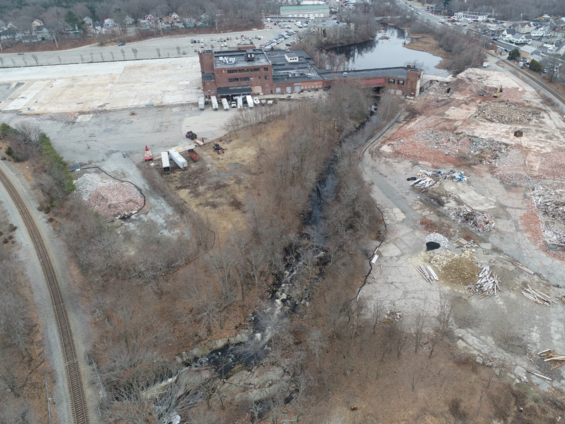
Former Armstrong World Industries Site. Drone photo by SLR Consulting.
Project Details
Project Title
Armstrong Dam and Ames Pond Dam Removals- Final Design and Permitting
Municipality
Braintree
MVP Region
Greater Boston
Award Year
FY2019
Grant Award
$90,000
Project Length
Two Year
Community Overview
Only 10 miles south of Boston and within Norfolk County, Braintree is a mature “inner ring” suburb of Boston. Braintree provides access to Boston and surrounding towns and to the South Shore through the major highways, Route 93 and Route 3, as well as the MBTA Red Line and Greenbush commuter rail. While Braintree has had strong residential development, there is a well-established pattern of commercial development along these transportation routes and the secondary highways (Route 37 and Route 53) through the Town.
As of the 2010 Census (the 2020 Census results have not been published at the time of writing), the population of Braintree was 35,744 people. There are three Environmental Justice Areas in Braintree, one of which is located in the center of Town. The dam removal project is located within this EJ area.
Project Description and Goals
- Where was the project located?
- The project locus is the approximately 30-acre former Armstrong World Industries site at 14 Plain St. in Braintree. The Monatiquot River bisects the site and was damned for mills in the early 1700s. The site evolved over centuries to the become the home of Armstrong World Industries which was a large manufacturer of flooring materials until they closed in 1995.
- What climate change impacts did the project address?
- Inland Flooding and Extreme Heat.
- What were the specific goals and tasks of the project?
- The project was focused on the final design and permitting for the removal of two obsolete dams, restoration of the river channel and floodplain, construction of a fish bypass channel at the rock falls on site and construction of a public access trail and boardwalk along the restored river channel.
- Did your project meet the goals:
- Yes, the project was successful in completing permitting and final design. The construction phase is being publicly bid in spring, 2021 with an expected construction start date of June, 2021.
Results and Deliverables
- Describe, and quantify (where possible) project results (e.g. square footage of habitat restored or created, increase in tree canopy coverage, etc.). Report out on the metrics outlined in your application.
- The completed project will:
- address three (3) barriers to diadromous fish passage (two dam removals and one nature-like fishway);
- reconnect 36 miles of upstream river access;
- provide access to 180 acres of river herring spawning/rearing habitat at Great Pond Reservoir;
- restore 4 acres of riparian floodplain wetlands and improve river water quality;
- manage 5,000 tons of contaminated sediment;
- create a one-third mile walking trail along the restored river in an Environmental Justice Area.
- The completed project will:
- Provide a brief summary of project deliverables with web links, if available.
- Project deliverables can be found on the project website.
Lessons Learned
- What lessons were learned as a result of the project?
- The project provides a good example of a public-private partnership. The site is privately-owned and landowner support is crucial to implementing the project. A good working relationship between the owner and Town and other agency partners was built over a period of several years. Feasibility work was important to both address the concerns of all parties but also to allow the working relationship to develop over time. Regular partner meetings are very helpful to keep communication open.
- Getting the support of the MA Division of Ecological Restoration has been another critical factor in the success of the project. Their technical expertise and support have provided the framework for a very complex design and permitting and funding process.
- The importance of breaking the overall project down into phases and manageable components can’t be stressed enough. This strategy has enabled the project partners to come up with local match for smaller grant opportunities and complete tasks necessary to advance the project.
- What is the best way for other communities to learn from your project/process?
- See the project website.
Partners and Other Support
- Town of Braintree
- the property owner, Hollingsworth Pond, LLC;
- MA Division of Ecological Restoration;
- MA Division of Marine Fisheries;
- MA Department of Fish and Game;
- MA Executive Office of Energy and Environmental Affairs;
- National Oceanic and Atmospheric Administration;
- US Fish and Wildlife Service;
- Fore River Watershed Association.