
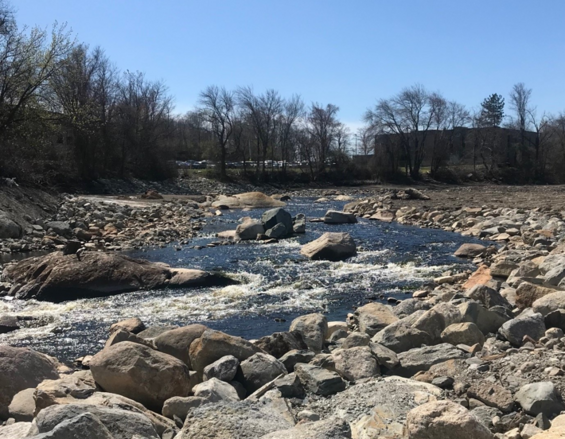
Restored Monatiquot River Channel Spring, 2024
Project Details
Project Title
Monatiquot River Restoration – Construction
Municipality
Braintree
MVP Region
Greater Boston
Award Year
FY2021
Grant Award
$750,000
Project Length
Two Year (plus extensions due to an appeal)
Community Overview
Braintree is a suburban community with a population of 39,143, and is located south of Boston, near the southern terminus of Interstate 93. Braintree Station is the southern terminus of the Red Line, providing transit access to Boston as well as Quincy and Cambridge. Braintree also has two commuter rail stops, providing access to Boston and other communities in the area. The access that Braintree has is a critical driving factor of issues and opportunities for the community and region. The level of access creates development opportunities, growth pressures, and strain on environmental resources.
Project Description and Goals
- Where was the project located?
- The project locus is within a privately-owned property of approximately 30 acres and which was the site of former industrial use. It is located off of Hancock St. and Plain St. The Monatiquot River bisects the site as it traverses from south to north.
- What climate change impacts did the project address?
- Inland Flooding and Extreme Heat.
- What were the specific goals and tasks of the project?
- The project includes removal of the “High Hazard” Armstrong Dam and Ames Pond Dam, restoration of the Monatiquot River channel in the area of the former mill pond, construction of a bypass fishway for river herring and American eel passage, and construction of a public access trail with interpretive signage along the restored river channel through the site.
- The specific tasks associated with the MVP Action Grant (as amended) were:
- 1A: Public Involvement & Community Engagement Plan
- 1.1A Posters, Press Release, Signage, Tabling
- 1.2A Interpretive Materials for Walkway
- 2A: Construction Phase 1
- 2.1A Trail and Fishway Modification
- 1B: Construction Phase 2
- 1.1B Armstrong Dam Removal mobilization, site prep, demo, channel construction
- 2B: Construction Phase 3
- 2.1B Fishway Construction (minimum 25% complete)
- 1A: Public Involvement & Community Engagement Plan
- Did your project meet the goals:
- Construction is ongoing but the project is on track to meet its objectives of eliminating the potential for a catastrophic dam failure, reconnecting river herring to their historic spawning habitat, increasing tree canopy and creating a new recreational opportunity by providing a walking trail along the river corridor.
Results and Deliverables
- Describe, and quantify (where possible) project results (e.g. square footage of habitat restored or created, increase in tree canopy coverage, etc.). Report out on the metrics outlined in your application.
- Access for river herring to the 180-acre spawning habitat at the Great Pond Reservoir;
- Creation of a one-third mile walking trail along the restored river corridor through the project site;
- Increased tree cover within the project locus.
- Provide a brief summary of project deliverables with web links, if available.
- See the project website.
Lessons Learned
- What lessons were learned as a result of the project?
- The project team relied upon Ground Penetrating Radar (GPR) for information on subsurface conditions and discovered differing site conditions than anticipated during the construction phase. The differing site conditions (namely, the abundance of boulders) made the helical coil design for the boardwalk footings infeasible and delayed completion of the project as alternatives were explored and brought before permitting agencies. The team did not conduct soil borings due to the complications and expense of access within the impoundment.
- What is the best way for other communities to learn from your project/process?
- Resources available for other communities to learn from our project include the project website as well as Town Staff and Project Partners (particularly MA Division of Ecological Restoration and NOAA).
Partners and Other Support
- Hollingsworth Pond, LLC – property owner and provided funding
- Fore River Watershed Association – project supporter
- MA Division of Ecological Restoration – provided technical assistance and funding
- MA Division of Marine Fisheries – funded feasibility analysis and provided technical assistance
- National Oceanic and Atmospheric Administration – provide technical assistance and funding
- National Fish and Wildlife Foundation- provide
- US Fish and Wildlife Service – provided funding