

- Scientific name: Hypomecis buchholzaria
- Species of Greatest Conservation Need (MA State Wildlife Action Plan)
- Endangered (MA Endangered Species Act)
Description
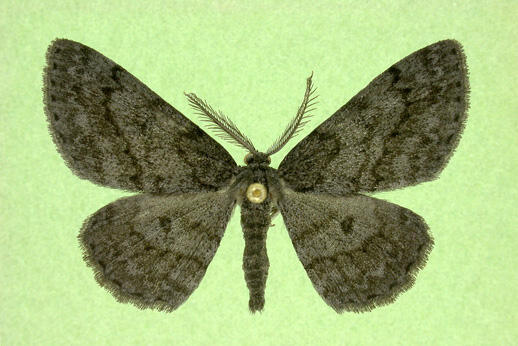
Buchholz’s gray (Hypomecis buchholzaria)
Buchholz’s gray (Hypomecis buchholzaria) is a geometrid moth with a forewing length of 14-18 mm (0.6-0.7 in) (Rindge 1973). Both the forewing and the hind wing have a dark gray ground color. The forewing postmedial line is black and toothed, curving outward from the costa and then inward in the vicinity of the radial veins. The forewing median line is diffuse and obscure. The antemedial line is black and wavy, outlining an oval area in the basal portion of the forewing that is often more darkly shaded than distal to the line. The reniform spot is a black, elliptical ring, often obscured by the median line. The hind wing has a black and toothed, shallowly curved postmedial line. The hind wing median line is straight, but diffuse and often obscure. The discal spot is a black, elliptical ring. The head, thorax, and abdomen match the dark gray ground color of the wings.
Life cycle and behavior

In Massachusetts, adult Buchholz’s gray moths fly in June and early July. Larval host plants are not well documented; captive larvae accept sweet fern (Comptonia peregrina) and bayberry (Morella pensylvanica [Schweitzer et al. 2011]). Larvae feed in July and August, pupating by September. The pupa overwinters.
Distribution and abundance
Buchholz’s gray is rare and locally distributed along the Atlantic and Gulf Coastal Plains, with populations in Massachusetts, New Jersey, North Carolina, South Carolina, Florida, Mississippi and eastern Texas (Rindge 1973). In Massachusetts, this species is only known from the pine barrens of southeastern Plymouth County.
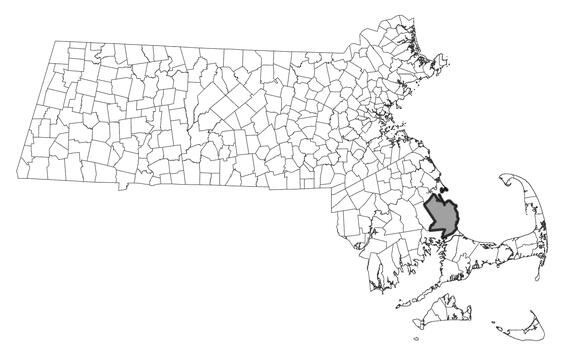
Distribution in Massachusetts.
2000-2025
Based on records in the Natural Heritage Database.
Habitat
In Massachusetts, Buchholz’s gray inhabits sandplain pitch pine-scrub oak barrens.
Healthy habitats are vital for supporting native wildlife and plants. Explore habitats and learn about conservation and restoration in Massachusetts.
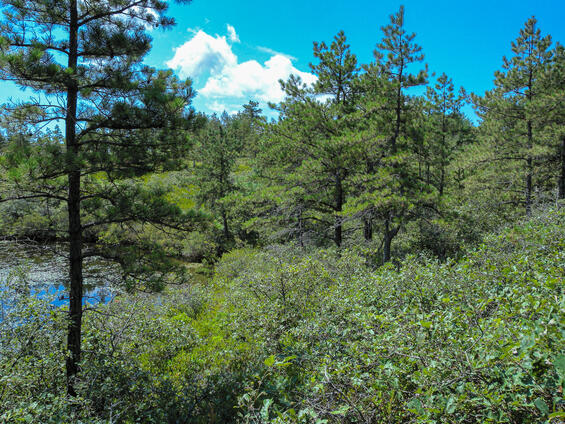
Sandplain pitch pine-scrub oak barrens habitat with sparse trees and a well-developed shrub layer, habitat for Buchholz’s gray. Habitat managed by MassWildlife and DCR at Camp Cachalot WMA.
Threats
Buchholz’s gray is threatened by habitat loss and fire suppression in its disturbance-dependent habitat, in particular sandplain pine-scrub oak barrens. Other potential threats include introduced generalist parasitoids, aerial insecticide spraying, non-target herbicide application, and off-road vehicles. The effect of a warming climate may not be detrimental to this species in Massachusetts; its range extends south to Florida, suggesting adaptation to warm temperatures.
Conservation
Land protection and habitat management are the primary conservation needs of this species in Massachusetts. In particular, sandplain pitch pine-scrub oak barrens should be conserved, restored, and managed to maintain habitat for this species and the entire suite of rare and threatened species dependent on such habitat.
Survey and monitoring
The distribution of Buchholz’s gray in sandplain pitch pine-scrub oak barrens is well documented. Known populations of this species should be surveyed to document persistence at least once every 25 years; every 10 years is more desirable when practicable.
Management
Management of sandplain pitch pine-scrub oak barrens benefits a suite of rare and threatened species, and habitat condition should be monitored and management adapted as needed. For Buchholz’s gray, open barrens habitat with a shrub layer is of particular importance.
Research needs
While the habitat of Buchholz’s gray is known, its larval host plants in Massachusetts have not been documented. As with other species with a geographic range mostly south of Massachusetts, the future effects of a warming climate on this species are unpredictable and should be documented.
References
Rindge, F.H. 1973. A revision of the North American species of the genus Pseudoboarmia (Lepidoptera, Geometridae). American Museum Novitates 2514: 1-27.
Schweitzer, D.F., M.C. Minno, and D.L. Wagner. 2011. Rare, Declining, and Poorly Known Butterflies and Moths (Lepidoptera) of Forests and Woodlands in the Eastern United States. Forest Service, U.S. Dept. of Agriculture, Washington, DC. 517 pp.
Contact
| Date published: | March 7, 2025 |
|---|