

A. 2025 Rail Transit Safety Division Accomplishments – Highlights
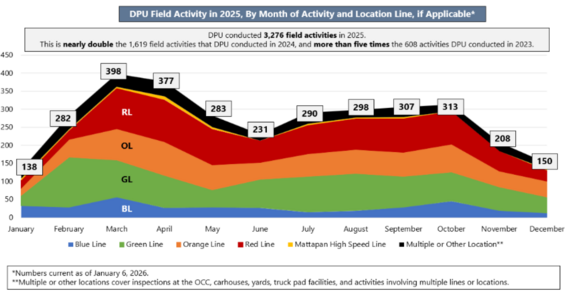
- DPU conducted over 3,276 field activities in 2025. These activities involve track walks, power system checks, speed audits, and station and carhouse safety audits. This is more than double the 1,615 field activities that DPU conducted in 2024, a 102.9% increase year over year;
- DPU reviewed more than 70 MBTA final reports and responded to more than 40 safety events in 2025 including those involving the National Transportation Safety Board (“NTSB”);
- DPU directed MBTA to create eighteen (18) corrective action plans (CAPs) in 2025 including major topics such as fatigue management, employee assaults, Green Line Type 7 crashworthiness, and power issues. Twenty-nine (29) CAPs have been closed this year;
- FTA required each rail transit agency to obtain SSOA approval for a Roadway Worker Protection (“RWP”) Program by December 2, 2025. DPU reviewed MBTA’s RWP Plan, verified FTA requirements, and approved MBTA’s RWP Plan on December 1, 2025;
- In 2025, DPU conducted two Risk-Based Inspections (“RBI”) and issued two RBI Final Reports to MBTA. One RBI addressed fire and smoke events on the ROW and the other RBI addressed pedestrian safety at the Green Line Park Street eastbound platform. In total, DPU issued four RBI Final Reports as part of DPU’s RBI program since 2024.
- DPU maintains an active role in overseeing the MBTA’s current $7.7 billion capital and safety improvement program, which encompasses major track, signal, vehicle, power, and infrastructure upgrades. As of December 2025, the Division is overseeing 52 projects; and
- Three Division employees received the 2025 Commonwealth Certificate of Achievement. Overall, DPU remains committed to being the SSOA that the Commonwealth deserves and a leader in the transit industry for safety oversight.
B. Training
The Division prioritizes the training and certification of Division staff, ensuring they have the knowledge and credentials required to uphold the highest standards of rail transit safety and oversight. The Division’s training approach exceeds FTA’s requirements and provides continuing opportunities for staff development. In 2025, the Division continued to expand technical education across track, signals, traction power, vehicle systems, and data analytics. Staff qualifications and certifications remain current with evolving FTA guidance and industry best practices, including training on new risk-based oversight methodologies.
Division personnel and contractors (“designated personnel”) are in compliance with training requirements to complete their Public Transportation Safety Certification Training Program (“PTSCTP”) (49 C.F.R. Part 672) within three years of hire, and refresher training every two years (including FTA-specified training called Advancing Safety Assurance Through Corrective Action Plans).
The Division’s Technical Training Plan requires that its designated personnel satisfy 22 mandated competency areas. All personnel will complete the seven FTA-required training courses for PTSCTP certification on time, and the majority of the Division staff completed the required PTSCTP training far in advance of the 3-year requirement for initial certification. Division staff obtained additional training in 2025, including courses on:
- Causal Factors and Root Cause Analysis;
- Emergency Management;
- Safety Certification;
- OSHA-30; and
- MBTA Vehicle Familiarization Training.
C. Inspections
Throughout 2025, DPU continued to ensure MBTA develops and implements a comprehensive safety program. DPU’s oversight methods include a robust routine inspection program. DPU significantly expanded its inspections of MBTA facilities and operations, conducting 3,276 inspections between January 1, 2025 and December 31, 2025.
In addition to field observations, document reviews, and inspections, DPU participates in and oversees numerous MBTA meetings to assess the effectiveness of changes to MBTA internal processes and organizational structure. In 2025, DPU engagement included regular MBTA safety meetings, weekly meetings with executive leadership, monthly hazard tracking reviews, CAP alignment discussions, Operational Testing and Inspection Program meetings, weekly safety performance reviews, and participation in the Subway Accident Reduction Committee.
D. Risk-Based Inspection Program (“RBI”)
Pursuant to FTA’s Special Directive 22-34 to all SSOAs, and 49 U.S.C. § 5329(k), FTA approved DPU’s RBI program on October 24, 2024. DPU submitted documentation to FTA on October 23, 2025, demonstrating DPU’s first year of implementing its RBI program.
In 2025, DPU achieved several key RBI milestones, including issuing RBI reports to MBTA on the following topics:
- Fire and smoke events on the Orange Line; and
- Pedestrian platform safety at Park Street Station.
DPU continues to monitor MBTA’s monthly data submissions and other pertinent safety data, such as safety event and hazard trends as well as DPU’s RBI dashboard, to identify and assess ongoing trends. These safety data play a central role in informing DPU’s current and future inspection activities. DPU’s RBI areas of focus in 2026 include emergency egress, overhead catenary system (“OCS”) and pantograph maintenance and inspections, and operational signal rules violations.
E. FTA Reportable Events and State Reportable Events; Investigations
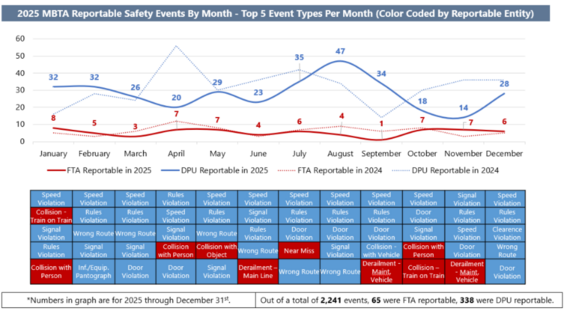
FTA’s amendments to the SSOA Program regulations (49 C.F.R. Part 674) in 2024 became effective on January 1, 2025. The revised requirements align safety event reporting more closely with Safety Management System (“SMS”) principles and updated definitions and categorization criteria for reportable events. FTA-Reportable Safety Events in 2025 include those involving:
- Derailments;
- Rail Vehicle Collisions;
- Fatalities;
- Two or more injuries;
- Evacuations for life safety events; and
- Unintended train movements.
Events that do not meet the threshold for FTA reporting may still require notification to DPU. State-Reportable Events are defined in the Standard Operating Guideline Manual (“SOG”) and include a broader range of incidents and hazardous conditions that warrant state oversight, such as:
- Operational disruptions linked to safety risks;
- Infrastructure failures;
- Near-miss events with high potential severity; and
- Safety Rule violations.
The enhanced state reporting is designed to strengthen early risk detection and support a more proactive, performance-based oversight framework.
These enhancements ensure that the causes of safety events are fully understood and addressed to minimize or prevent recurrence.
Under 49 C.F.R.§ 674.35 and 220 CMR 151.09, DPU delegates investigation responsibilities for reportable safety events to MBTA. DPU retains full authority and accountability for ensuring that every investigation is sufficient, thorough, and compliant with federal and state standards.
The Division provided real-time oversight of MBTA investigations in 2025 by:
- Issuing targeted information requests to ensure DPU obtains and reviews all relevant records, procedures, and data;
- Monitoring and participating in MBTA-initiated investigations from opening through closure;
- Conducting field verification, including on-scene presence to observe evidence collection and incident response activities;
- Reviewing operational data, maintenance records, safety certifications, and system performance analytics related to safety events;
- Participating in post-incident investigative reviews, such as interviewing MBTA personnel to validate findings and corrective actions;
- For certain significant events in 2025, DPU hosted weekly post-incident review sessions with MBTA to ensure alignment on investigative strategy, findings, and corrective action implementation;
- Review of video, audio, and system performance data; and
- Analyzing root cause evaluations and development of CAPs.
The Division analyzes this information independently to validate the accuracy, completeness, and thoroughness of MBTA’s investigations. The Division requires corrective actions as appropriate and closely tracks the implementation to ensure safety improvements are completed.
When the Division’s review of MBTA Investigation Reports identified deficiencies in MBTA’s scope, methodology, causal analysis, or corrective action development, the Division required revisions, directed additional investigative tasks, or assumed supervision of the investigation. The Division may reject MBTA investigation reports until they are sufficient and thorough.
The Division also has authority to issue independent final reports when MBTA’s conclusions do not adequately address safety concerns or root causes. In 2025, DPU exercised this authority in response to the February 2025 Mattapan Line flood and trolley evacuation incident at Milton Station, where DPU issued its own investigation report to ensure appropriate findings, accountability, and mitigation strategies. This demonstrates DPU’s commitment to maintaining independence, analytical rigor, and transparency in safety investigation oversight.
In 2025, DPU:
- Provided oversight of 117 safety investigations, including 64 FTA-Reportable events and 53 State-Reportable events, consistent with federal and state reporting requirements;
- Closed 113 investigations;
- Received 73 final investigation reports; and
- Rejected nine final reports for additional work or corrective action.
These oversight activities reinforce continuous improvement in MBTA’s investigative practices and ensure that safety lessons learned are incorporated into operations and maintenance programs.
F. Participation in NTSB Investigations
NTSB has authority to assume jurisdiction over investigations of rail accidents. When NTSB opens an investigation, DPU participates as a party to assist NTSB, providing operational expertise, documenting evidence, participating in interviews, and reviewing MBTA procedures. DPU ensures that all investigative findings and recommendations are fully considered in state oversight activities. NTSB continued or started two investigations of MBTA safety events in 2025.
October 1, 2024: Green Line Derailment at Red Bridge Interlocking, Somerville, MA (RRD24FR017)
NTSB issued its Final Report on October 9, 2025, and is summarized below:
- Train: Eastbound Green Line revenue train, leading car derailed;
- Passengers and crew: 50 passengers and 2 crewmembers;
- Route: Departed Lechmere Station eastbound;
- Event summary: Train entered a 10-mph zone at 36 mph, passed a double-red signal west of the Red Bridge interlocking, and reached a switch still in motion directing the train to the diverging track. Seven passengers transported to hospital for minor injuries.
- DPU participation: 13 staff members assigned to observation, operational analysis, and investigative support.
- NTSB outcome: Preliminary findings issued via docket RRD24FR017; final report (RIR-25-14) determined that the probable cause of the train derailment was the operator failing for unknown reasons to obey a stop signal and proceeding through an interlocking while the track switch was still in motion. Contributing to the accident was the train’s excessive speed, which increased the likelihood of the train reaching the interlocking while the switch was still in motion.
February 9, 2025: Collision of Two Light Rail Trains with Derailment, East Somerville MA (RRD25FR007)
- Train(s) involved: 3840-3698 and 3851-3663;
- Passengers and crew affected: Total 4 Crew Members, 6 passengers;
- Event summary: On February 9, 2025, at approximately 12:22 a.m., westbound MBTA light rail train 3840-3698 collided with the stationary out-of-service train 3851-3663 at East Somerville Station, derailing one car on each train and damaging four cars. Two passengers and four crew members sustained non-life-threatening injuries, and equipment damages were estimated at $6.6 million. Preliminary data indicate the striking train entered a 25-mph zone at approximately 32 mph, passed a red signal, and entered the 10-mph station zone before the collision.
- DPU participation: 13 DPU staff members engaged in on-site monitoring, interviews, video review, and analysis of operational and maintenance records. As a result, DPU directed the MBTA to assess the crashworthiness of the Type 7 train.
- Documentation: NTSB docket RRD25FR007 includes investigative files, preliminary factual reports, and supporting documentation. NTSB has not yet issued a final report.
DPU’s participation in NTSB investigations ensures that MBTA implements corrective actions consistent with federal and state safety requirements, and that NTSB safety recommendations are fully evaluated for future CAPs.
G. Agency Safety Plan/PTASP
MBTA is required under federal regulations to maintain an Agency Safety Plan (“ASP”) that establishes processes and procedures to effectively manage safety risks, including implementation of a SMS. DPU reviews and verifies MBTA’s ASP for compliance with FTA requirements. MBTA updated its ASP in August 2025 and submitted it to DPU for review. DPU issued comments to MBTA and required revisions on 9/15/25. DPU’s primary comments concerned the need for the ASP to more closely track the Safety Risk Reduction Program requirements in 49 C.F.R. Part 673. MBTA resubmitted a revised ASP on 12/22/25. DPU reviewed and approved the revised ASP on 1/13/26.
H. Compliance and Enforcement Procedures including Corrective Action Plans (“CAP”)
DPU may issue directives or other enforcement actions requiring MBTA to take immediate or planned measures to ensure safety. In most cases, DPU and MBTA staff collaborate to resolve safety concerns through the development and implementation of CAPs.
In 2025, DPU continued its active oversight of MBTA’s track maintenance program, ensuring that safety corrective actions from 2024 CAPs were achieved and maintained. DPU closely monitored track infrastructure enhancements, maintenance projects, and inspections. DPU’s engineering and compliance staff conducted reviews to verify adherence to safety standards and industry best practices.
DPU tracks MBTA’s CAPs to ensure the approach and timelines are reasonable and practicable. When necessary, DPU may direct MBTA to develop a CAP if MBTA does not self-initiate a CAP, or may direct certain mitigations to ensure a hazard is mitigated to the lowest practical level.
As of December 31, 2025, MBTA had 21 open CAPs monitored by DPU. DPU regularly meets with MBTA’s Quality Control and Safety Oversight teams to discuss progress on open CAPs and ensure required actions are implemented effectively. Several of the key CAPs from 2025 include:
Fatigue Management:
- Hazard: fatigue and hours-of-service ("HOS") in safety sensitive MBTA departments.
- Required Actions (examples): Develop HOS parameters and a Fatigue Management Policy; develop a roadmap to implement the new Policy including tracking and enforcement. Final corrective action completion dates are in 2026.
Employee Assaults:
- Hazard: MBTA trended higher than its performance targets related to assaults on employees, plus it initiated a fare engagement (enforcement) program that subjects employees to potentially increased confrontations with the public.
- Required Actions (examples): MBTA is implementing mitigations to address this hazard; the CAP adds a focus on hazards related to new fare enforcement, collaboration with Transit Police, and enhancing accuracy in reporting.
Green Line Type 7 Crashworthiness:
- Hazard: Type 7 vehicle crashworthiness.
- Required Actions: Crashworthiness assessment of the Type 7 vehicle, including potential risks to customers and motorpersons; develop and implement a hazard mitigation plan based on the crashworthiness assessment (e.g., have fully operational the Green Line Train Protection System Phase 1 (real-time detection of collision hazard and alarms/warnings to motorperson) by August 31, 2026). Corrective action completion dates are in 2026.
Operation Control Center (“OCC”)/Power Issues:
- Hazard: multiple near misses of employee electrocution injury while accessing the right-of-way (“ROW”) and requesting power. Highlighted the need for improved OCC communication and power request procedures to mitigate unsafe power conditions for employees entering the ROW.
- Required Actions: Specific communication protocol for OCC dispatchers when personnel call onto the ROW; a Power Request Chain of Review document for supervisory and dispatcher quality checks; removal, insulation, and tagging of feeder taps prior to work in certain locations.
I. FTA 2022 Safety Management Inspection
During 2024, DPU made substantial progress on completing the CAPs that FTA issued to DPU in 2022 following the Safety Management Inspection (“SMI”) of MBTA’s transit operations and maintenance programs. In 2025, all SMI CAPs for DPU were either closed or pending FTA review for closure.
Special Directive (“SD”) 22-8 required DPU to oversee MBTA’s CAPs addressing SMI findings. FTA fully closed SD 22-8 on September 25, 2024.
SD 22-13 included several findings requiring DPU action. FTA previously closed Findings 1.A, B, C and 2. DPU addressed Finding 1.D (enforcement processes and thresholds for timely CAP resolution), and submitted a closure request to FTA in November 2024; FTA’s review and closure remains pending. DPU completed Finding 3 (validation of MBTA’s fatigue management program) in 2024 and submitted a closure request to FTA in December 2024; FTA’s review and closure remains pending. DPU addressed Finding 4 (DPU’s overall ability to resolve safety issues identified during the SMI) by its vastly expanded routine inspections, CAP enforcement program, Triennial Audit of MBTA for 2021–2023, and compliance with SSOA requirements. DPU submitted a closure request for Finding 4 to FTA in December 2024; FTA’s review remains pending. Full closure of SD 22-13 remains under FTA review.
DPU continued to support FTA oversight of the SDs that FTA issued to MBTA, including reviewing and commenting on MBTA documentation, participating in FTA/MBTA meetings, and conducting field observations. These activities help ensure that MBTA continues to implement FTA-required corrective actions.
J. Roadway Worker Protection (“RWP”)
On December 1, 2025, DPU approved MBTA’s updated RWP Program, reflecting changes to worker safety protocols from the original 2014 program. The RWP Program update modernizes track access protocols, integrates advanced mobile flagger technology, and aligns MBTA operations with current federal regulations and industry best practices. The RWP program improvements focus on reducing exposure to on-track hazards, improving situational awareness for train crews and maintenance personnel, and establishing clearer communication protocols for work zones across the transit system.
The revised RWP Program builds on the foundation of the 2014 Access and Advanced Mobile Flagger Program while incorporating lessons learned from regulatory requirements, safety events, and DPU oversight activities. It includes updated training requirements, enhanced monitoring and reporting procedures, and the use of new levels of roadway protection for on track crews. DPU monitors program implementation through a CAP (issued in 2026), audits, and field observations, to ensure that the RWP Program maintains a high standard of roadway worker safety throughout MBTA’s rail transit system.
K. Safety Certification Program
In accordance with 49 C.F.R. § 674.25, DPU independently verifies compliance with safety review procedures for MBTA capital projects in the engineering and construction phases. DPU ensures that engineering, construction, and testing activities for qualifying projects adhere to MBTA’s System Safety Certification Program Plan.
MBTA currently has a $7.7 billion capital and safety improvement program, which encompasses major track, signal, vehicle, power, and infrastructure upgrades. As part of the certification process, DPU verifies that all safety mitigations, testing activities, and corrective actions have been implemented, validated, and appropriately documented.
MBTA projects subject to safety certification are categorized under the MBTA Safety Certification Manual as:
- Category 1 Projects: Major capital or safety-critical projects with significant operational, system-integrated, or infrastructure impacts, generally involving substantial cost, complexity, or risk.
- Category 2 Projects: Lower-risk or smaller-scope projects that still require safety certification but involve limited operational impact or reduced complexity compared to Category 1 projects.
As of December 2025, DPU is overseeing 52 projects in both categories.
L. Program Standard
DPU’s Program Standard consists of regulations at 220 CMR 151.00 and the SOG. There was no amendment to 220 CMR 151.00 in 2025.
The SOG as a whole was updated on March 24, 2025. Those updates to the SOG reflect RTSD’s current practice, and recent rulemakings and requirements by FTA, including amendments to 49 C.F.R. § 674 that became effective on January 1, 2025. Included in the update were new SOG sections 5.6a (DPU access to the ROW) and 5.8 (RBI). DPU provided the draft SOG to MBTA on November 26, 2024, and MBTA submitted comments to DPU on December 13, 2024. DPU reviewed MBTA’s comments and revised the draft update as appropriate based on MBTA’s comments.
Subsequently, DPU updated SOG section 2.7a (Field Engagement and Findings of Potential Non-Compliance) on April 4, 2025, and section 2.7 (Dispute Resolution) on October 29, 2025, after providing MBTA with opportunity to review and comment on the updates and incorporating MBTA’s comments as appropriate.
M. Triennial Audit of MBTA
DPU is required to conduct a Triennial Audit of MBTA’s rail transit system pursuant to 49 C.F.R. Part 674 and 220 CMR 151.10(2). DPU initiated a rolling Triennial Audit of MBTA for the 2024-2026 cycle, starting with an audit (phase one) of the Power Systems Maintenance in late 2024/2025. DPU will issue a phase one audit report to MBTA in 2026 (subsequent audit phases will occur in 2026).
N. Conclusion
The 2025 Annual Report on Rail Transit Safety summarizes DPU’s commitment to protecting passengers, employees, and communities served by the MBTA’s rail transit system. Through comprehensive analysis, strategic planning, and diligent safety measures, MBTA, in coordination with DPU’s safety oversight, has made continued progress on mitigating risks and improving overall safety performance. DPU values its strong collaboration with FTA in strengthening the Commonwealth’s SSO Program and looks forward to continuing this vital partnership.
| Date published: | June 1, 2026 |
|---|