
- Scientific name: Carex lupuliformis
- Species of Greatest Conservation Need (MA State Wildlife Action Plan)
- Endangered (MA Endangered Species Act)
Description
False hop sedge, a member of the sedge family (Cyperaceae), is a perennial, herbaceous, grass-like plant of non-acidic vernal pools, pond shores, and floodplain forests. It is a large, robust sedge with large spikes and reaches 5 -13 dm (about 1-4 ft.) in height. It can be found either in loose clumps or in spreading colonies.
To positively identify the false hop sedge and other members of the genus Carex, a technical manual should be consulted. Species in this genus have tiny, wind-pollinated flowers that are borne in spikes. Each flower is unisexual and is closely subtended by small, flat scales that largely conceal the flowers. The staminate (i.e., pollen-bearing) flowers are subtended by a single scale. The pistillate (i.e., ovule-bearing) flowers are subtended by two scales, an outer flat scale (pistillate scale) and an inner, sac-like scale, called a “perigynium,” that encloses the flower and, later, the fruit. If the perigynium tapers or contracts to a tip, it is described as a “beak.”
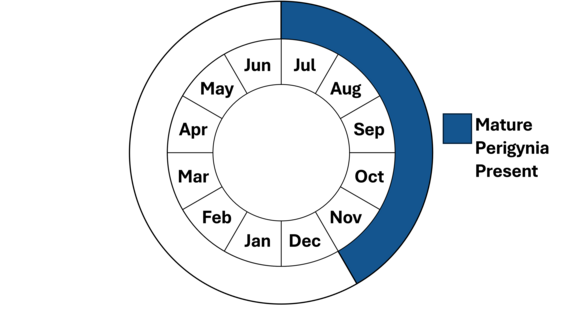
The false hop sedge belongs to a group of Carex (section Lupulinae) that have the largest perigynia in the genus; these are inflated, distinctly veined, and beaked, with two conspicuous beak-teeth. Styles are persistent on the achenes. In the false hop sedge, specifically, the staminate spikes are terminal and long-cylindric; the pistillate spikes below are thick-cylindric and ascending. The hard, nut-like fruits within the perigynia, called “achenes,” are triangular in cross-section with concave faces and thick angles with knobby projections (see illustration). Mature achenes are necessary for identification.
A very similar sedge of wetland habitats is the more common hop sedge (Carex lupulina). This sedge can tolerate more acidic habitat types but is also found on neutral substrates alongside the false hop sedge. While the false hop sedge is typically a larger, more robust sedge, the only reliable way to distinguish the two sedges is by mature achenes. The achenes of the false hop sedge (C. lupuliformis) are often nearly as wide as long and have strongly concave faces and knob-like projections on the achene angles. In contrast, the achenes of the hop sedge (C. lupulina) are longer than wide, have less concave faces, and have smooth achene angles without conspicuously knobby projections. Another common sedge with large, inflated perigynia that is frequently confused with the hop and false hop sedges is the bladder sedge (C. intumescens). The uppermost true leaf (that is, not a leaf-like bract immediately beneath a spike) in the hop and false hop sedges has a distinct leaf sheath, 1.7 cm (0.7 in) or longer; that of the bladder sedge is sheathless or less than 1.5 cm (0.6 in). Superficially, the bladder sedge spikes are usually less thick-cylindric in shape, and instead are more globose to short-ovoid. Also in contrast to the false hop sedge, the achenes of the bladder sedge are not thickened on the angles, and the faces are convex to flat.
Population status
False hop sedge is listed under the Massachusetts Endangered Species Act as Endangered. All listed species are protected from killing, collecting, possessing, or sale and from activities that would destroy habitat and thus directly or indirectly cause mortality or disrupt critical behaviors. The false hop sedge has only recently been documented from Massachusetts, along the borders of Hampden and Hampshire counties. This species is, in part, rare in the state because it is nearing the northeastern limit of its range. It is considered rare throughout New England with additional populations only known from Vermont and Connecticut. MassWildlife’s Natural Heritage & Endangered Species Program database has 5 records from 3 counties: Franklin, Hampden, and Hampshire. 4 of these records have been observed within the last 25 years.
Distribution and abundance
The documented range of the false hop sedge extends from Quebec and Ontario south to Florida and Texas.
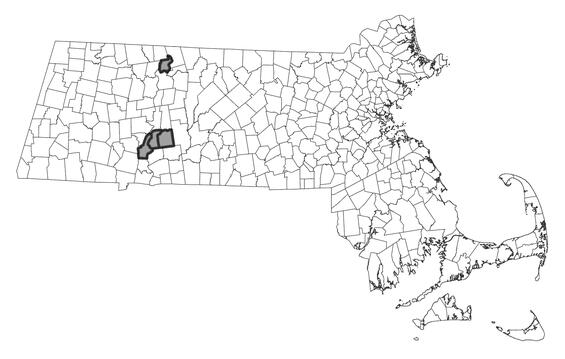
Distribution in Massachusetts
1999-2024
Based on records in the Natural Heritage Database
Habitat
In Massachusetts, the false hop sedge has been documented growing in vernal pools and on pond shores over basalt-derived (relatively neutral and nutrient-rich) soils. In Vermont, it has been documented in floodplain habitat on marble-derived (alkaline) soils. This species requires at least partial sun in areas of open canopy and limited shrub cover. It often grows in shallow water or in very wet areas of floodplains. Associated species in Massachusetts include red maple (Acer rubrum), swamp white oak (Quercus bicolor), button-bush (Cephalanthus occidentalis), winterberry (Ilex verticillata), hop sedge (C. lupulina), tussock sedge (C. stricta), and bristly sedge (C. comosa).
Healthy habitats are vital for supporting native wildlife and plants. Explore habitats and learn about conservation and restoration in Massachusetts.
Conservation
As for many rare species, exact needs for management of the false hop sedge are not known. The following comments are based mainly on observations of Massachusetts’ populations. Protecting the natural disturbance and hydrologic regimes, such as annual flooding that keep the habitat open and/or soils moist, is critical. Because false hop sedge prefers an open understory with filtered light, competing vegetation should be monitored and removed, if necessary.
Contact
| Date published: | April 9, 2025 |
|---|