
- Scientific name: Somatochlora forcipata
- Species of Greatest Conservation Need (MA State Wildlife Action Plan)
- Endangered (MA Endangered Species Act)
Description
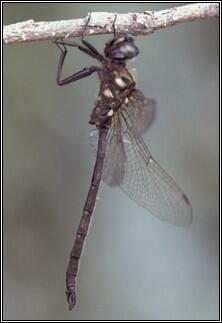
Male forcipate emerald
The forcipate emerald (Somatochlora forcipata) is a large, slender insect of the order Odonata, suborder Anisoptera (the dragonflies), family Corduliidae (the emeralds). Most striped emeralds (Somatochlora) are large and dark with at least some iridescent green coloration, brilliant green eyes in the mature adults (brown in young individuals), and moderate pubescence (hairiness), especially on the thorax. The forcipate emerald has thoracic markings consisting of two lateral yellow ovals, the front one more elongate, on each side of the thorax. The thorax overall is of a bronzy brown color with metallic green highlights throughout. The face is mostly black. The large eyes, which meet at a seam on the top of the head, are brilliant green in mature adults. The long and slender abdomen, black with a dull metallic green luster, is most narrow at the base, with a yellow lateral spot on segment 2, a pale basal ring on segment 3, and dull yellowish lateral spots on segments 5-7 (in males, 3-7 in females) and occasionally 8. The wings of this species are clear and, as in all dragonflies and damselflies, are supported by a dense system of dark veins.
Adult forcipate emeralds range from 43 to 51 mm (1.7 to 2 in) in length. Females are stockier than males and have a pale-yellow ovipositor parallel to the abdomen. Final instar nymphs can range from 17 to 20mm (0.6 to 0.8 in) in length.
Adult forcipate emeralds are distinguished from other striped emeralds in Massachusetts by the thoracic markings and by the shape of the terminal appendages (part of the reproductive structures). Definitive identification requires examination of the shape of the male terminal abdominal appendages or the female’s large triangle-shaped vulvar lamina or subgenital plate that lies parallel to the abdomen (Lam 2024). Therefore, identification usually requires species in-hand accompanied by a hand lens or macro camera lens. Incurvate emerald is most like forcipate emerald but is on average larger and has an anterior lateral thoracic stripe and posterior spot, while forcipate has two oval-shaped spots.
The nymphs and exuviae can be distinguished by characteristics as per the keys in Needham et al. (2000), Soltesz (1996), and Tennessen (2019).
Life cycle and behavior
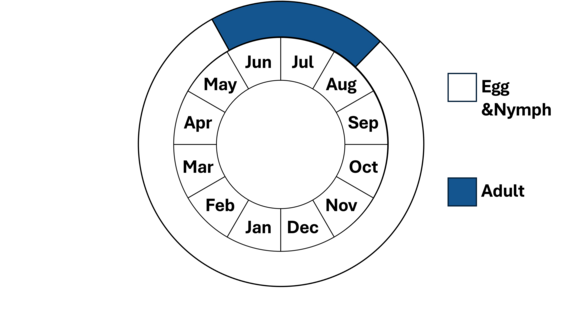
Note, nymphs are present year-round.
Although little has been published about the life cycle of the forcipate emerald in particular, information documented for other species is most likely applicable. The egg and nymph life stages are fully aquatic. The cryptic nymphs are predators, feeding on a wide variety of aquatic insects, small fish, and tadpoles. Nymphs undergo several molts (instars) for at least 2 years until they are ready to emerge as winged adults. Nymphs emerge up onto emergent vegetation or other stable substrate. When the nymph reaches a secure substrate, the adult begins to push itself out of the exoskeleton. As soon as the abdomen and wings are fully expanded, the adult takes its first flight. This maiden flight usually carries the individuals up into surrounding forest or other areas away from water, where they spend several days maturing and feeding and are somewhat protected from predation and inclement weather. Forcipate emeralds can be found in fields and forest clearings foraging on small aerial insects, such as flies and mosquitoes, which are consumed while flying. When not feeding, forcipate emeralds rest hanging vertically or perch obliquely from tree or shrub branches. After about a week, adult coloration is acquired, and the dragonfly becomes sexually mature before returning to the breeding habitat to initiate mating.
Males patrol up and down small streams, usually no more than two feet above the surface of the water, in search of females. The joined pair quickly flies off into the surrounding upland habitat to mate. Following mating, oviposition (egg laying) occurs. Females of the genus Somatochlora oviposit alone and deposit their eggs directly into the substrate by tapping the tip of the abdomen on its surface. Forcipate emerald females have been observed ovipositing by tapping the tip of their abdomen into pockets of water along the stream bank and in moss.
Adults forcipate emeralds are on the wing from early June to early August.
Distribution and abundance
The forcipate emerald is a rare species distributed across Canada into Michigan, Minnesota, and Maine south to West Virginia. In New England, this species is found in Maine, New Hampshire, Vermont, and Massachusetts. Forcipate emerald has been recorded at 5 sites in north-central and western Massachusetts within the Nashua, Millers, Swift, and Westfield watersheds. The species has been observed in low abundance with variable breeding evidence and has not been observed in 20 years.
The forcipate emerald is listed as endangered in Massachusetts. As with all species listed in Massachusetts, individuals of the species are protected from take (picking, collecting, killing, etc.) and sale under the Massachusetts Endangered Species Act.
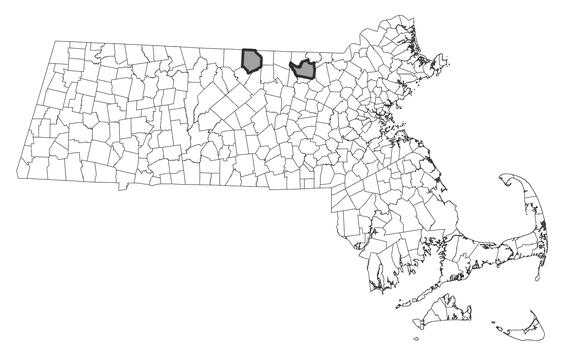
Distribution in Massachusetts.
1999-2024
Based on records in the Natural Heritage Database.
Habitat
In Massachusetts, the forcipate emerald inhabits pools and rivulets in bogs and small spring-fed forested streams. The adults also inhabit forested uplands and clearings.
Healthy habitats are vital for supporting native wildlife and plants. Explore habitats and learn about conservation and restoration in Massachusetts.
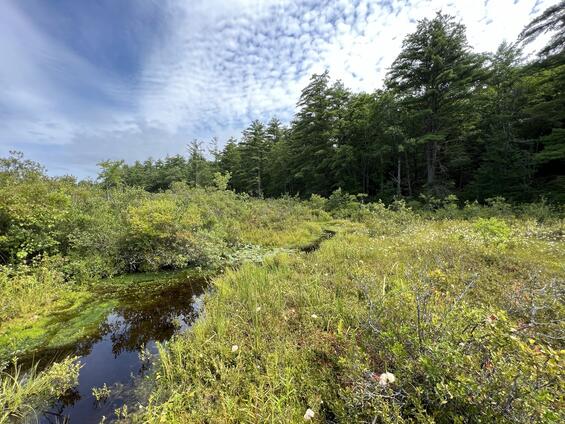
Acidic sphagnum-dominated dominated bog habitat typical for incurvate emerald.
Threats
The greatest threat to this species is likely loss and degradation of streams and associated bogs from development and the impacts of pollution resulting from road run-off including salt and chemical pollutants. Additional threats include loss of upland forests needed for adult development and water-level or flow manipulation from beavers and humans. Climate change poses a potential threat for the persistence of forcipate emerald in Massachusetts as its southern range limit is in New England is Massachusetts and is a relatively high elevational species.
Conservation
Survey and monitoring
Surveys should target known sites and new streams and bogs to determine forcipate emerald occupancy. Although the species has been detected from only three sites, the species has the potential to occupy other wetland systems in northern and western Massachusetts. Surveys should target adults in feeding and breeding habitats, where the species is mostly likely to be detected. Multiple site visits (e.g., >3) are likely required to detect this species because of its rarity and its difficulty to capture by net or camera. Known sites should be monitored at least every 5 years to document changes in occupancy and habitat conditions.
Management
Land and wetland protection is critical for the conservation of forcipate emerald. Upland habitats adjoining the breeding sites should be maintained for roosting, hunting, and for newly emerged adults that are more susceptible to mortality from predation and inclement weather. Development of these areas should be discouraged, and the preservation of remaining undeveloped uplands should be a priority. Alternatives to commonly applied road salts should tested to minimize freshwater salinization. Management of beaver-induced water levels may be needed to minimize stream and associate bog habitat degradation.
Research needs
Research effort is needed to estimate occupancy and detection rates for this species as detection is likely low and may inhabit other bogs. The effects of climate change on forcipate emerald and climate resistance of its aquatic-nymphal habitat, including water temperature and water quantity, warrant further investigation. Furthermore, confirmation of known and identification of new source and sink wetlands are needed to accurately assess the species risk to anthropogenic threats.
References
Dunkle, Sidney W. Dragonflies Through Binoculars. Oxford University Press, 2000.
Lam, E. Dragonflies of North America. Princeton NJ: Princeton University Press, 2024.
Mills, P.B. Somatochlora of Southern Ontario. Self-published, 2015.
Needham, J.G., M.J. Westfall, Jr., and M.L. May. Dragonflies of North America. Scientific Publishers, 2000.
Nikula, B., J.L. Ryan, and M.R. Burne. A Field Guide to the Dragonflies and Damselflies of Massachusetts. 2nd ed. Massachusetts Natural Heritage and Endangered Species Program, 2007.
Paulson, D. Dragonflies and Damselflies of the East. Princeton NJ: Princeton University Press, 2011.
Soltesz, K. Identification Keys to Northeastern Anisoptera Larvae. Center for Conservation and Biodiversity, University of Connecticut, 1996.
Tennessen, K. Dragonfly Nymphs of North America: An identification guide. Springer, 2019.
Walker, E.M., and P.S. Corbet. 1975. The Odonata of Canada and Alaska, Vol. III. University of Toronto Press.
Contact
| Date published: | March 6, 2025 |
|---|