
- Scientific name: Cryptogramma stelleri
- Species of Greatest Conservation Need (MA State Wildlife Action Plan)
- Endangered (MA Endangered Species Act)
Description
Fragile rock-brake is a small (3–25 cm [1.2–9.8 in]), delicate fern of moist, wooded calcareous outcrops and ledges. The leaves take two forms; one form bears spores (i.e., the fertile frond), and the other form is sterile. The fertile frond is erect and taller than the sterile frond, with spreading, lance-shaped pinnae (leaflets), and narrow pinnules (subleaflets). The pinnules have inrolled margins that conceal and protect the sporangia (spore-bearing structures). The sterile frond is more delicate and decumbent (i.e., more creeping) than the fertile frond, with broadly rounded pinnae, and fan-shaped, irregularly toothed pinnules.
The fronds arise at intervals from a succulent horizontal rhizome, which is covered with minute transparent scales. The petioles are brownish toward the base and green higher up. The sterile frond is ovate in outline, widest toward the base, and once or twice dissected into round, coarsely toothed segments. The longer fertile frond is broadly lance-shaped, and twice dissected into narrow, lance-shaped to linear segments. To be sure of identification, examine the mature fertile frond leaflets for sporangia along rolled margins.
Young plants of fragile fern (Cystopteris fragilis) resemble sterile fronds of fragile rock-brake, but the more common fern has fronds that are tufted or closely spaced, not spread out along the rhizome. Mature reproductive plants of both species are easily differentiated by the fertile fronds, which in fragile fern are lacy and broader, with clusters of sporangia along the veins (not along the margin).
Life cycle and behavior
Fragile rock-brake emerges in spring and senesces by late summer.
Population status
Fragile rock-brake is listed under the Massachusetts Endangered Species Act as Endangered. All listed species are protected from killing, collecting, possessing, or sale and from activities that would destroy habitat and thus directly or indirectly cause mortality or disrupt critical behaviors. The MassWildlife’s Natural Heritage & Endangered Species Program database has 9 records from 2 counties: Berkshire and Franklin. Five of these records have been observed within the last 25 years.
Distribution and abundance
Fragile rock-brake is circumboreal. In North America it is known from most provinces and states from Newfoundland and Quebec, south to New Jersey and West Virginia, and west to Alaska, Washington, Oregon, and Nevada.
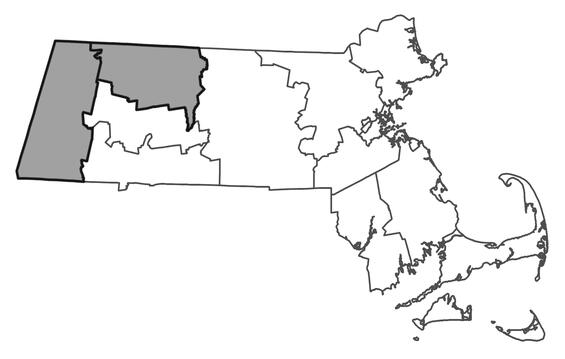
Distribution in Massachusetts
1999-2024
Based on records in the Natural Heritage Database
Habitat
Fragile rock-brake inhabits very seepy, shady crevices and shelves of vertical ledges and talus slopes composed chiefly of calcareous sedimentary rocks. Co-occurring species include bulblet-fern (Cystopteris bulbifera), white wood-aster (Eurybia divaricata), early meadow-rue (Thalictrum dioicum), herb-robert (Geranium robertianum), wild sarsaparilla (Aralia nudicaulis), wild columbine (Aquilegia canadensis), marginal wood-fern (Dryopteris marginalis), and bush-honeysuckle (Diervilla lonicera).
Healthy habitats are vital for supporting native wildlife and plants. Explore habitats and learn about conservation and restoration in Massachusetts.
Threats
Threats include drought or drying through removal of shade cover by logging or development, and invasion by exotic invasive species.
Conservation
Known habitat locations should be protected from dramatic changes in light or moisture conditions. Cliff specialists may be threatened if a site becomes popular for rock climbing. Rare plant locations that receive heavy recreational use should be carefully monitored for plant damage or soil disturbance; trails can sometimes be re-routed to reduce recreational impacts to the population.
Sites should be monitored for invasions of exotic plants; if exotic plants are crowding and out-competing this species, a vegetation management plan should be developed. All active management of state-listed plant populations (including invasive species removal) is subject to review under the Massachusetts Endangered Species Act and should be planned in close consultation with MassWildlife’s Natural Heritage & Endangered Species Program.
Contact
| Date published: | April 14, 2025 |
|---|