

MassWildlife’s upland habitat goals
MassWildlife’s habitat program works to provide a healthy mix of open and closed upland habitats for the benefit of common and rare plants and animals that rely on them. By promoting functional, interconnected systems and restoring unique habitat types and features, MassWildlife is ensuring the full suite of benefits and values of these lands are realized, including biodiversity conservation, public access to nature for recreation, and climate resilience.
To reach these goals, MassWildlife is proposing the following desired composition of upland habitats on MassWildlife lands. Explore this page to learn about these habitats, discover why they’re important for wildlife, and watch a recorded presentation.
These goals aim to foster open habitats and mature forests on the landscape, both of which are declining across Massachusetts and will require both active and passive management approaches to achieve.
| Upland habitat category | Description | Desired composition on MassWildlife lands* |
|---|---|---|
| Grassland | An open canopy habitat, dominated by grasses, sedges, and other herbaceous vegetation. Without regular burning or mowing, grasslands can be quickly colonized by shrub and tree species. | MassWildlife proposes managing 2% of its uplands as grasslands |
| Shrubland** | An open canopy habitat, dominated by low, woody vegetation and sparse young trees. Most shrublands also require frequent disturbance to persist, such as mowing or burning. | MassWildlife proposes managing 8% of its uplands as shrublands |
| Young forest** | An open canopy habitat made up of a regenerating patch of dense shrubs and young trees (less than 20 years old); created through natural disturbances or intentional overstory tree removal. | MassWildlife proposes managing 10% of its uplands for young forest composition |
| Mature and maturing forest | Mostly closed canopy forests with scattered older and larger trees, some small openings in the canopy, well-developed organic soils, and large woody material in various stages of decay. Most mature and maturing forests will have limited intervention and be driven by natural processes, but some may require active management to support their continued growth, promote complexity, and maintain ecological services. | About ~78% of uplands will be left to age and develop as mature and maturing forests MassWildlife proposes designating 20% of mature and maturing upland forests as forest reserves*** |
* The remaining ~2% of upland areas are all other, non-vegetated cover. This includes infrastructure, such as parking lots, but also some natural areas, like rock outcroppings.
** Shrubland and young forest goals include barrens habitats restoration.
*** Forest Reserves will be formally designated areas where natural processes, including small and large-scale natural disturbances, determine changes in the long-term structure, composition, function, and dynamics of the forest ecosystem.
Why does a mix of upland habitats matter?
Upland habitats are areas that are generally dry, without regular flooding. They include many of our forest types, various shrub communities, grasslands, and heathlands.
Both open and closed canopy upland habitat types are important, and along with wetland and aquatic habitats, they create the diverse landscape of our Commonwealth’s ecosystems. We need a dynamic upland habitat mosaic that has these habitat types in proximity to one another so that species can move across them and utilize them during different life stages. In short, a diversity of habitats ensures all animals and plants have a place to live.
Unfortunately, the Commonwealth’s land use history means that some important habitat types are declining across the landscape. For example, human infrastructure and development have restricted certain natural disturbance processes, including flooding and fire, that historically provided diverse open habitats for wildlife. Many kinds of birds, mammals, reptiles, insects, and plants thrive in or near open habitat types. The continuing decline of open habitats has impacted many wildlife and plant species. In fact, the newly updated State Wildlife Action Plan (SWAP) shows that 45% of our Species of Greatest Conservation Need (SGCN) require or use open habitats at some point in their lifecycle; however, these open habitats are in decline across the state. On the other hand, most of the Commonwealth’s forests are less than a hundred years old and do not exhibit the unique mature and old growth forest characteristics that support their own suite of specialized plants and animals.
How does MassWildlife work toward these goals?
As of 2026, MassWildlife has care and control over 239,000 acres of lands and waters. Of this total, approximately 126,000 acres are upland habitats on Wildlife Management Areas owned by MassWildlife. MassWildlife’s land protection program conserves key fish and wildlife habitats and enhances public access to wildlife-related outdoor recreation.
While land protection is an important conservation strategy, many of these habitats also need active restoration and management to provide a range of open habitats that are no longer created frequently enough by natural events. Tools like selective tree removal, invasive plant management, mowing and mulching, and prescribed fire are used to restore natural processes in some areas. However, other areas are better suited to passive management, where natural processes and disturbances drive system development and changes. MassWildlife takes a strategic and science-based approach to deciding which, if any, management tools may be employed at various sites. Learn more about some of our habitat restoration projects.
Why is MassWildlife updating its goals?
In 1996, MassWildlife first established statewide upland habitat management goals, and these have been updated over time. Today, catalyzed by the 2025 State Wildlife Action Plan, the Biodiversity Goals for the Commonwealth, the Forests as Climate Solutions initiative, and our growing land conservation and habitat restoration program, MassWildlife has revisited information from scientific literature, biological monitoring, and private conservation organizations to propose revised upland habitat management goals.
These goals strive to foster open habitats and mature forests on the landscape, both of which are declining across Massachusetts, and will require both active and passive management approaches to achieve. These goals are designed only for the upland habitats owned by MassWildlife; however, MassWildlife will continue to work with other public and private partners to advance habitat restoration work on their lands as well.
| Habitat category | Existing goals (2006) | Proposed goals (2026) | Current status |
|---|---|---|---|
| Grassland | 1–2% | 2% | 1.5% |
| Shrubland* | 8–9% | 8% | 6% |
| Young Forest* | 10–15% 30% managed in place** | 10% 50% managed in place** | 3.7% |
| Forest Reserves | 7% of mature and maturing upland forests designated | 20% of mature and maturing upland forests designated | 7% of mature and maturing upland forests designated |
* Shrubland and young forest goals include barrens habitats restoration.
** A percentage of young forest management will be reoccurring in place on the same footprint; these areas will have periodic management to maintain young forest conditions at the same site thereby reducing the overall management footprint across MassWildlife lands. The remaining young forest areas will not undergo repeated management but will age and develop, and work will be done to create young forest characteristics at other sites.
Share your feedback
The public feedback period closed July 31; comments collected are now being reviewed.
Learn more about upland habitats and MassWildlife’s goals
Video: MassWildlife's Habitat Goals 2026
Skip this video MassWildlife's Habitat Goals 2026.Our important open and closed canopy upland habitats
Open habitats
Grasslands
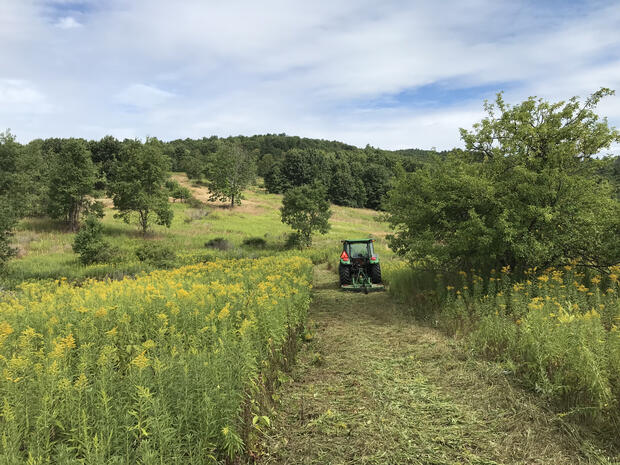
Grasslands are open habitats dominated by grasses that also support other herbaceous vegetation, including flowering plants. These habitats support some of the richest suites of specialized and imperiled species in Massachusetts, with over 150 Species of Greatest Conservation Need (SGCN) relying on them. Many grasslands require ongoing management to maintain the habitat type. Without management, woody species grow, close the canopy, and shade the ground cover. Grassland habitats include the natural communities associated with dry grasslands and heathlands, like sandplain grassland and sandplain heathland, as well as cultural grasslands.
MassWildlife proposes managing 2% of its upland habitats as grasslands, primarily though mowing, prescribed fire, and conversion from cold season to warm season grasslands.
Shrublands
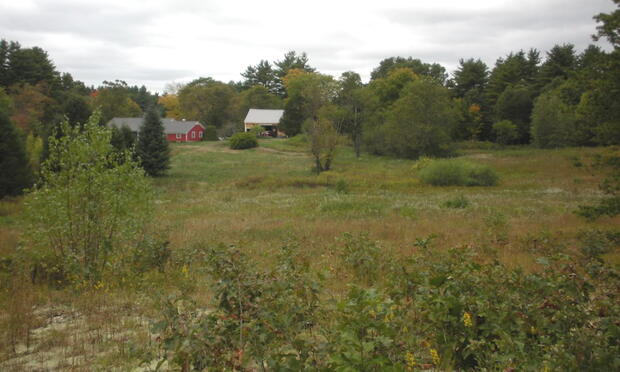
Shrublands are areas dominated by low woody vegetation, with varying amounts of herbaceous plants (including grasses and flowing plants) and sparse young tree cover. These areas provide foraging and nesting sites for many pollinators, nesting and basking habitat for reptiles, and breeding sites for songbirds, including many declining shrubland birds. These habitats require periodic disturbance to persist on the landscape and support over 61 SGCN. MassWildlife has worked on upland shrubland restoration and management project in project in natural communities such as: Pitch Pine - Scrub Oak Community, Ridgetop Pitch Pine - Scrub Oak Community, Sandplain Heathland, and Scrub Oak Shrubland, and Sandplain Heathland - Inland Variant.
MassWildlife proposes managing 8% of its upland habitats as shrublands, primarily through selective tree removal, followed by mowing, mulching, and potentially prescribed fire.
Young forests
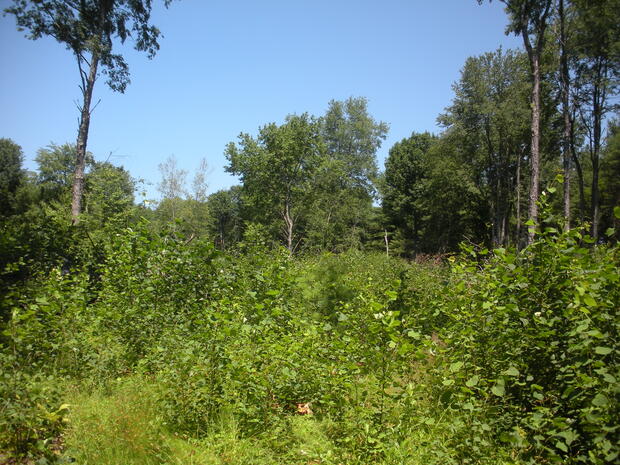
Young forest conditions are found in forests that are less than 20 years of age and occur where a natural or human-induced disturbance has resulted in removal of overstory trees. These areas can move across the landscape or be maintained in place through periodic disturbance, supporting over 87 SGCN. Young forests may occur within any forest type, including wetlands, and are characterized by regenerating stands of young trees, accompanied by shrubs, grasses, and flowering plants. They typically fall within the natural communities associated with oak forests and woodlands, northern hardwood conifer forests, and maritime forests and shrublands. Disturbance dependent forest communities, such as dry woodland and barrens, can also maintain, and be managed for, young forest conditions.
MassWildlife proposes managing 10% of its upland habitat as young forests. Of this, 50% will be managed in place—returning to the same location to continuously maintain it as open habitat through selective tree removal and mowing; and 50% of the young forest will move across the landscape—as areas of young forest age, new areas of young forest will be created through selective tree removal and mowing, building a dynamic landscape.
Barrens
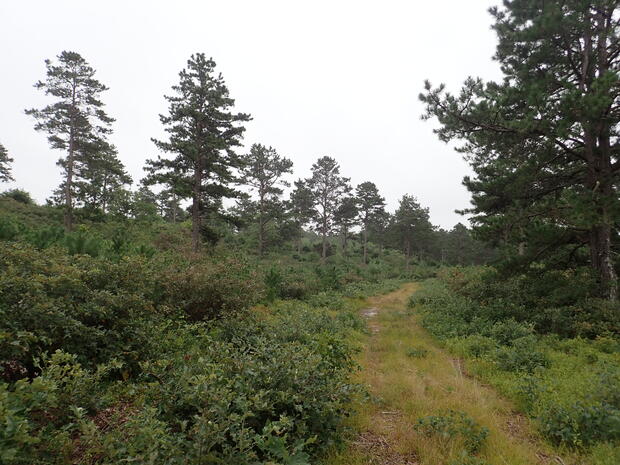
Barrens are a globally rare habitat that support unique assemblages of endemic species. The vegetation structure can vary across sites, but all barrens share dry, nutrient poor soils and communities that are dependent upon disturbance. Due to the reoccurrence of natural disturbance events, most barrens retain a relatively open canopy cover. Most barrens in Massachusetts are found in coastal areas, but smaller isolated barrens can also be found inland in areas. Barrens habitats support over 135 SGCN. Note: Depending on the structure of the particular barrens, work to restore these critical habitats will fall within young forests or shrubland goal categories highlighted above.
Closed canopy habitats
Mature and maturing forest
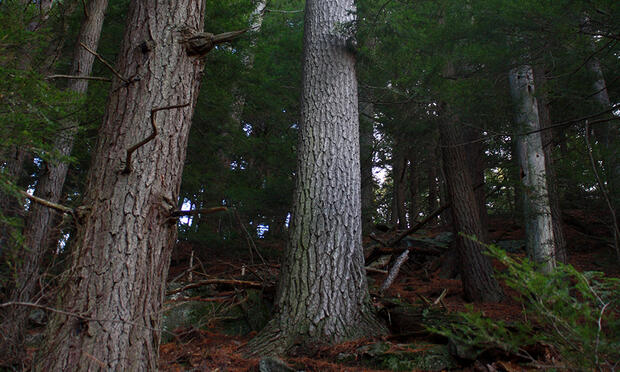
Mature forest conditions are found mostly in closed canopy forests with scattered older and larger trees (over 80 years), some small gaps and openings in the canopy, well-developed organic soils, and large woody material in various stages of decay. Mature forests will look different depending on the site and the dominate tree cover type. For example, a highly shaded dense hemlock forest is very different from a mixed northern hardwoods forest. And even some open habitats, like barrens, have mature trees. Mature forest may require active management to protect native species and keep these sites on their developmental trajectory. The most common reason for intervention is reducing the impact from invasive species. As a forest matures into older growth, it will increase structural complexity that can create micro habitats and niches for invertebrates, animals, plants and lichen to inhabit, supporting over 116 SGCN. Any of the upland or wetland forest habitats of Massachusetts, and their associated natural communities, may develop into mature forest. In Massachusetts, with its long history of human landscape alteration, northern hardwood and conifer forests and oak forests and woodlands represent the majority of currently existing mature upland forests.
The majority (78%) of MassWildlife’s uplands will be left to age and develop as mature and maturing forests.
Forest Reserves
A subset of mature and maturing forests will be formally designed as Forest Reserves, landscapes where natural processes, including small and large-scale natural disturbances, determine changes in the long-term structure, composition, function, and dynamics of the forest ecosystem. MassWildlife worked alongside DCR and EEA to develop criteria and guidance for establishing forest reserves and for what kind of activities are allowed in those reserves. Reserves will generally be managed passively without attempts to alter ecosystem process and function or shape structure and composition. More information on those criteria, guidelines, and allowable activities is available here.
MassWildlife is proposing a goal for designating 20% of upland forests as Forest Reserves. The intent is for these areas to develop into more structurally complex, mature forests that support a suite of species.
Broad benefits of upland habitats
By promoting functional, interconnected systems and restoring unique habitat types and features, MassWildlife is ensuring the full suite of benefits and values of these lands are realized, including biodiversity conservation, public access to nature for recreation, and climate resilience.
- Biodiversity: Restoring critical habitat aligns with the 2025 Biodiversity Goals for Massachusetts, which call for restoring 75% of our most important habitats. This will be achieved through both active and passive management techniques. As noted above, these upland habitat types support a significant portion of SGCN identified in the 2025 SWAP.
- Public access to nature for recreation: Maintaining a mosaic of upland habitats on public lands provides opportunities for hunting, birding, and other wildlife viewing. Many of our restored and managed sites become hotspots for recreation and provide unique experiences not available on other protected lands.
- Building climate resilience: Healthy ecosystems provide clean air, clean water, flood storage, and carbon storage and sequestration. Protecting lands ensures they can continue to provide these benefits into the future. Then, managing those lands restores ecological processes and a complex mosaic with diverse species compositions and age classes, which makes them more resilient to natural disturbance events. Carbon accounting on MassWildlife lands has shown that carbon sequestration and storage over time vastly outnumbers the small amounts of carbon initially released from management on a small portion of our lands. MassWildlife will also continue to utilize climate-oriented management strategies and address the Climate Forestry Committee’s recommendations, including managing in a way that balances multiple values, managing most upland habitat as aging forests, reducing early successional habitats, and increasing forest reserves.
More resources
- MassWildlife’s featured habitat projects
Learn about the variety of habitat management activities MassWildlife conducts across the state. - Habitat restoration resources
Explore Massachusetts habitats and learn about the key practices for restoring and managing habitat. - Massachusetts State Wildlife Action Plan (SWAP)
The SWAP identifies and assesses the health of rare, declining, and vulnerable plants and animals in Massachusetts, and outlines key actions for conserving them. - Why is habitat restoration & management needed on MassWildlife lands?
Contact
Online
| Last updated: | June 17, 2026 |
|---|