

A flagship for inland barrens habitat restoration
Montague Plains Wildlife Management Area (WMA) is a globally and regionally significant inland pine barrens where decades of habitat restoration have helped sustain a remarkable diversity of wildlife and plant communities.
Pine barrens are globally rare ecosystems found in scattered locations from New Jersey to Maine along the Atlantic coast and nearby inland river systems or small rocky outcrops. They are formed on nutrient poor sandy soils. The extensive sandplain supporting the Montague Plains pine barrens in the Connecticut River Valley formed some 10,000 years ago, and this geologic base, the droughty soil conditions, and long history of fire, helps maintain a globally and regionally significant inland pine barrens. The ecological importance of Montague Plains was recognized long before modern restoration efforts began, and biologists and naturalists have documented its unusual flora and fauna for decades. The Commonwealth’s first land acquisition on the sandplain was in 1908, and efforts to conserve this special place continue today. There are now over 1,980 acres protected as part of the Montague Plains Wildlife Management Area (WMA). MassWildlife also works closely with conservation partners in the area, including the Town of Montague and the Massachusetts Department of Conservation of Recreation.
What does habitat restoration look like?
Over the past two decades, restoration has taken a phased approach. The first phase focuses on recovering the physical structure and characteristic open conditions of barrens communities through tree thinning. This selective tree removal allows sunlight to reach the ground, creates an open woodland or shrubland structure, and connects natural community patches. This phase may be followed by mowing and mulching depending on the buildup of dense vegetation in the midstory in preparation for reintroducing prescribed fire. Finally, prescribed fire is used to manage the barrens to maintain the open canopy of pine and oak woodlands and the structural complexity of understory vegetation. Invasive plant management is used alongside these tools to target invasive exotic plants that threaten the native plant communities.
Because units begin in different conditions and respond at different rates, these phases overlap across Montague Plains WMA. One unit may be receiving its first thinning while another is undergoing follow-up control and a third is ready for a maintenance burn. This staggered approach avoids treating the entire landscape at once and continually provides different vegetation heights, ages, and structures in close proximity.
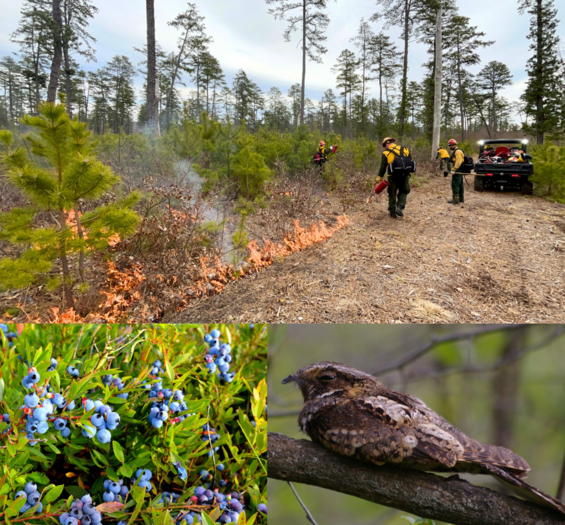
MassWildlife carefully plans and conducts prescribed fire to maintain habitat for barrens plants and specialized wildlife.
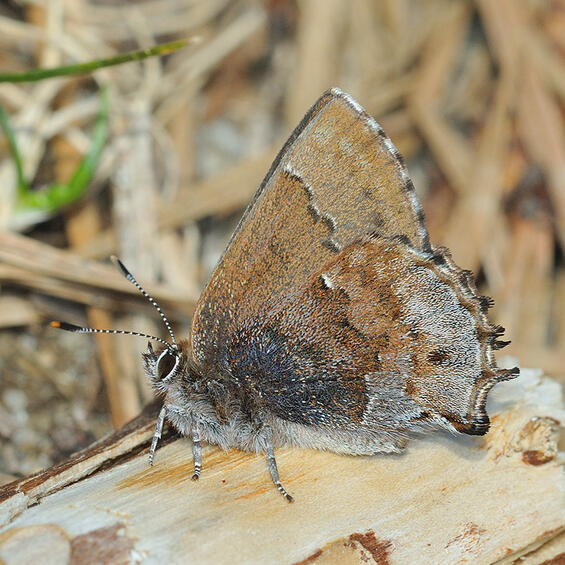
In 2023, MassWildlife discovered frosted elfins at Montague Plains WMA—one of many signs that restoration is benefiting rare species.
Measuring success
Montague Plains WMA has long served as an important center for biological research by universities and research institutions studying declining taxa, pine barrens ecology, and fire science in the Northeast. The site is particularly valuable for studies regarding the migratory and nesting habitat of declining bird species. Taxa under study include native birds, reptiles, invertebrates (including native bees, ants, butterflies, moths, tiger beetles) and plants, and results of these studies indicate that management is successful. Today, at least 50 Species of Greatest Conservation Need (SGCN) rely on the unique habitat of Montague Plains WMA.
The positive response of these species to habitat management is particularly evident among native bees and other pollinators. Both the number of bee species and the number of individual bees have increased in response to habitat management activities at Montague Plains. Today, the Plains are home to the greatest diversity of native bees documented in Massachusetts, which benefit from exposed mineral soils and abundant flowering plants such as low bush blueberry and yellow whorled loosetrife. On-going studies at the University of Massachusetts Amherst show that the native bee fauna is more abundant in thinned pitch pine woodlands and periodically burned scrub oak shrublands. Butterflies and moths listed under the Massachusetts Endangered Species Act (MESA) have also responded positively to habitat management at the Plains. Pine barrens management has favored dramatic increases in wild lupine and the return of the frosted elfin butterfly. Fire maintained shrublands and thinned pine and oak woodlands provide important habitat needed by declining songbirds, like eastern towhee, prairie warbler, brown thrasher, eastern whip-poor-will and native game birds, like ruffed grouse and American woodcock. Many of these species such as the whip-poor-will require the juxtaposition of open woodlands in close association to shrublands to complete their life cycle.
Learn more
Explore pine barrens of the Northeast
Montague Plains WMA on iNaturalist
Video: Montague Plains WMA on Connecting Point (New England Public Media)
Webinar: Fauna and Fire at Montague Plains (North Atlantic Fire Science Exchange)
Maintaining sandplain grasslands
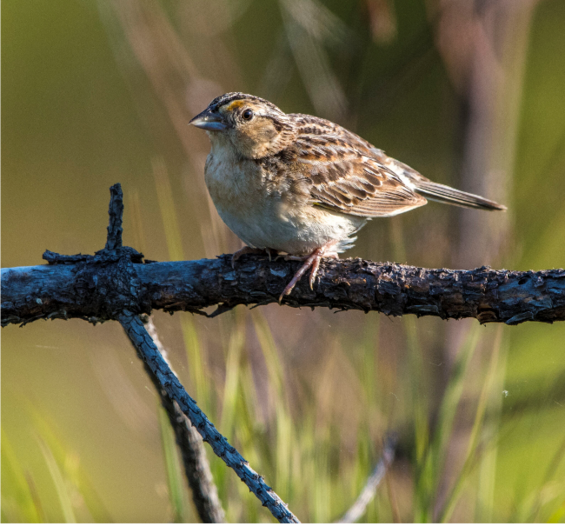
Grasshopper sparrows need healthy sandplain grassland habitats for nesting.
One of the most imperiled natural communities in Massachusetts and in the world, sandplain grasslands are mostly treeless communities, dominated by native grasses and herbaceous species with sparse shrubs, on sand or other dry, low-nutrient soils. Sandplain grasslands are found at Frances Crane Wildlife Management Area (WMA) in Falmouth and Bourne, which is home to more than 20 species listed as endangered, threatened, or of special concern under the Massachusetts Endangered Species Act (MESA), ranging from grassland birds to less familiar creatures, such as butterflies and moths, tiger beetles, and plants. For more than a decade, MassWildlife has been active in restoring and maintaining this critical habitat at Frances Crane WMA.
What does habitat restoration look like?
MassWildlife conducted extensive restoration operations at Frances Crane WMA to expand the sandplain grassland and to improve the surrounding pitch pine and oak woodland habitats. Between 2014 and 2017, MassWildlife expanded the primary ~150-acre grassland by cutting woody species, removing stumps, grading, and planting native little bluestem grass. The grassland now encompasses nearly 400 acres, making it one of the largest warm season grasslands in New England. During the same years, MassWildlife thinned and introduced prescribed fire to the surrounding woodlands to restore open oak-pitch pine woodland with scrub oak, lowbush blueberries, and other native vegetation. Since then, invasive species control, mowing, and prescribed burns have been periodically conducted to keep these disturbance-dependent habitats healthy.
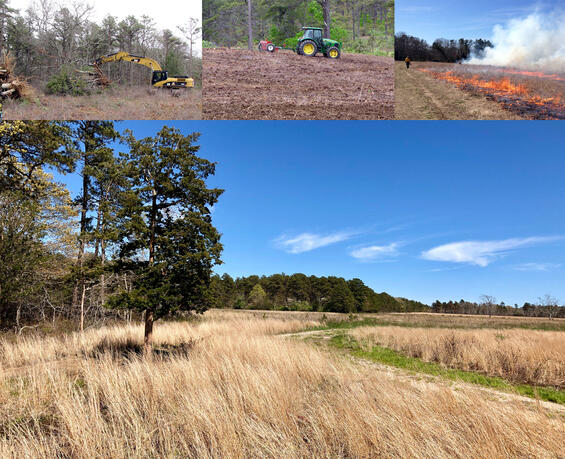
Selective tree cutting, grading, and planting were used to expand grassland habitat at Frances Crane WMA. Regular application of prescribed fire maintains this disturbance-dependent habitat.
Measuring success
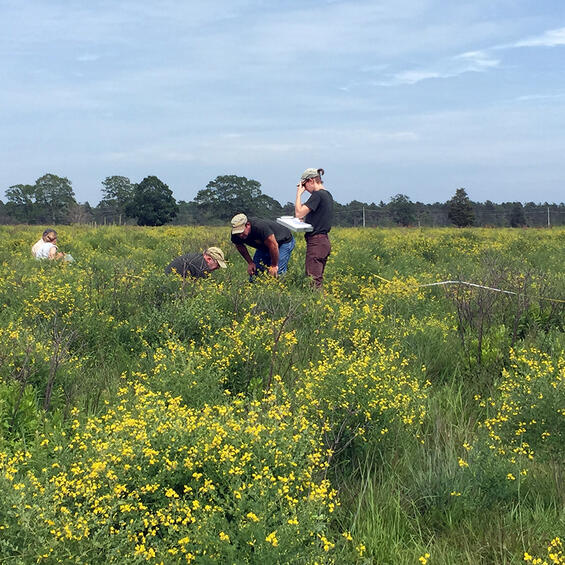
MassWildlife staff monitors after a prescribed burn.
Positive results of the extensive restoration projects at Frances Crane WMA can be observed on several fronts. Populations of some rare and endangered species are increasing. For example, the number of breeding pairs of grasshopper sparrows has had an exponential increase over the last 25 years. The site now supports around 70 territories, compared to a single grasshopper sparrow surveyed prior to restoration. The purple tiger beetle, which formerly occurred in low numbers in just a few small areas, is now found in greater numbers across a significantly larger portion of the WMA. And sandplain gerardia, an endangered plant that has been thriving as a result of habitat management efforts. Additionally, hunting opportunities have improved with the thinning of dense vegetation, and the WMA is a beloved destination for bird and butterfly enthusiasts.
Learn more
Restoring globally rare barrens
Barrens are globally rare ecosystems that support a disproportionately high number of the region’s specialized, rare, and imperiled plants, animals, and invertebrates. Vegetation varies across sites, but all barrens are characterized by dry, nutrient-poor soils and communities that are dependent upon disturbance (primarily fire). This regular disturbance accounts for the relatively open canopies found in most barrens occurrences. Barrens are found on the coastal plain and on the glacial outwash associated with interior river valleys, and occasionally on the exposed bedrock of ridges across Massachusetts. Especially in the interior of the state, many of these sites have become degraded and obscured by the encroachment of generalist species due to a lack of disturbance, but MassWildlife’s experience—beginning with the restoration of the cryptic barrens of Muddy Brook WMA in Hardwick—shows that these sites can not only be restored, but they can once again thrive.
What does habitat restoration look like?
Muddy Brook was first identified in 2004 as a cryptic barrens site by MassWildlife staff who found clues in the widespread presence of key barrens community indicator species, such as pitch pine, scrub oak, native warm-season grasses, and large aggregations of low-bush blueberry. After 10 years of studying and inventorying the site, restoration began in 2014. Generally speaking, the restoration approach in cryptic barrens is often a two-step process. Step one involves a timber harvest designed to remove the generalist tree species, such as white pine, that have established due to a lack of disturbance and reset the composition and structure of the historical community. Keystone tree species in barrens communities, such as oak, pitch pine, and hickory, are retained. Step two introduces periodic prescribed fire to the landscape to maintain these naturally fire-adapted communities— and the species that rely upon them—far into the future.
Measuring success
During the pre-restoration period, a total of 7 MESA-listed species were identified, as well as seven species included on MassWildlife’s Natural Heritage and Endangered Species Program’s (NHESP) Plant Watch List—most of which were associated with the wetlands and waterways on site. As of 2026, just twelve years after initial restoration began, there are now 22 MESA-listed species on Muddy Brook WMA, 14 of which have been established as a direct result of the restoration work, plus an additional 5 MESA-listed species that were reintroduced or translocated onto the site now that it has regained its barrens integrity. Further, the site now hosts 13 Plant Watch List species, and a very long list of other uncommon, highly specialized barrens-obligate plants and animals. Bees documented on site has increased from 36 species before restoration, to 103 just two years following the initial timber harvest, to 179 species in 2024, including the macropis cuckoo bee (thought to be globally extinct as recently as 2002).
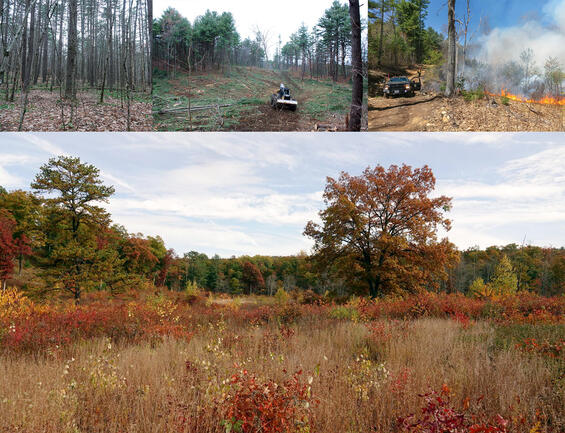
Before restoration, dense stands of white pine and other fire-intolerant tree species dominated the area. Selective tree cutting and reintroduction of periodic prescribed fire have restored natural processes and allowed specialized plants to emerge and wildlife species to thrive in the Muddy Brook Valley.
Learn more
Supporting mature forests
Rich mesic forests are dominated by hardwoods, such as sugar maple, white ash, hickory, basswood, hop hornbeam, and red oak. Most rich mesic forests will develop along the moist nutrient-rich colluvial soils found on east or south facing slopes; there, you will commonly find a forest canopy dominated by sugar maple accompanied by rich herbaceous flora thriving on the forest floor. Ephemeral native plants form spectacular floral displays in the spring of each year; wild leeks, blue cohosh, and many rare plants are found in these natural communities. But the conditions that support this unique natural community also make the system vulnerable to threats. Invasive plant species do very well in the nutrient-rich, mesic conditions associated with these forests. The exemplary rich mesic forests found in several upland portions of Maple Hill WMA in West Stockbridge require active interventions to control the spread of invasive plant species into this mature forest.
What does habitat restoration look like?
In 2016, MassWildlife undertook an herbicide treatment project spanning 68 acres at Maple Hill WMA to control invasive plant species in the former agricultural areas adjacent to high quality rich mesic forest stands. Invasive targets in these areas included large Japanese barberry stands, dense areas of honeysuckle, dense thickets of multi-flora rose, and Asiatic bittersweet occurrences that extended up into the canopy.
The long-term management goal at this site is to control invasives and support a mosaic of meadow, shrubland, and rich mesic forest. Invasive plants can outcompete native herbaceous plants and reduce tree regeneration in rich mesic forests. Invasive plant control treatments are planned for 2026 and 2027 to continue to reduce and ultimately control the invasive plant pressure along the boundaries of the rich mesic forest stands.
Measuring success
Active management in this location has allowed the rich mesic natural community to persist, reducing further constriction or fragmentation of this special forest type. Rare plant species are still found in this location.
Invasive species will continue to threaten native plant growth and regeneration and reduce the integrity of the rich mesic forest. Ongoing monitoring of the site is necessary to identify when treatment thresholds are reached.
Restoring fish passage
Removing dams that are in poor condition or have outlived their original purpose is one of the best restoration actions to restore aquatic connectivity and increase climate resilience of Massachusetts rivers and streams. MassWildlife supports and partners on stream connectivity projects across Massachusetts to improve aquatic habitat, restore natural river processes, and enhance fish and wildlife passage. One notable success was the Hamant Brook Dam Removal Project in Sturbridge, completed in 2018. Through a collaborative effort involving local landowners and conservation partners, three aging dams were removed, restoring a free-flowing stream and reconnecting important coldwater habitat for native species.
What does habitat restoration look like?
Each project is unique in terms of its exact scope and approach, but, in general, dam removals will remove all infrastructure within aquatic habitats, as well as the full removal of supporting infrastructure on stream banks. The goal is to reroute all water back to the natural river channel or lakebed and provide unobstructed movement of organisms, water, nutrients, and sediments.
In 2018, three aging dams were removed along a three-quarter-mile stretch of Hamant Brook in Sturbridge. The project was the culmination of nearly a decade of planning and collaboration among the landowners—the Town of Sturbridge and Old Sturbridge Village—and project partners, including MassWildlife, American Rivers, and the Division of Ecological Restoration. The dams on Hamant Brook, and the shallow, warmwater ponds that they created, are gone, replaced by a grassy meadow and free-running trout stream. Over the next several decades this meadow will change as brush, shrubs, and trees take root in the fertile sediments that were pond bottom.
Measuring success
The project restored a section of Hamant Brook that is designated as a Coldwater Fish Resource. Removing the dams improved water quality, restored passage for fish and other aquatic organisms, enhanced river and streamside habitat connectivity, and eliminated aging infrastructure. The restored stream allowed species such as brook trout and wood turtles to move more freely. MassWildlife biologists will continue to monitor the project area to document the recolonization by native species and to guard against, and remove if necessary, exotic invasive species that may try to take advantage of this new landscape.
Surveys within the reach in the last several years have documented the restoration of riverine habitat. The former impoundments, once dominated by warmwater pond fish species like panfish and bass, now have fish communities made up of more typical native riverine species like blacknose dace and white sucker. As the reach becomes more shaded by increasing stream bank and wetland plants, we expect to see brook trout extend through the reach as well. Monitoring is ongoing.
Starting in 2024, MassWildlife embarked on an effort to remove seven dams from Wildlife Management Areas across the state. Work on these projects is expected to conclude in 2026.
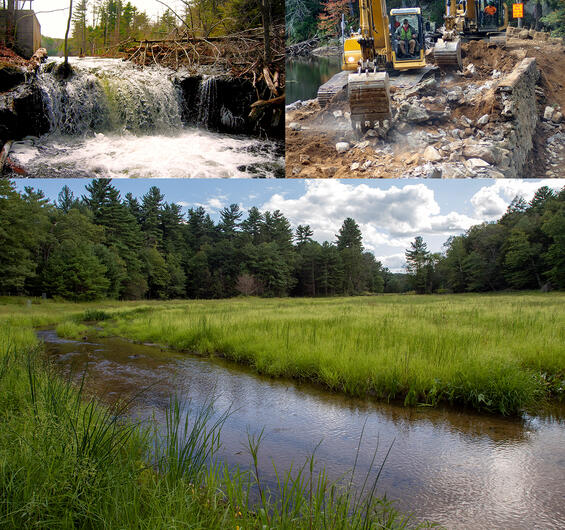
Aging dams and streambank infrastructure were removed along Hamant Brook allowing natural streamflow to return.
Learn more
Working across boundaries
To support a diversity of wildlife and strengthen vulnerable species populations, it is important to maintain a dynamic mix of different habitat types in close proximity. This allows species to move between habitats and use them during different life stages. Having multiple populations of the same species across the landscape also provides redundancy, reducing the risk that local disturbances will threaten the species throughout the region. MassWildlife works with a range of partners to achieve landscape-scale habitat restoration. A prime example of this work is happening at the U.S. Army Corps of Engineer’s (USACE) Birch Hill Dam in Templeton and Winchendon. This large property contains a variety of habitats, and thoughtful management can benefit a range of species across the area.
What does habitat restoration look like?
MassWildlife and USACE began working on a restoration vision and strategic planning for this site in 2014. Field assessments, including moth and butterfly inventories and vernal pool surveys, were conducted by MassWildlife and USACE contractors.
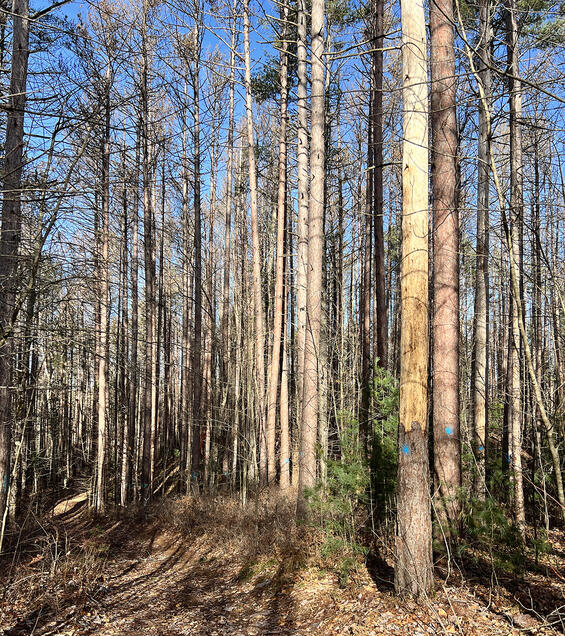
Dead and dying plantation of red pine trees marked for removal.
In 2022, USACE approved a License granting MassWildlife authority to conduct fish and wildlife activities on about 3,818 acres at Birch Hill Dam. A diversity of habitats and priority natural communities will be managed and/or restored under the License, including important fire-influenced habitats, such as oak and pine woodlands and savannas, as well as mesic oak forests, mixed hardwood-hemlock-white pine forests, and structurally diverse mixed hardwood forests.
The first phase of restoration was conducted along the Otter River in Templeton at a plantation of dead and dying red pine trees infested with an invasive insect called red pine scale. The red pines were removed, while oaks and pitch pine were retained. The open canopy now allows sunlight to reach the forest floor, and soil disturbance from the tree skidding has stimulated the understory seed bank to germinate and grow.
Work has also been done to control invasive plants and to return fire to the landscape through periodic prescribed burns.
Habitat management activities at USACE Birch Hill Dam are contributing to the restoration of one of the largest inland cryptic barrens in the region. In addition to the USACE Birch Hill Dam, restoration efforts span MassWildlife’s Birch Hill WMA and the Department of Conservation and Recreation’s Otter River State Forest.
Measuring success
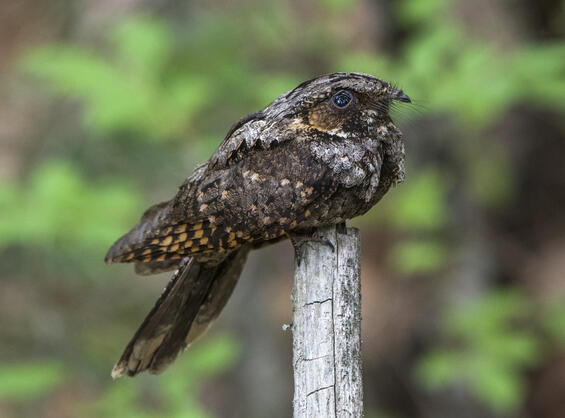
Eastern whip-poor-wills make their homes in areas that experience regular disturbance, like fire.
In the 1960s, the Birch Hill Dam area was a stronghold for eastern whip-poor-will; however, they declined over time with the loss of suitable habitat, though they are still found nearby. At the end of May 2025, portions of the USACE Birch Hill Dam property were included in the annual survey route for whip-poor-wills, and one was heard within the Phase I restoration unit, confirming the presence of this state listed species after a 60+ year absence.
Similar restoration efforts at the nearby Birch Hill WMA have led to the return of MESA-listed moths and butterflies, early successional birds, and rare plants, which are benefiting from the shifting mosaic of habitats across the landscape. MassWildlife will continue biological monitoring, and it is expected that additional rare and highly specialized species will continue to recolonize the USACE Birch Hill Dam site as restoration progresses.
Learn more
Maintaining young forest
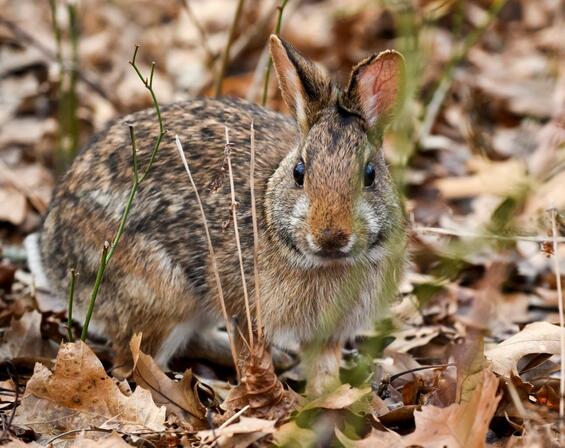
The New England cottontail is our only native rabbit. It looks similar the eastern cottontail, a non-native rabbit introduced in the late 1800s that is commonly seen in yards, parks, and fields.
Young forest conditions (less than 20 years of age) occur where a natural or human disturbance has resulted in removal of overstory trees within a forest. Young forests may occur within any forest type and are characterized by regenerating stands of young trees, accompanied by shrubs, grasses, and flowering plants. These areas provide particularly important cover and food for migrating, breeding, and fledgling songbirds, foraging habitat for large mammals, as well as for the winter cover for the New England cottontail. Young forest habitat also provides quality outdoor recreational opportunities for sportsmen and women of the Commonwealth. At Stafford Hill WMA in Cheshire, there is an opportunity to maintain young forest habitat centered on unique aspen stands on site.
What does habitat restoration look like?
Historically, much of this property was a working dairy farm. As the fertile farm fields were abandoned, pioneering or sun loving tree species, like aspen, began to rapidly grow. The mix of aspen, field edges, and remaining open grasslands found at Stafford Hill WMA is critical to many wildlife species and upland birds. To enhance the habitat for prime young forest conditions, management practices began in 2005 by removing select trees and other woody vegetation to stimulate young aspen growth, to restore an apple orchard, and to maintain open grasslands.
Several phases of successful habitat management at Stafford Hill WMA, including tree clearing and mulching, have produced over 250 acres of young forest habitat that includes aspen (Populus tremuloides) as a significant component of its composition. Large contiguous stands of aspen at this high elevation are not common within the state. Aspen is an important food and cover source for ruffed grouse, American woodcock, and migratory songbirds, like the mourning warbler. This type of habitat enhancement and creation helps support wildlife populations that are declining in many areas of the region.
Areas dominated by trembling or bigtooth aspen are excellent candidates for ongoing management because they provide valuable habitat for a wide variety of SWAP species. Young aspen dominated stands are relatively uncommon in Massachusetts, making them especially important from a habitat conservation perspective. Because aspen readily regenerates through root sprouting following cutting or mowing, these areas are well suited to ongoing, or “in place” management (management activities conducted periodically at the same location to maintain desired habitat conditions), on approximately a 40-year rotation. Maintaining a range of aspen stand ages across the property from recently regenerated stands to 40-year-old stands helps ensure continued diverse habitat conditions that benefit rare and common species.
In addition to young forest restoration work at Stafford Hill, MassWildlife has also been conducting calcareous fen restoration on the site.
Measuring success
Since 2001, MassWildlife has conducted breeding bird monitoring at Stafford Hill WMA. The survey data show that the habitat work at the property is providing important breeding habitat for numerous SWAP bird species, including but not limited to eastern towhee, brown thrasher, field sparrow, black and white warbler, ruffed grouse, Nashville warbler, and American kestrel. These biological surveys, along with citizen science data submitted through the Cornell Lab of Ornithology’s eBird platform, provide a wealth of bird data, not only within the nesting season but also spring and fall migrations. This diversity has led to Stafford Hill WMA becoming an eBird birding hotspot.
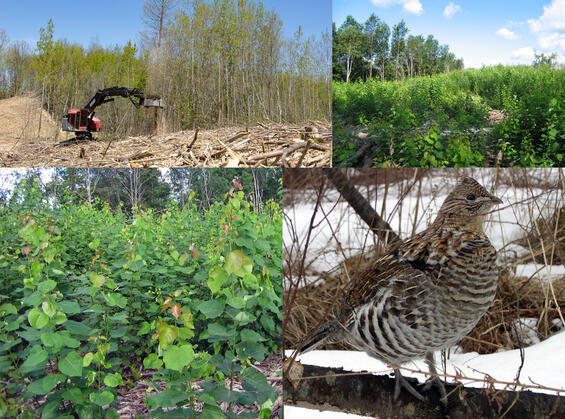
Young forest habitat is maintained at Stafford Hill WMA by selective tree removal and mulching. This allows vigorous regrowth of aspen trees which provide food and cover for many types of wildlife, including ruffed grouse.
Learn more
Contact
Online
| Last updated: | June 16, 2026 |
|---|