
- Scientific name: Papaipema cerina
- Species of Greatest Conservation Need (MA State Wildlife Action Plan)
- Endangered (MA Endangered Species Act)
Description
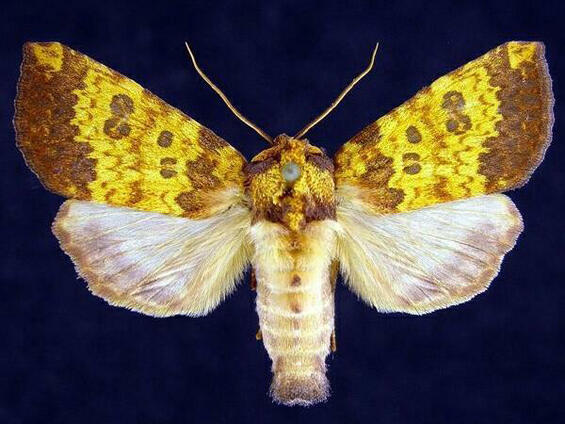
Golden borer moth, Papaipema cerina
The golden borer (Papaipema cerina) is a noctuid moth with a wingspan of 35-40 mm (1.4-1.6 in). The forewing is bright yellow in color, with rusty brown distal to the postmedial line and in the basal area, and a yellow apical patch. The reniform, orbicular, and claviform spots are all rusty brown in color. The median line is pale rusty brown, relatively thick but diffuse, blending with the yellow of the median area. The hind wing is pale tan, tinged with pale rusty brown shading distally. The elongate scales of the head and thorax are predominantly yellow, mixed with a variable amount of rusty brown; the abdomen is pale tan, tinged with pale rusty brown.
Life cycle and behavior
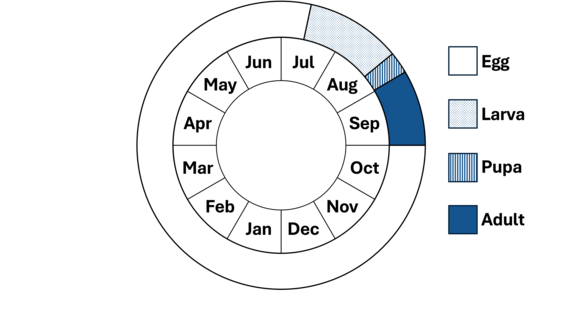
In Massachusetts, golden borer moths fly in September. Eggs overwinter, hatching in early summer. The larvae bore into and feed internally on the stems of eastern bottlebrush grass (Elymus hystrix). Late instar larvae have been found in other plants, including lilies (Lilium spp.) and mayapple (Podophyllum peltatum) (Schweitzer et al. 2011). Larvae are fully grown and pupate in August.
Distribution and abundance
The golden borer moth occurs from southern Maine south to New Jersey, and west to Wisconsin and Kansas (Schweitzer et al. 2011). In Massachusetts, there is currently only one known population in Hampshire County.
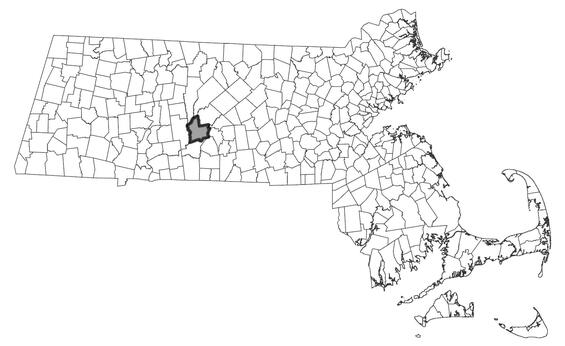
Distribution in Massachusetts.
1999-2024
Based on records in the Natural Heritage Database.
Habitat
In Massachusetts, the golden borer moth inhabits grassland with eastern bottlebrush grass (Elymus hystrix) and native forbs, including openings and edges within a forested landscape.
Healthy habitats are vital for supporting native wildlife and plants. Explore habitats and learn about conservation and restoration in Massachusetts.
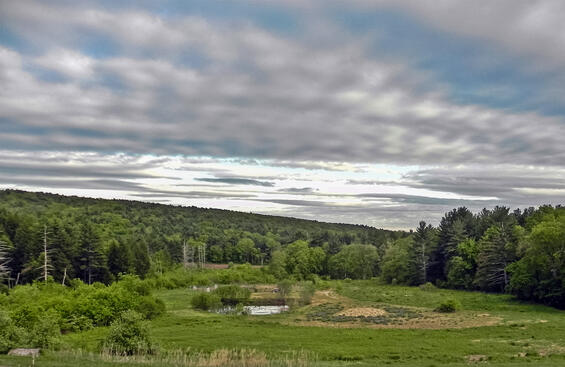
Grassland with native grasses and forbs, habitat for the golden borer moth.
Threats
The golden borer moth is threatened by habitat loss and suppression of natural disturbance such as fire or flooding, which is needed to maintain its grassland habitat and allow growth of its larval host plants. Other potential threats include invasive exotic plants, excessive browse of host plants by overabundant deer, aerial insecticide spraying, non-target herbicide application, and off-road vehicles. A warming climate may be detrimental to this species, as its range has a narrow latitudinal extent. Northward range expansion may be possible, though this has not yet been documented.
Conservation
Land protection and habitat management are the primary conservation needs of this species in Massachusetts. In particular, grassland with eastern bottlebrush grass and native forbs should be conserved, restored, and managed to maintain habitat for this species and other species dependent on such habitat.
Survey and monitoring
It is unlikely that there are more than a few, if any, undocumented populations of golden borer moth in Massachusetts. Known populations of this species should be surveyed to document persistence at least once every 25 years; every 10 years is more desirable when practicable.
Management
Management of grassland habitat with native grasses and forbs benefits a suite of species, and habitat condition should be monitored and management adapted as needed. For the golden borer moth, grassland with eastern bottlebrush grass (Elymus hystrix) and native forbs is of particular importance.
Research needs
The natural history and conservation needs of the golden borer moth are only partially understood. In particular, are native forbs alternative host plants to eastern bottlebrush grass, or are such plants only used secondarily by late instar larvae? If used secondarily, is this necessary to complete larval development, or is eastern bottlebrush grass sufficient? In addition, the future effects of climate change on this species are unpredictable and should be documented.
References
Schweitzer, D.F., M.C. Minno, and D.L. Wagner. 2011. Rare, Declining, and Poorly Known Butterflies and Moths (Lepidoptera) of Forests and Woodlands in the Eastern United States. Forest Service, U.S. Dept. of Agriculture, Washington, DC. 517 pp.
Contact
| Date published: | March 24, 2025 |
|---|