
- Scientific name: Littoridinops tenuipes
- Species of Greatest Conservation Need (MA State Wildlife Action Plan)
- Special Concern (MA Endangered Species Act)
Description
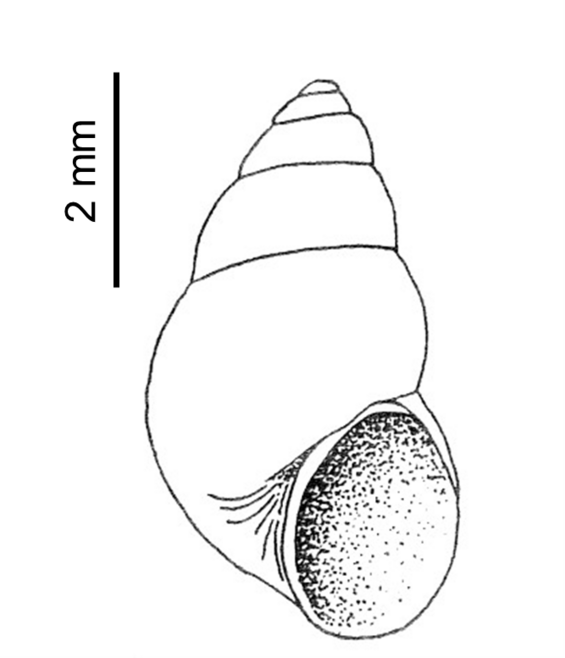
A drawing of a hydrobe shell.
The henscomb hydrobe is a small snail with an average shell length of 4 mm (0.16 in). Its spiral shell is generally thin and transparent but can be thicker and more opaque in larger specimens. The shell appears glossy and light brown or olivaceous in color with nearly 5 relatively flat-sided whorls (Pilsbry 1952). The shell aperture (opening to shell cavity) is dextral (coiled to the right when facing observer) and has an operculum, a hardened circular structure that seals the shell. The operculum of this species is characteristically thin and transparent and has a single spiral that fans out to the perimeter of the operculum (i.e., paucispiral). Identification of this species is difficult because it requires knowledge of the anatomical features of snails.
The henscomb hydrobe is similar in appearance and co-occurs with other species in the hydrobioid group including the New England siltsnail which has a broader conical shell. Identification guides sufficiently illustrate the differences among these species (Smith 2000).
Life cycle and behavior
Little is known about the life history of the henscomb hydrobe. Adults are found in summer and probably live 2 to 3 years (D.G. Smith, personal communication 2003). Snails in this family (Hydrobiidae) are browsers, consuming fine particulate matter or grazing diatoms and other microorganisms on various substrates. This species has separate sexes and fertilization takes place internally (Taylor 1966). Eggs are deposited by the female and are enclosed in a protective capsule.
Distribution and abundance
The henscomb hydrobe is distributed along the Atlantic coast from northern Massachusetts south to Florida, with Massachusetts as its northern range limit. Here it is known from two localities confined to the north shore where development pressures are high. The henscomb hydrobe is listed under the Massachusetts Endangered Species Act as a species of Special Concern. All listed species are protected from killing, collecting, possessing, or sale and from activities that would destroy habitat and thus directly or indirectly cause mortality or disrupt critical behaviors. In addition, listed animals are specifically protected from activities that disrupt nesting, breeding, feeding, or migration.
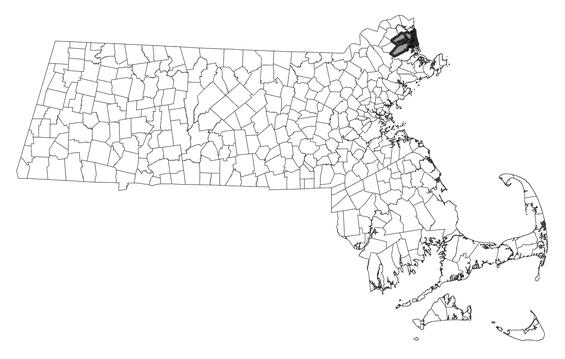
Distribution in Massachusetts. 2000-2025. Based on records in the Natural Heritage Database.
Habitat
The henscomb hydrobe inhabits coastal waters that are fresh or oligohaline. In Massachusetts, this snail has been found in a ditch containing cattails (Typha spp.) and rushes that drains an oak-alder-pine swamp. Here, the henscomb hydrobe occurred with the New England Siltsnail (Floridobia winkleyi) and the saltmarsh hydrobe (Spurwinkia salsa). The henscomb hydrobe was also found in a tidal marsh dominated by cattails. Co-occurring snail species included the New England siltsnail and pulmonate snails from the genus Lymnaea. Elsewhere, this species is known from streams and ditches with little or no water current and is usually found on hard sand beds (Thompson 1968).
Healthy habitats are vital for supporting native wildlife and plants. Explore habitats and learn about conservation and restoration in Massachusetts.
Threats
Threats to henscomb hydrobe include habitat degradation and loss from commercial and residential development, sea-level rise associated with climate change, chemical pollution from development and road runoff, and legacy effects from agriculture (e.g., ditch creation and nutrient pollution).
Conservation
Survey and monitoring
Surveys for henscomb hydrobe are needed at historical sites and potentially suitable locations in northeast and southeast MA. Monitoring efforts are recommended every 5 years or as needed (e.g., in response to potential disturbance events) to update its population status in Massachusetts.
Management
As with many rare species, the exact management needs for the species are unknown. However, the protection of henscomb hydrobe habitat is critical for species persistence in Massachusetts. Restoration and protection of saltmarsh habitats would likely benefit this species.
Research needs
The population status of henscomb hydrobe remains uncertain in Massachusetts. Surveys targeting historical and new sites are needed to better understand its distribution and habitat requirements. Basic life history traits (e.g., lifespan, dispersal) for this species are unknown. Species risk assessment to sea-level rise and associated habitat loss via climate change is warranted.
References
Pilsbry, H.S. 1952. Littoridina tenuipes (Couper). Nautilus 66:50-54.
Smith, D.G. 1987. The Genus Littoridinops (Mesogastropoda: Hydrobiidae) in New England. The Veliger 29(4):442–444.
Smith, D.G. 2000. Keys to the freshwater macroinvertebrates of southern New England. Published by author. Sunderland, MA. 243 pp.
Taylor, D.W. 1966. A remarkable snail fauna from Coahuila, Mexico. Veliger 9: 152-228.
Thompson, F.G. 1968. The Aquatic Snails of the Family Hydrobiidae of Peninsular Florida. University Florida Press. Gainesville, FL. 268 pp.
Contact
| Date published: | April 11, 2025 |
|---|