
How degrees of kinship work
- Degrees of kinship are used to identify heirs at law in the “next of kin” category. The “next of kin” category applies only if there are no members in the first four groups of heirs: 1) the decedent’s surviving spouse; 2) the decedent’s descendants; 3) the decedent’s parents; and 4) the decedent’s siblings and their descendants. See G. L. c. 190B, §§ 2-102, 2-103, 2-106.
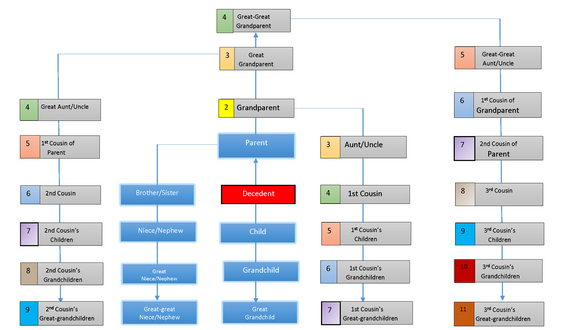
- The degrees of kinship chart is centered on the decedent. Relationships branch upward from the decedent to the decedent’s ancestors and sideways and downwards from the decedent’s ancestors to the decedent’s ancestor’s descendants. Again, the “next of kin” category only applies when the decedent dies without a surviving spouse, descendants, parents, or siblings.
- The numbers in the chart represent the order of nearness to the decedent and are referred to as “degrees of kindred.” The lower the degree or number, the closer a relation is to the decedent. The degrees of kinship start with “2” because the first four closest groups of heirs (surviving spouse, descendants, parents, and parents’ descendants) are the first degree. In the degrees of kinship list, each title is that person’s relation to the decedent.
- When there are multiple relations with the same degree, those who claim through the nearest ancestor are preferred. See G. L. c. 190B, § 2-103 (4). For example, if the nearest living relatives are a great-aunt, a great-uncle, and two first cousins (all fourth degree relations), the two first cousins inherit because they claim through the decedent’s grandparents – a closer ancestor than the decedent’s great-grandparents.
Degrees of Kinship
- Second degree
- Grandparent
- Third degree (in order of nearest ancestor to the decedent):
- Aunt/uncle
- Great-grandparent
- Fourth degree (in order of nearest ancestor to the decedent):
- First cousin
- Great aunt/uncle
- Great-great-grandparent
- Fifth degree (in order of nearest ancestor to the decedent):
- First cousin’s children
- First cousin of parent
- Great-great aunt/uncle
- Sixth degree (in order of nearest ancestor to the decedent):
- First cousin’s grandchildren
- Second cousin
- First cousin of grandparent
- Seventh degree (in order of nearest ancestor to the decedent):
- First cousin’s great-grandchildren
- Second cousin’s children
- Second cousin of parent
- Eighth degree (in order of nearest ancestor to the decedent):
- Second cousin’s grandchildren
- Third cousin
- Ninth degree (in order of nearest ancestor to the decedent):
- Second cousin’s great-grandchildren
- Third cousin’s children
- Tenth degree
- Third cousin’s grandchildren
- Eleventh degree
- Third cousin’s great-grandchildren
Degrees of Kinship Notes
- A first cousin is a child of the decedent’s aunt or uncle. A second cousin is a child of the decedent’s parent’s first cousin. A third cousin is a child of the decedent’s parent’s second cousin.
- The nearest living relatives of the lowest degree inherit the estate equally regardless of whether they claim on a mother’s side or a father’s side of the family. Children of deceased relatives in a class are excluded. See G. L. c. 190B, § 2-103 (4).
- If there are no known heirs at law, see G. L. c. 190B, § 2-105. In such cases, the Attorney General must be given notice.
Massachusetts Degrees of Kinship Chart
Contact
| Date published: | April 14, 2026 |
|---|---|
| Last updated: | April 14, 2026 |