
580 acres conserved for wildlife and outdoor recreation in Blandford
BLANDFORD — Today, the Department of Fish and Game (DFG) Division of Fisheries & Wildlife (MassWildlife), Department of Conservation and Recreation (DCR), and The Nature Conservancy (TNC) in Massachusetts joined local leaders, partners, and the public to celebrate the conservation of over 580 acres in Blandford for wildlife and outdoor recreation.
This project conserves a key piece of land across the Mass Pike (I-90), connecting over 39,000 acres of adjacent protected land to enhance wildlife migration and boost climate resilience in the region. Lands are open to the public as the new 360-acre MassWildlife Blandford Wildlife Management Area (WMA) and a 218-acre addition to DCR’s Chester-Blandford State Forest.
“Massachusetts is home to incredible forests, waterways and wildlife, and we’re committed to protecting them for generations to come,” said Governor Maura Healey. “By conserving more than 580 acres in Blandford, we’re protecting clean water and critical wildlife habitat, strengthening our resilience to climate change and opening up more land for people to get outside and enjoy.”
“Western Massachusetts has some of the most beautiful outdoor spaces in our state, and protecting them is good for our communities, our environment and our economy,” said Lieutenant Governor Kim Driscoll. “This project connects thousands of acres of protected land while creating more opportunities for residents and visitors to hike, explore and enjoy everything this region has to offer.”
“Protecting nature is essential for our wildlife and way of life. We are proud to support projects like this that invest in nature as a solution to climate change,” said Executive Office of Energy & Environmental Affairs Secretary Rebecca Tepper. “Conserving large forest areas will help reduce flooding, provide clean water, store carbon, and improve public safety.”
The Massachusetts Biodiversity Goals call for the state to double the pace of conservation to protect 30% of our lands and waters by 2030 and 40% by 2050, with focus on the most important habitats for wildlife and climate resilience. Additionally, the plan sets targets to identify and protect key wildlife migration corridors. Through the Mass Ready Act, the Healey-Driscoll Administration has proposed historic investments to accelerate progress towards these goals, including $304.5 million to support state land protection programs and $20 million dedicated to advancing the Biodiversity Conservation Goals.
“This project is a shining example of partnership to conserve large, connected landscapes for people and wildlife. Conserving connected lands gives wildlife the best chance of keeping pace with climate shifts, all while enhancing opportunities for people connect with nature through outdoor recreation,” said DFG Commissioner O’Shea. “Projects like this don’t happen overnight—they take tremendous partnership and collaboration. Thank you to our partners at DCR and TNC who made this possible.”
"This project is a testament to what we can accomplish when state, local and nonprofit partners work together towards a common goal," said DCR Commissioner Nicole LaChapelle. "This 580-acres will create new recreational opportunities while preserving cultural resources and protecting incredible landscapes that will help increase climate resilience. I want to thank the DCR staff and our partners at DFG and the Nature Conservancy for their years of work on this project and commitment to protecting our natural spaces."
A former Christmas tree farm, the property was initially purchased by TNC with the intent to permanently conserve the land with the state. It features a variety of important habitats for fish and wildlife, including mature forest, young forest, agricultural grasslands, wetlands, and four brooks (Sanderson, Cushman, Finley, and Peebles Brooks) in the Westfield River watershed. Conservation will protect water quality, nearby drinking water supplies, and important coldwater fish habitat that species like Eastern brook trout rely on. Additionally, conservation could enhance habitat for New England cottontail, Massachusetts’ only native rabbit that is vulnerable to habitat loss.
This project also conserves a key wildlife migration corridor, stitching together protected lands to create a contiguous landscape of over 39,000 acres of permanently protected land and one of the only links of protected land across I-90. MassWildlife, DCR, and MassDOT have had a long partnership to identify and facilitate transportation improvements for wildlife. Through this collaboration, the MassDOT Highway Division is developing a wildlife transportation action plan and monitoring wildlife use of culverts and bridges at various locations statewide. At this specific property, MassDOT and TNC are actively monitoring the culvert that connects lands on either side of I-90, and black bear, bobcats, coyotes, river otters, and other wildlife have already been documented passing through.
“Conservation is truly a team effort—this project is no exception. For years, this property has been a priority for our team because of its tremendous ecological value and rare opportunity for conserving connected lands for wildlife,” said MassWildlife Director Eve Schlüter. “We look forward to continued work with MassDOT and TNC to improve wildlife passage across the region and hope this project serves as an inspiration for what we can achieve when we come together.”
“The Appalachians are one of the most important landscapes in the world for biodiversity, and conserving this property helps keep that landscape connected across one of New England’s busiest transportation corridors,” said The Nature Conservancy in Massachusetts State Director Kris Sarri. “As our climate changes, connected landscapes are essential for wildlife to move, adapt, and thrive. By protecting these forests, streams, and wildlife habitats and strengthening a critical link in more than 39,000 acres of conserved land, we create a future where both people and nature flourish. This project shows what is possible when conservation partners work together to protect and reconnect the lands and waters that sustain us all."
“MassDOT congratulates MassWildlife, DCR and TNC on this land conservation achievement." said Tim Dexter, MassDOT Highway Division Deputy Director of Environmental Services. "We look forward to continued partnership with MassWildlife to reduce wildlife-vehicle collisions and improve wildlife connectivity within the Commonwealth."
Statements of Support:
“Access to the outdoors is one of the great benefits of living in Western Massachusetts, and this project will give people another reason to visit and explore our Hilltowns. Preserving this land in Blandford also protects an important connection for wildlife across the Mass Pike. I thank the Healey-Driscoll Administration and all the partners whose work made this possible,” State Senator Paul Mark (D-Peru).
“The Hilltowns have always been defined by their natural beauty, open spaces, and strong connection to the outdoors, and we should work to preserve those qualities for future generations,” said State Representative Nicholas Boldyga (R-Southwick). "This project represents an important step toward protecting the forests, waterways, and wildlife habitat that are such an important part of Blandford and the surrounding region. I’m pleased to see this land permanently conserved while also expanding public access and recreational opportunities.”
Deer hunting and freshwater fish regulations
New hunting and fishing regulations are now in effect for Massachusetts, including expanded deer seasons, limits on deer-based lures, and changes to trout and eel limits. See what’s changed before heading afield or on the water:
Deer hunting regulations
Freshwater fishing regulations
A place for bats to call home
Bat Week is coming up at the end of October—a perfect time to get to know the bats of Massachusetts! Learn more about these important nocturnal neighbors, the threats they face, and how you can help in the recent Massachusetts Wildlife magazine article, “A Place for Bats to Call Home.”
Wildlife-friendly fall clean-up tips
Leave the leaves
Although raking leaves seems synonymous with autumn, allowing some leaves to remain in your yard can provide benefits for plants and local wildlife. When they decompose, leaves return nutrients to the soil. In addition, fallen leaves provide cover and insulation to overwintering insects including many types of moths and butterflies.
Mow over fallen leaves to break them up and speed decomposition. Use a rake to spread out the leaves so underlying plants and grass aren't smothered. Excess leaves can be used as mulch in gardens and flower beds. Extras beyond that can be added to your compost bin.
Bonus: Leaving leaves in your yard can save you time in the fall, reduce the need for mulch in the spring, and keeps leaves out of landfills.
Make brush piles to help provide shelter for wildlife
During your fall clean up, make small brush piles along the edges of your yard. These piles may not seem like much to you, but they can provide shelter and insulation for many species of pollinators, birds, reptiles like turtles and snakes, amphibians like frogs and salamanders, and small mammals during the cold winter months. Especially in developed areas where natural shelter is hard to find, brush piles give wildlife a place to hide and rest.
Bonus: As the brush breaks down, it provides food for many of these animals and eventually returns nutrients to the soil.
Wait to clean up perennial plants and flower heads
Leaving your perennial beds a bit untidy can provide a boost to birds and insects. Not all birds migrate south for the winter; those that remain can survive on natural foods. Leaving flower heads on your plants can provide nutritious seeds with high fat content to birds throughout the winter. Pollinators like bees and butterflies can make use of hollow stems and other parts of the plants to overwinter.
Bonus: Using bird feeders can cause problems by attracting other types of wildlife to your yard, like bears, turkeys, and coyotes. Leaving natural areas in your yard can provide food for birds without the negative side effects of bird feeders.
Go native
Already dreaming about next year’s plantings? As you plan your gardening projects over the winter, use this list of native plants to select shrubs that provide food to many types of native Massachusetts wildlife.
Drivers, brake for moose and deer
Because fall is the breeding season for both moose and white-tailed deer, MassWildlife reminds motorists to be mindful of increased deer and moose activity, especially during early morning and evening hours. Moose, found in central and western parts of Massachusetts, breed in September and October. White-tailed deer breed from late October to early December.
Moose on the road are especially hazardous. The dark color and height of moose make them difficult to see in low light; moose eyes rarely shine like deer eyes because their eyes are above headlight level. In addition, long legs and heavy top bodies make moose very dangerous to motorists when struck. Observe road signs for moose and deer crossings and slow down. Do not swerve to avoid hitting a deer because it may lead to more risk and damage than hitting the deer. Moose are less likely to move from the road than deer, so stay alert and brake when you see a moose in or near the road.
Deer and moose/vehicle collisions should be reported to the Environmental Police at 1-800-632-8075. In the event of a deer/vehicle collision, the driver or passengers of the vehicle involved (MA residents only) may salvage the deer by bringing it to a MassWildlife office to be officially tagged.
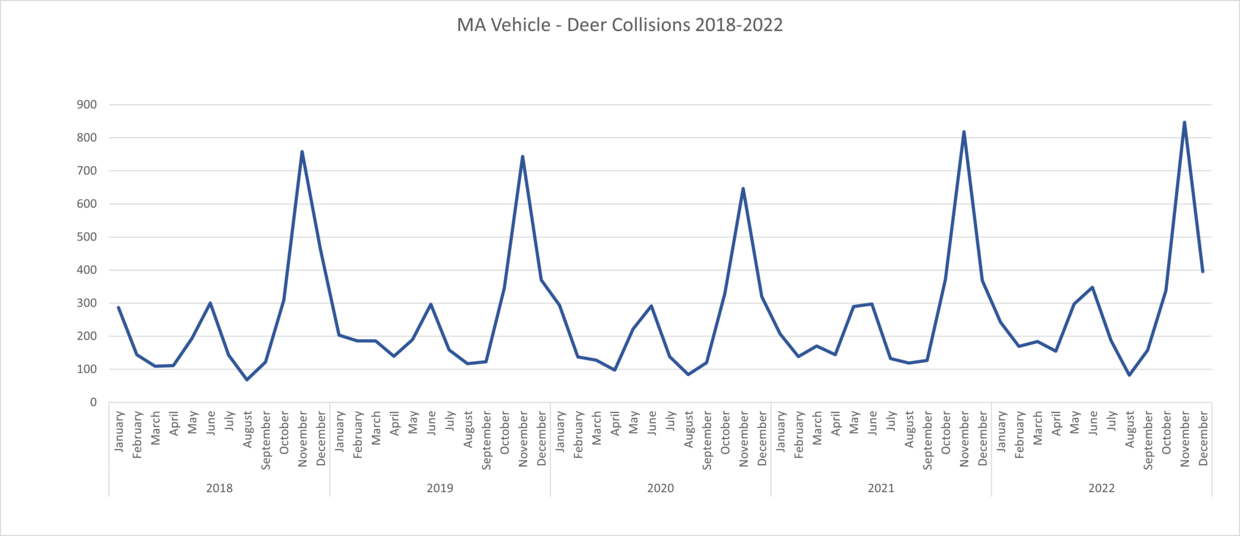
MassDOT data shows that 25% of all reported collisions from 2018 – 2022 occurred in November; 48% occurred between October and December.
Ernie Foster receives conservation award
On September 23, 2026, Ernest (Ernie) Foster IV of Scituate received the Francis W. Sargent Conservation Award from the Fisheries and Wildlife Board for his contributions to the sporting community and to the conservation of the Commonwealth’s natural resources. Foster is the 17th recipient of the prestigious award named for the former governor and noted conservationist who directed the Massachusetts Division of Fisheries and Wildlife (MassWildlife) in 1963–64.
Foster, a lifelong hunter and angler, accepted the award—an engraved crystal obelisk—during a ceremony at MassWildlife’s Field Headquarters in Westborough. “Receiving the Francis W. Sargent Conservation Award is an incredible honor, especially given Governor Sargent’s legacy as a true champion for the Commonwealth’s natural resources and sporting heritage,” said Ernie Foster upon receiving the honor. “Conservation in Massachusetts is a team effort built on strong partnerships, dedicated state staff, and passionate outdoor communities. I share this award with my family, my former colleagues on the Fisheries and Wildlife Board, and all the sportspeople who work every day to protect and pass down our wild places to the next generation.”
The ceremony brought together Fisheries and Wildlife Board members, MassWildlife staff, leaders of sporting and conservation organizations, previous Sargent Award recipients, colleagues, friends, and family. “Ernie’s dedication to conservation comes from his deep connection to the outdoors and a strong belief in sharing those traditions with others,” said Emma Ellsworth, Fisheries and Wildlife Board Chair. “During his years on the Board, he was a thoughtful leader, a trusted colleague, and a tireless advocate for creating opportunities for people of all ages to hunt, fish, and connect with nature.” Foster also received a Governor’s citation celebrating his achievement.
When presenting the award, Ellsworth praised Foster’s passion for the outdoors and his commitment to passing those traditions on to the next generation. Foster served on the Fisheries and Wildlife Board for nearly a decade, from 2017 to earlier this year. During his tenure, Foster was elected to positions of Secretary and then Vice Chair during his last year on the Board.
“Throughout his life, Ernie Foster has been an enthusiastic champion of access to outdoor recreation, conservation, and stewardship,” said Department of Fish and Game Commissioner Tom O’Shea. “Congratulations on this well-deserved honor.”
Foster's love for the outdoors was established early in life, with hunting, fishing, and shooting all strong elements of his family tradition. Foster is an active life member of the Scituate Rod and Gun Club, the Old Colony Sportsmen's Association, the National Skeet Shooting Association, and the National Sporting Clays Association (NSSA-NSCA). He is a current member and past chairman of the Ducks Unlimited Minot's Ledge Chapter and a member of the Ruffed Grouse Society, Pheasants Forever, SE Mass Sporting and Conservation Alliance, and The Trustees.
Foster has served as a volunteer hunter education instructor for the past several years, helping teach hundreds of new hunters how to practice safe, ethical, and legal hunting. His service to the Hunter Education Program reflects his commitment to passing on Massachusetts’ sporting traditions and preparing the next generation of responsible hunters.
“Ernie understands that lasting conservation depends on people having a meaningful connection to the outdoors,” said MassWildlife Director Eve Schlüter. “His service on the Fisheries and Wildlife Board and his lifelong commitment to hunting, fishing, stewardship, and introducing others to the outdoors have strengthened Massachusetts’ conservation community. We are grateful for his leadership and congratulate him on this well-earned recognition.”
A graduate of Marquette University with a Bachelor of Science in business administration, Foster began his career as a commercial printer and is now an established business owner and marketing and branding executive with businesses located on the South Shore. His work in the printing and paper industries gave him firsthand exposure to the scientific and technical aspects of forest and habitat management. Tours of paper mills and timber harvesting sites broadened his understanding of working forests and helped shape his advocacy for conservation and the preservation of open space. Foster now lives with his wife, four children, and three dogs in the Scituate home he has owned for over thirty years. In his rare leisure time, he enjoys casting a fly, training his bird dog, and shooting his bow.
Fall trout stocking is underway!
Visit Mass.gov/Trout for daily updates and a map of trout stocked waters. Updated regulations in effect this fall.
All outdoor users: Wear blaze orange during hunting seasons
Hunting is one of the safest forms of outdoor recreation, and decades of hunter education and blaze orange requirements have helped make it safer. Whether you’re hunting, hiking, walking the dog, or enjoying the woods in another way, a few simple precautions can help everyone share the outdoors safely during hunting season.
Watch the short video above to see just how effective blaze orange can be at helping people stand out in the woods.
Tips for non-hunters
- Know when and where hunting is allowed. Review Massachusetts hunting season dates. Hunting on Sunday is not permitted in Massachusetts. MassWildlife lands, including Wildlife Management Areas and Wildlife Conservation Easements are open to hunting. Most state parks and forests are open to hunting, and many towns allow hunting on municipal lands. Learn about lands open to hunting in Massachusetts. Research the property you plan to visit beforehand to learn if hunting is allowed. If being in the woods during hunting season makes you uneasy, find a location where hunting is not allowed or plan your outing for a Sunday or another day outside of hunting season.
- Keep pets leashed and visible. Place a blaze orange vest or bandana on your pet to keep it visible.
- Make your presence known. Talk loudly or whistle to identify yourself as a person. You may also consider wearing a bell. If you see someone hunting or hear shots, call out to them to identify your location.
- Be courteous. Once you've made your presence known, don't make unnecessary noise to disturb wildlife or hunting. Hunter harassment is against state law. Avoid confrontations with hunters. If you think you've witnessed a fish or wildlife violation, report it to the Massachusetts Environmental Police at 1-800-632-8075.
Tips for hunters
Hunting is among the safest of all recreational activities. You can help keep it that way by following the 10 basic rules of firearms safety and wearing blaze orange when required.
- All hunters during shotgun deer season and deer hunters during the primitive firearms season must wear at least 500 square inches of blaze orange on their chest, back, and head. (Exception: coastal waterfowl hunters in a blind or boat.)
- All hunters on Wildlife Management Areas during the pheasant or quail season on WMAs where pheasant or quail are stocked must wear a blaze orange cap or hat. (Exception: waterfowl hunters in a blind or boat, and raccoon and opossum hunters at night.)
Note: Game animals like deer can’t detect the fluorescent orange color, allowing hunters to wear it without sacrificing camouflage.
Why blaze orange?
Blaze orange is now a familiar sight in the woods during hunting season, but its use as a safety tool has an interesting Massachusetts connection.
A Long, Colorful History of Safety
The way people hunt today is not the same way people hunted generations ago. The International Hunter Education Association reports that hunting-related injury rates have decreased dramatically over the last 50 years with the widespread adoption of hunter education and blaze-orange requirements. Interestingly, research by MassWildlife played an important role in the history of blaze-orange as a safety innovation.
In 1959, Jack Woolner, an information officer with MassWildlife (known then as the Massachusetts Division of Fisheries and Game), spearheaded a study at Fort Devens to test which colors were most visible in the woods under various light and weather conditions. Greens and yellows blended into vegetation, while blues, reds, and purples appeared black in low light. Blaze orange (a highly specific, daylight-fluorescent color officially defined by its dominant wavelength of 595 to 605 nanometers) was found to be the most visible under a variety of terrain and lighting conditions. Additionally, game animals like deer can’t detect the fluorescent orange color, allowing hunters to wear it without sacrificing camouflage.
The concept of blaze orange circulated widely through the hunting community when Jack’s brother Frank Woolner published an article entitled “Hunter Orange—Your Shield For Safety” in Field & Stream magazine in 1960. Soon after, Massachusetts became the first state to require hunters to wear blaze orange. Today, Massachusetts law requires hunters to wear blaze orange during certain hunting seasons, including the popular shotgun deer season. Nationwide, over 40 states now have some blaze-orange requirements for hunters. Additionally, non-hunters and their companion animals are also encouraged to wear blaze orange for enhanced visibility during hunting seasons.
While the widespread adoption of blaze orange has made hunting safer, wearing an orange hat or vest is not a replacement for following safe hunting practices. Blaze orange cannot identify a target or judge if the shot is safe. But it helps to give hunters and other outdoor users a much better chance of seeing one another. Hunter education is a similar, preventative tool. It cannot make decisions for hunters once they are alone in the field, but it helps build good habits and reduce the chance of accidents.
Experience the unique habitats of Massachusetts
Explore our unique landscapes and discover how MassWildlife works to conserve and restore habitat for wildlife. This fall, join habitat biologists for a series of guided walks and talks focused on biodiversity hotspots in Massachusetts.
Upcoming events are listed below. Space is limited, and registration is required.
- October 7: Protecting Our Coastal Plain Ponds: Science, Stewardship, and Management Presentation
2–4 p.m., Plymouth Public Library, Plymouth
Join us for a talk exploring the natural history and unique ecology of Massachusetts’ Coastal Plain Ponds. Learn about the threats facing these special habitats and discover practical management and conservation options. The discussion will highlight the important role private landowners can play in protecting and restoring Coastal Plain Ponds for future generations. The presentation is from 2–4 p.m. at the Plymouth Public Library (132 South Street, Plymouth) Space is limited, and pre-registration is required; sign up now to save your spot! - Sunday, October 11: Restoring Woodlands for Wildlife Guided Walk
12–2 p.m., Frances Crane Wildlife Management Area, East Falmouth
Join MassWildlife habitat biologists for a walk through a remarkable place that provides critical habitat for wildlife, including more than 20 species listed as endangered, threatened, or of special concern. Discover how more than a decade of successful habitat restoration has transformed the area and hear about the management activities planned there for this winter. Participants should be prepared for a ~2.5 mile walk on uneven ground. The Massachusetts Forester Licensing Board will award 2 Category 1 credits for the walk. Click here to register. - October 30: The Remarkable Landscapes of Montague Plains Presentation
5–7 p.m., Great Falls Discovery Center, Turners Falls
Join this engaging presentation from 5–7 p.m. at the Great Falls Discovery Center. Explore the natural history of Montague Plains through 4 complementary perspectives. Geology professor Richard Little will explain the glacial lake Hitchcock origins of the Montague Plain and why Turners Falls would not exist if not for this delta. Pat Conlin, Habitat Biologist at MassWildlife, will describe the agency’s long-term stewardship and restoration of imperiled natural plant communities. Caren Caljouw, Prescribed Fire Manager at MassWildlife, will cover the benefits of prescribed fire. And ecologist Mike Akresh, PhD, will review findings from wildlife research conducted there. Together they will show how geology, land management, and ecological research have shaped our understanding of one of New England’s most distinctive pine and oak barrens. Register for the Montague Plains presentation.