
Project Details
Project Title
Lower Mystic Cool Communications
Municipality or Organization
Metropolitan Area Planning Council (MAPC) with Chelsea, Revere, Winthrop, Everett, and Malden
MVP Region
Greater Boston
Award Year
FY2025
Grant Award
$490,813
Project Websites
Project Overview
The Lower-Mystic Cool Communications to Build Regional Heat Resiliency, built upon years of work within the region to better prepare for and respond to the impacts of climate-driven heat in Chelsea, Revere, Winthrop, Malden, and Everett. Metro Boston is getting hotter- both in terms of longer and more extreme heatwaves, as well as warmer temperatures in spring and fall. Climate-driven heat exacerbates urban heat islands (UHIs) in which built-up areas experience hotter daytime and night-time temperatures when compared to surrounding suburban/less developed areas. Many communities living and working in UHIs are also at increased risk of the health impacts of extreme heat and may lack the resources to adapt and prepare. As extreme heat becomes more prevalent, existing regional and municipal systems are under-prepared for this threat. Specifically, these systems lack comprehensive strategies for effectively communicating with vulnerable populations before, during, and after extreme heat events.
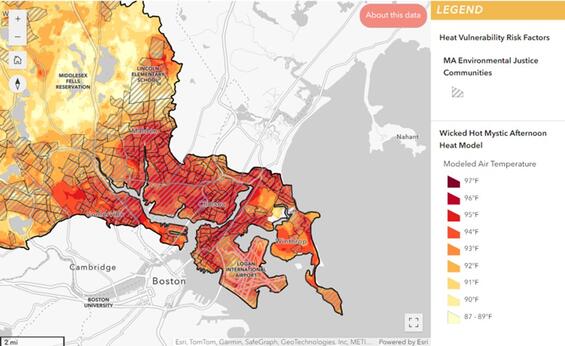
Visualization of Ambient Air Temperature collected by Wicked Hot Mystic project in 2021 funded by a previous MVP Action Grant.
Community Overview
Everett, Chelsea, Malden, Revere, and Winthrop (combined population of 237,627) are five densely developed cities in the Mystic River Watershed, where residents are disproportionately impacted by extreme heat. All five of the Lower Mystic communities have EJ block groups meeting one or more EJ criteria. Each of these EJ indicators can increase communities’ vulnerability to extreme heat.
First, residents who are linguistically isolated – which ranges from about one-quarter of residents to three-quarters of residents in the focus communities – may not understand official English-only warnings or recommendations and therefore not be able to take effective actions to adapt. Low-income households have fewer resources to pay bills for air conditioning, weatherize housing units, or take other actions to improve thermal comfort. Low-income residents are also more likely to have pre-existing health conditions that increase the likelihood of experiencing health emergencies due to extreme heat.
Further, neighborhoods in the Mystic River Watershed that were deemed “hazardous” through racist redlining policies are today about 4 degrees hotter on average than neighborhoods that had the “best” categorization. Together, these indicators and other indicators of social vulnerability (e.g. age, outdoor worker, etc.) make residents in Everett, Chelsea, Malden, Revere, and Winthrop particularly vulnerable to extreme heat compared with some of their neighboring municipalities.
MVP Core Principles Exemplified
The MVP Core Principles that this project exemplifies includes:
1. Utilizing regional solutions for regional benefit
2. Increasing equitable outcomes for Environmental Justice (EJ) and other priority populations
3. Conducting robust community engagement and supporting strong partnerships with EJ communities
Project Goals and Outcomes
| Project Objective | Outcome |
|---|---|
|
|
|
|
| Based on lessons learned from the 2025 summer pilot, we developed the Cool Communications Toolbox which includes the following:
In addition, for municipalities, we developed guidance for creating effective heat resource web pages. MAPC worked with the Lower Mystic municipalities to develop and update their own heat webpages. |
|
|
Results and Deliverables
Outcome 1: Pilot a coordinated, regional communications campaign that is culturally and linguistically relevant (2025 & 2026)
- Regional Coordination: The project was co-led by MAPC and MyRWA, engaged 5 municipalities and 4 Community-Based Organization (CBO) partners across those communities, partnered with BUSPH as a research partner, and worked with 3 artist teams and 13 resident Climate Leaders.
- Linguistic & Cultural Relevance:
○ All materials - from social media messages to artist materials - were translated into Spanish, Portuguese, Arabic, Simplified Chinese, and Haitian Creole.
○ MyRWA’s Climate Leaders, thirteen residents from across the participating municipalities, tabled at over 25 events across the summer, distributed care bags, and hosted 2 festivals.
○ The artist teams prototyped ways to facilitate interactive conversations with communities, especially those most vulnerable to heat, through pop-up lounges, youth workshops, and engagement toolkits. - Communications Campaign:
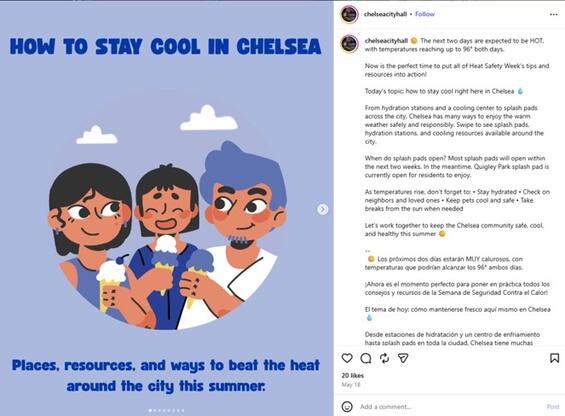
- Summer 2025: Weekly emails distributed to municipal/CBO partners with the MA DPH 7-Day Unhealthy Heat Forecast and ready to use social media slides. Municipalities and CBOs posted on their preferred platform (Instagram, Facebook, and WeChat). Materials shared via blog post and with the Resilient Mystic Coalition’s (RMC) Heat Working Group.
- Summer 2025 Campaign Evaluation: MAPC facilitated an evaluation of the Summer 2025 campaign to determine how effective project strategies were in supporting timely, consistent, messaging; whether the project strengthened equity in outreach to vulnerable populations; and what the recommendations were for MVP Year 2 and municipal planning efforts.
- Summer 2026: the Stay Cool design packets and a heat message library provided to partners before summer began to make sure everyone had materials ready to go. When heat arrives, partners can act without waiting for an email from us. Materials shared regionally via a blog post and 2 presentations to regional groups (joint RMC and Metro Mayors Coalition, Shared Regional Epidemiologists), plus 4 additional posts on extreme heat resources on MAPC Planning 101 Blog.
- Available Deliverables:
- Stay Cool Materials: Package includes two Canva brand kits and a Heat Message Library, all are downloadable from the Cool Communications Arts Toolbox:
- Animals Are Cool — a vibrant, illustrated style featuring animals and their heat-beating adaptations, developed in partnership with artist Hania Mariën
- Designed by Depict Brands — an expansive library of heat graphics, templates, and guidelines organized by heat season, with various layouts suited for graphic-, photo-, and text-based designs
- Heat Message Library — a ready-to-use, pre-translated library of messages that can be used with either brand kit. The Library is organized by heat season and includes suggested messaging for high-risk groups.
- Stay Cool Materials: Package includes two Canva brand kits and a Heat Message Library, all are downloadable from the Cool Communications Arts Toolbox:
- Municipal Website Guidance: Residents and community organizations rely on municipal websites during extreme heat events. Based on a nationwide scan of heat relief websites, MAPC developed The Elements of an Effective Municipal Heat Relief Website.
Outcome 2: Integrate artists to increase cultural relevance and build a culture around cooling
- Summer 2025: Launched a Call for Artists to imagine creative ways of engaging communities around heat. The goal was to use art and storytelling to build more interactive conversations with communities, especially those most vulnerable to heat. Three artist teams were selected to develop prototypes to spark conversations, strengthen social ties, and build resilience.
- Artists hosted 5 pop-ups, 2 youth workshops, 2 art exhibits, and created engagement toolkits used by CBO partners during the summer.
- Summer 2026: Elements of the Summer 2025 prototypes were packaged into the Cool Communications Arts Toolbox for any municipality or organization to use or adapt:
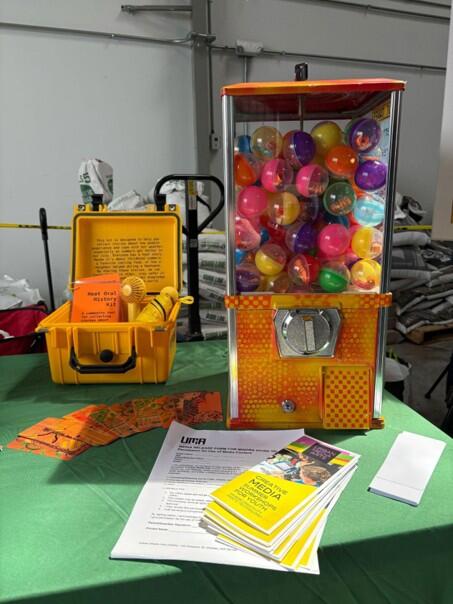
- Cool Communications Network - The Heat Oral History Kit (conversation cards, guidebook, stickers, mini fan), and The Hot Takes Gumball Machines, which are filled with heat stories and prizes
- Animals Are Cool - an animal-themed activities guide, illustrated booklet, coloring sheets, and stickers for use with elementary-age children
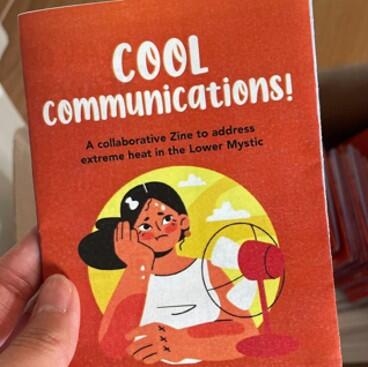
- Tropical Resilience Lounge Zine - a multilingual zine with cooling resources and tips.
- The Cool Communications Network was deployed live at 6 community events (Feb–June 2026)
- Worked with Urban Media Arts to film and edit answers to the Cool Communciations Network’s conversation cards in the Hot Takes: How do you stay cool in the summer heat? video series (check out the MAPC YouTube Channel for more!).
Outcome 3: Use heat data to inform who/when/where communications strategies target
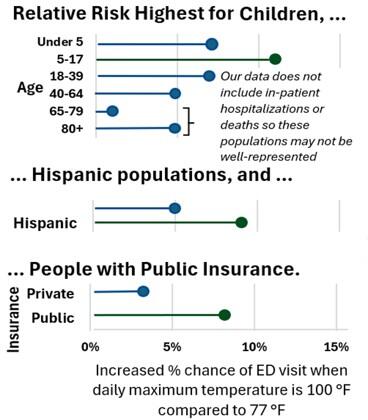
- Partnered with BU School of Public Health to analyze heat-attributable emergency department visits across the partner municipalities. Beyond making the case that heat's health burden is likely far greater than heat-related counts suggest, it reveals how that burden falls unevenly across age, ethnicity, and insurance status, helping practitioners target outreach and resources to the residents who need them most.
- Aligned research with the DPH Bureau of Climate and Environmental Health’s statewide HEAT initiative, which developed evidence-based thresholds for unhealthy heat alerts, through multiple conversations between teams.
Lessons Learned
- Some residents are at higher risk: The data identified three groups with elevated individual risk of heat-attributable ED visits: youth ages 5–17, Hispanic residents, and people on public health insurance. This emphasized the need to build out messaging tailored for these priority populations, informing both the content of the Heat Message Library and the design of the Arts Toolbox.
- Individual risk is only one part of the story: You need to communicate to those at highest risk, but you also need to prepare systems for the days when they will face the highest demand. BUSPH analysis found that the populations where any one person is at higher risk aren’t always the same ones driving the highest volume of heat-attributable ED visits – the same is true for timing. For example, caseload peaks in July or Aug simply because there are more hot days, yet an early-season heat wave is more likely to land any one person in the hospital than the same temperature later in summer. The messaging should reflect this: strategies for preparing health systems should differ from those aimed at the public.
- The Importance of municipal heat web pages: Partners expressed strong interest in dedicated municipal heat resource web pages to centralize information for residents. Using the Elements of an Effective Municipal Heat Relief Website guide as a foundation, we're working with Lower Mystic municipalities to build or strengthen their own online heat resource hubs — so residents have a trusted, local destination for heat information before, during, and after heat events.
- Heat thresholds are a tool, not the whole strategy: Inspired by Alert Boston, Partners came into the project interested in identifying a local heat threshold to trigger heat communications. The release of the Department of Public Health’s (DPH) Unhealthy Heat Forecast and related alerts, alongside the BUSPH analysis sent us in another direction. Beginning in 2025, the DPH began providing color-coded heat risk forecasts and sending Unhealthy Heat Alerts when the daily temperature was forecast to be greater than 85°F for three or more consecutive days. The DPH tool is critical for communities in deciding when to take action. For non-emergency communications, however, we found that issuing a communication campaign whenever an alert was active led to message fatigue in the general public. Furthermore, BUSPH's analysis suggested an alternative approach – using ED visit data to better understand who is most at risk and when and building seasonal communications around that.
- Smarter timing, targeted audiences. The data told us that the same temperature can be experienced differently throughout the summer season and that some residents face significantly higher risk than others. In response, the 2026 Heat Message Library is organized around seasonal messages and includes messages tailored for priority audiences.
Partners and Other Support
| Organization | Role |
|---|---|
| Metropolitan Area Planning Council | Project Management/Lead- Public Health, Clean Energy, Arts & Culture, Communications Departments |
| Mystic River Watershed Association | Co-Project Management, Project Team Member |
| Boston University School of Public Health - Center for Climate and Health | Project team member; analytical research lead |
| GreenRoots | Community partner |
| Urban Media Arts | Community partner and creator/editor of video series |
| Chinese Cultural Connection | Community partner |
| Everett Community Growers | Community partner |
| Resilient Mystic Collaborative/Heat Working Group | Steering committee and guidance around design of the project; informed and regional dissemination of learnings and materials |
| Metro Mayors Climate Taskforce | Informed/regional dissemination |
| City of Chelsea, Public Health Dept | Community partner |
| City of Revere, Public Health Dept | Community partner |
| Town of Winthrop, Public Health Dept | Community partner |
| City of Everett, Communications | Community partner |
| City of Malden, Sustainability | Community partner |
| MA Department of Public Health, Bureau of Climate and Environmental Health | Expert advisor on analytical research and leads the Unhealthy Heat Alerts used in 2025 pilot campaign |
| Carolyn Lewenberg and Edwardo Chacon | Artist team |
| Hania Mariën and Anna Lucia Deloia | Artist team and graphic designer (animals are cool) |
| Daphne Lundi | Artist |
| Depict Brands | Artist and graphic designer for toolkit |