
- Scientific name: Valvata sincera
- Species of Greatest Conservation Need (MA State Wildlife Action Plan)
- Endangered (MA Endangered Species Act)
Description
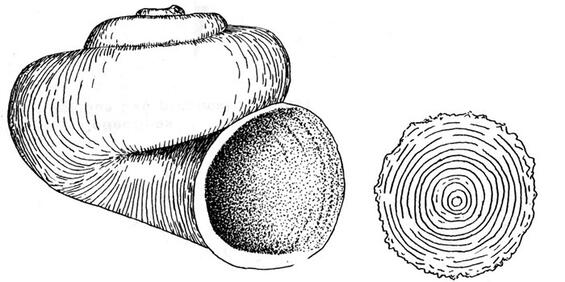
A drawing of a mossy valvata.
The mossy valvata is a small snail in the family Valvatidae with a shell that measures up to 5 mm (0.2 in) in diameter and 3mm (0.12 in) in length. The shell is yellowish-brown in color with a low spire with 4 rounded whorls and impressed sutures. The shell aperture (opening to shell cavity) is dextral (coiled to the right when facing observer) and has an operculum, a hardened circular structure that seals the shell. Like other species of the Valvatidae family, the operculum has a tight inner ring that spirals out in many whorls to the perimeter (multispiral).
The mossy valvata is like the only other Valvatidae in Massachusetts, the threeridge valvata (V. tricarinata), which can be identified by two or three spiral ridges along the shell surface. The threeridge valvata is more widely distributed and locally abundant. Identification guides sufficiently illustrate the differences among these species (Jokinen 1992, Smith 2000).
Life cycle and behavior
Little is known about the life history of the mossy valvata. In Canada, the species has an annual life cycle with younger individuals present from May-July (McKillop 1985). The snail lays egg capsules, containing two to four eggs, typically onto submerged aquatic vegetation throughout the summer. Natural dieback likely occurs in cooler fall months.
Distribution and abundance
The mossy valvata is a northernly species distributed from Connecticut north into Canada and west to Alaska. In Massachusetts, the species is at its southern range limit and has been found in two lakes and a pond in the Housatonic River Watershed. There is also one record from a lake in the Concord River Watershed (Jokinen 1983). Populations in Massachusetts probably represent glacial relicts where a few populations remained as animals dispersed northward following glacial retreat (Smith 1984). When detected, the species is often found in low abundances.
Surveys in 2003 failed to detect this species at historical sites (McLain 2003) in the Housatonic River Watershed and the snail was presumed extirpated from the state. However, a more recent effort has rediscovered the species at one of its historical waterbodies. The mossy valvata is listed under the Massachusetts Endangered Species Act as Endangered. All listed species are protected from killing, collecting, possessing, or sale and from activities that would destroy habitat and thus directly or indirectly cause mortality or disrupt critical behaviors. In addition, listed animals are specifically protected from activities that disrupt nesting, breeding, feeding, or migration.
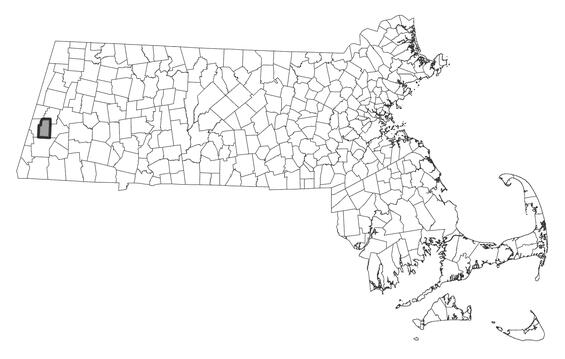
Distribution in Massachusetts. 2000-2025. Based on records in the Natural Heritage Database.
Habitat
The mossy valvata is a northernly species that lives in cold water and is usually found in high-calcium habitats. It is found in large oligotrophic lakes with water depths greater than 2 m (6.6 ft) and in association with rooted aquatic vegetation including Chara spp. and Potamogeton spp. Outside Massachusetts, it has been found in rivers (Clarke 1973) and in eutrophic ponds in Connecticut and New York in association with filamentous algae (Jokinen 1992).
Healthy habitats are vital for supporting native wildlife and plants. Explore habitats and learn about conservation and restoration in Massachusetts.
Threats
Shoreline development, water level drawdowns, increased nutrient input, herbicides, loss of submerged aquatic vegetation, increased frequency of cyanobacteria blooms, and non-native snails (e.g., banded mystery snail) are potential threats to this species.
Conservation
Survey and monitoring
Surveys for mossy valvata are needed at its historical sites and other potential suitable waterbodies. Monitoring efforts are recommended every 5 years or as needed (e.g., in response to potential disturbance events) at its historical sites to update its population status in Massachusetts.
Management
As with many rare species, the exact management needs for the species are unknown. However, the protection of mossy valvata habitat is critical for species persistence in Massachusetts. Watershed-scale nutrient management is needed to reduce nutrient input from shoreline and agricultural sources in occupied waterbodies. Deceleration of eutrophication rates can improve water quality and reduce cyanobacteria bloom frequency.
Research needs
The population status of mossy valvata remains uncertain in Massachusetts. Physical surveys coupled with eDNA collections could improve detection of this locally rare species. Surveys should target historical and new sites to better understand its distribution and relative abundance. Studies of herbicide toxicity effect concentrations on appropriate surrogate snail species may be needed.
References
Clarke, A.H. 1973. The freshwater molluscs of the Canadian Interior Basin. Malacologia 13: 1-509.
Heard, W.H. 1963. Reproductive features of Valvata. Nautilus 77: 64-68.
Jokinen, E. 1992. The Freshwater Snails (Mollusca: Gastropoda) of New York State. New York State Museum Bulletin 482.
Jokinen, E. 1983. The freshwater snails of Connecticut. Bulletin Connecticut Geological and Natural History Survey 109: 1-83.
Lang, B.Z., and N.O. Dronen, Jr. 1970. Eggs and attachment sites for Valvata lewisi. Nautilus 84: 9-12.
McKillop, W.B., 1985. Distribution of aquatic gastropods across the Ordovician dolomite–Precambrian granite contact in southeastern Manitoba, Canada. Canadian Journal of Zoology, 63(2), pp.278-288.
McLain, D. 2003. Status of 4 State-listed Snails in Western Massachusetts in 2002. Report to the Massachusetts Natural Heritage and Endangered Species Program.
Smith, D.G. 2000. Keys to the freshwater macroinvertebrates of southern New England. Published by author. Sunderland, MA. 243 pp.
Smith, D.G. 1984. Selected freshwater invertebrates proposed for special concern status in Massachusetts. Mass. Dept. of Env. Qual. Engineering, Div. of Wat. Pollut. Control. Westborough, MA. 26 pp.
Contact
| Date published: | April 11, 2025 |
|---|