
- Scientific name: Koeleria spicata (Linnaeus) Barberá, Quintanar, Soreng, & P.M. Peterson
- Synonyms: Trisetum spicatum (L) Richter
- Species of Greatest Conservation Need (MA State Wildlife Action Plan)
- Endangered (MA Endangered Species Act)
Description
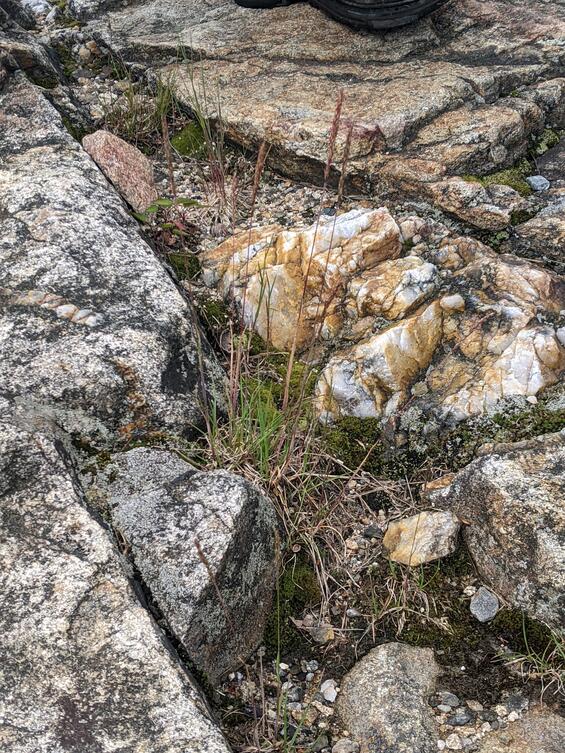
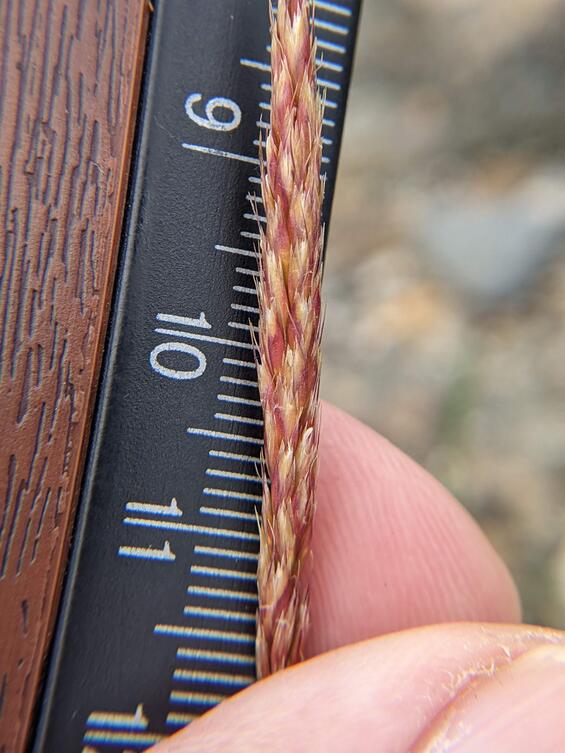
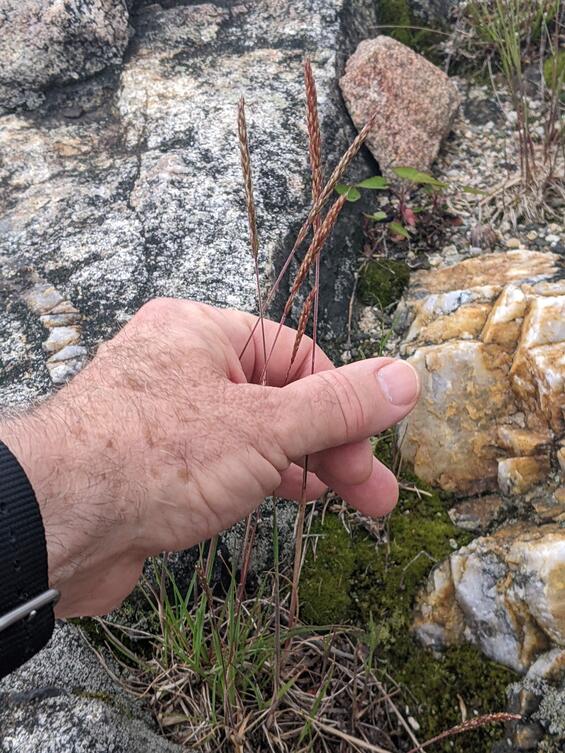
Narrow false oats is a cespitose (tufted), perennial species in the grass family (Poaceae), found in a variety of open habitats from rocky summits to alluvial boulders. It has one to multiple culms, with dense spikes that are often pinkish-brown to purplish, and silvery or shiny. “Trisetum” means three (tri) bristles (seta), referring to the two setae and one awn at the apex of the lemma, a characteristic of this genus. The species name “spicatum” refers to the narrow, spike-like inflorescence.
A technical manual and hand lens or microscope should be used to identify this and other grass species. The culms of spiked false oats are 9-60 cm (3.5-23.6 in) tall with a spiciform (spike-like), densely flowered panicle that is 2.5-7 cm (1.1-2.8 in) long. The panicle can appear somewhat interrupted at the base, with more distance between the lowest spikelets than the upper ones. Each culm has one to two nodes with flat, narrow leaves. The sheaths are usually glabrous but the stem below the panicle, the rachis, and the rachilla (axis of the spikelet) are densely hairy. The spikelets are 1 to 2 flowered. Each floret has a 3-nerved lemma, with the mid-nerve often scabrous. The setae originate above halfway up the back of the lemma. The awn is 3.5-5 mm (0.14-0.2 in) long; it is curved, geniculate, or sometimes twisted, originating in the upper 1/3 of the lemma.
A similar, introduced species, yellow false oats (T. flavescens) can be differentiated by its looser panicles and somewhat wider leaves (2-6 mm [0.08-0.24 in]) than those of narrow false oats. Yellow false oats is also usually found in disturbed habitats such as fields and roadsides.
Life cycle and behavior
This is a perennial species.
Population status
Narrow false oats is listed under the Massachusetts Endangered Species Act as endangered. All listed species are protected from killing, collecting, possessing, or sale, and from activities that would destroy habitat and thus directly or indirectly cause mortality or disrupt critical behaviors. Narrow false oats is currently known in Franklin, Hampshire, Hampden, and Worcester Counties, and it occurred historically in Essex, Middlesex and Norfolk Counties. A population reported from Berkshire County could not be found during later surveys. This species is also listed as endangered in New Hampshire, Pennsylvania, and North Carolina, threatened in Wisconsin, and special concern in Connecticut. MassWildlife’s Natural Heritage and Endangered Species Program has 13 records from 6 counties: Essex, Franklin, Hampden, Hampshire, Middlesex, Norfolk, and Worcester. Five of these records have been observed within the last 25 years.
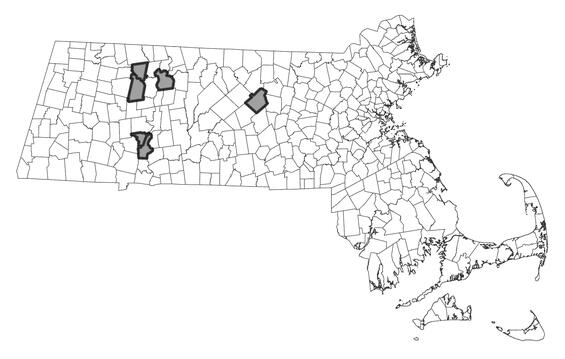
Distribution in Massachusetts. 1999-2024. Based on records in the Natural Heritage Database.
Distribution and abundance
Narrow false oats has a circumboreal distribution; in North America, it occurs from the low arctic (boreal) to temperate zones. It is found from Greenland west across Canada and the northern United States, south along both the east and west coasts. It is not found in the southern and midwestern plains states.
Habitat
In Massachusetts, narrow false oats occurs in a variety of open, sunny locations on rocky summits, ledges, alluvial terraces and riverside boulders. It occurs on bare rock or large boulders with little to no soil accumulation. Associated species in woodland edges and openings on rocky summits are red maple (Acer rubrum), hickory (Carya spp.), black cherry (Prunus serotina), black chokeberry (Aronia melanocarpa), deerberry (Vaccinium stamineum), bush-honeysuckle (Diervilla lonicera), poverty-grass (Danthonia spicata), common hairgrass (Deschampsia flexuosa), downy goldenrod (Solidago puberula) and white wood aster (Eurybia divaricata). On alluvial outcrops, it occurs with witch-hazel (Hamamelis virginiana), royal fern (Osmunda regalis var. spectabilis), interrupted fern (O. claytoniana), harebell (Campanula rotundifola), and wild columbine (Aquilegia canadensis). Rare species growing with or near narrow false oats include green rock-cress (Boechera missouriensis) and New England blazing star (Liatris scariosa var. novae-angliae).
Healthy habitats are vital for supporting native wildlife and plants. Explore habitats and learn about conservation and restoration in Massachusetts.
Threats
Several populations of narrow false oats occur on open, rocky, exposed summits that have apparently been maintained in an early stage of succession by historical fires. In the absence of fire or other disturbances, increased shading by woody species may threaten these populations. Populations located in popular recreational areas may be damaged by heavy trail use, mowing, or other maintenance activities. Populations on outcrops and high cobble banks and ledges of rivers may be lost as a result of ice and flood scouring during high water, and by human alteration of water levels and flood regimes. Invasive species such as swallowwort (Cynanchum spp.), Oriental bittersweet (Celastrus orbiculatus) and Morrow's honeysuckle (Lonicera morrowii) have been found growing in proximity to several populations of narrow false oats. Monitoring is needed to determine the extent to which populations of narrow false oats are threatened by invasive species, and to develop management plans to reduce such threats. All active management of state-listed plant populations (including invasive species removal) is subject to review under the Massachusetts Endangered Species Act and should be planned in close consultation with MassWildlife’s Natural Heritage and Endangered Species Program.
Conservation
As this plant is under-surveyed, a serious effort should be made to conduct de novo surveys in areas where the plant is likely to occur or resurveyed where records are over 25 years old. On established sites where management is taking place, annual monitoring should be conducted including precise plant counts and notes on flowering stems.
As exposed rocky areas are essential for this species, maintenance or restoration of these sites is essential. Hand-pulling of invasive species is recommended around populations of rare species. Limiting upland and shoreline disturbance by hikers or all-terrain vehicles is important. All active management of rare plant populations (including invasive species removal) is subject to review under the Massachusetts Endangered Species Act and should be planned in close consultation with the MassWildlife’s Natural Heritage & Endangered Species Program.
The exact ecological needs of this species are not well understood. As this plant is under-surveyed, standard information is needed such as lists of associated species possibly including mosses and lichens, comments on habitat quality and threats, and assessments of soil conditions and phenology. Research is needed to determine whether this plant can be grown in a greenhouse or garden setting for purposes of reintroductions. If habitat degradation accelerates losses of current populations, this strategy could prove useful to long-term conservation of this species.
References
Finot, V. L., P. Peterson, R. J. Soreng, and O. Zuloaga. 2004. A Revision of Trisetum and Graphephephorum (Poaceae: Pooideae Aveninae) in North America North of Mexico. SIDA, Contributions to Botany.
Randal, J. L., and K. W. Hilu. 1986. Biosystematic Studies of North American Trisetum spicatum (Poaceae). Systematic Botany 11: 567-578.
Penskar, M.R., and S.R. Crispin. 2009. Special species abstract for downy oat-grass (Trisetum spicatum). Michigan Natural Features Inventory, Lansing, MI.
Contact
| Date published: | May 15, 2025 |
|---|