
Project Details
Project Title
MetroWest Climate Equity Project
Municipality or Organization
Town of Natick (with Ashland and Framingham)
MVP Region
Greater Boston
Award Year
FY2022
Grant Award
$127,150
Project Overview
The MetroWest Climate Equity Project focused on building stronger relationships between municipal governments and Environmental Justice communities in Natick, Framingham, and Ashland. The project aimed to address barriers to participation in local climate planning and ensure that residents most vulnerable to climate change have meaningful opportunities to influence municipal decisions.
Approximately 128,000 people live across the three communities, including approximately 95,500 residents in designated Environmental Justice neighborhoods. Historically, these populations have been underrepresented in municipal planning and decision-making processes.
The municipalities recognized that improving climate resilience requires addressing the social, environmental, and economic vulnerabilities that disproportionately affect EJ populations. The project therefore emphasized relationship-building, community engagement, and municipal capacity-building as foundations for long-term climate equity.
Project Goals
The project's primary goals were to:
- Build lasting relationships with MetroWest Environmental Justice communities to support meaningful, long-term participation in climate resilience planning and action.
- Better understand residents' experiences with climate change and identify community priorities to inform local climate plans and future investments.
- Increase municipal staff knowledge of climate equity and strengthen their ability to engage and support EJ populations.
The project brought together municipal staff, community liaisons, and residents to identify barriers to participation and create opportunities for more inclusive climate planning.
Key activities included equity training for municipal staff, collaboration with community liaisons, and a series of Community Climate Conversations designed to facilitate dialogue between residents and local governments.
The project emphasized a regional approach, recognizing that Natick, Framingham, and Ashland share climate challenges and that collaboration can strengthen engagement across municipal boundaries.
Results and Deliverables
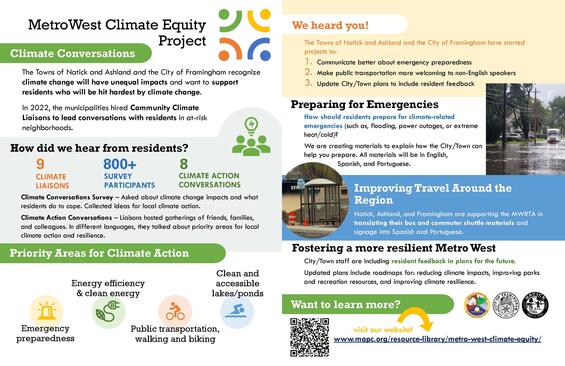
- 9 Community Climate Liaisons were hired: In 2022, the municipalities hired Community Climate Liaisons to lead conversations with residents in at-risk neighborhoods. These individuals we reached through collaborations with local community groups, such as the Framingham ESL Program and Natick for Black Lives Matter.
- 800+ residents participated in a regional survey: Liaisons created a survey and collected responses. They asked about climate change impacts, what residents do to cope, and ideas for local climate action. Survey participants who learned about the survey from Liaisons were more likely to be people of color than participants who heard about the survey from standard municipal communication channels (e.g., town website, city newsletter).
- 8 Climate Action Conversations were hosted: Liaisons hosted community gatherings in different languages, with several occurring at liaisons’ homes. The conversations focused on priority areas for local climate action and resilience.
- 40+ municipal leaders were trained on climate equity: Municipal leaders at all levels – staff and volunteers – learned about EJ communities and the importance of including EJ members in local policy work.
- 3 additional grants were pursued: The municipalities sought funding to deliver quick action on climate priorities identified. Natick and Framingham received a grant from the National Association of City and County Health Officials (NACCHO) to develop climate and emergency preparedness communication materials for people whose first language is not English. The three communities also successfully applied for TAP funding from MAPC to support this and additional climate preparedness work. A separate grant application was submitted in collaboration with the regional transit agency to improve language accessibility of transit signage.
Lessons Learned
- Natick, Framingham and Ashland’s EJ populations prioritized the following climate action areas:
- emergency planning
- equitable clean energy & energy efficiency programs
- making it easier to get around without a car, and
- improving access to lakes/ponds to cool off.
- Standard municipal communication channels (e.g., website, newsletter, print ad) are not effective at reaching EJ populations or launching new programs targeting EJ communities. Printed materials and direct mail is highly preferable to online communications.
- Working with Community Liaisons is an iterative process, and Liaisons should be brought into all areas of phases of a project. Organizations pursuing a Community Liaison model for their projects should include bandwidth in their budget and timeline to include time for co-designing aspects of the project (e.g., survey collection approach, outreach plan) with the Liaisons.
- Individualized outreach is more successful in securing Community Liaisons than general promotion. Municipal relationships with CBOs, especially organizations serving people who speak English as a second language, proved to be the most productive at identifying potential Community Liaisons.
Project Partners
The MetroWest Climate Equity Project brought together three municipalities and regional and community partners to advance more equitable climate resilience planning.
- Town of Natick: Lead municipality responsible for coordinating the MVP Action Grant project and working with regional partners to support community engagement and climate equity initiatives.
- City of Framingham: Municipal partner collaborating on community engagement, climate equity training, and efforts to incorporate Environmental Justice perspectives into local climate planning.
- Town of Ashland: Municipal partner participating in equity training, community engagement, and efforts to strengthen relationships with Environmental Justice populations.
- Metropolitan Area Planning Council (MAPC): Regional planning organization associated with the MetroWest Climate Equity Project and its project resources.
- Local community organizations: The most involved partner was the Framingham Adult English as a Second Language program.
- Community Liaisons and Residents: Community participants who helped inform the project by sharing local experiences, identifying climate resilience concerns, and participating in conversations with municipal staff.