
- Scientific name: Neoligia semicana
- Species of Greatest Conservation Need (MA State Wildlife Action Plan)
- Special Concern (MA Endangered Species Act)
Description
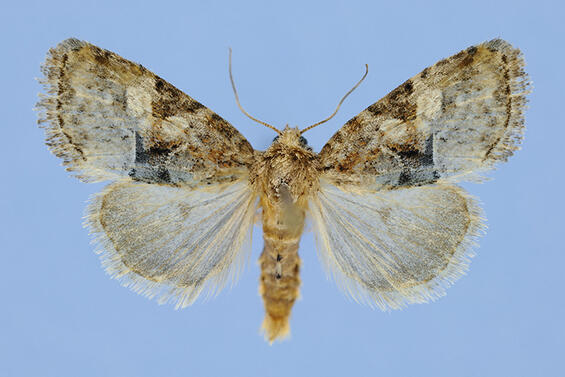
Northern brocade moth, Neoligia semicana
The northern brocade moth (Neoligia semicana) is a noctuid moth with a wingspan of 18-21 mm (0.7-0.8 in) (Forbes 1954). The forewing has a grayish brown to grayish green ground color, paler distal to the postmedial line, with dark patches at the outer margin and near the apex. The median area is shaded with brown toward the costal margin, and with a dark brown to black bar toward the inner margin. The postmedial and antemedial lines are white and smoothly curved. Both the reniform and orbicular spots are relatively large and cream-colored, though the orbicular spot may be obscure in some individuals. The hind wing is uniformly tan, with a faint discal spot. The head and thorax are concolorous with the forewing ground color, and the abdomen is tan with black-tipped tufts of elongated, dorsal setae on segments three and four. Two similar congeneric species occur in Massachusetts, the Atlantic brocade moth (Neoligia atlantica) and the dusky brocade moth (Neoligia subjuncta); the former tends to have a more distinct black bar between the postmedial and antemedial lines, and the forewing of the latter tends to be more brown than grayish brown to grayish green (Troubridge & Lafontaine 2002). However, the wing patterns of the northern, Atlantic, and dusky brocade moths are so similar that genitalic dissection may be necessary for definitive identification.
Life cycle and behavior
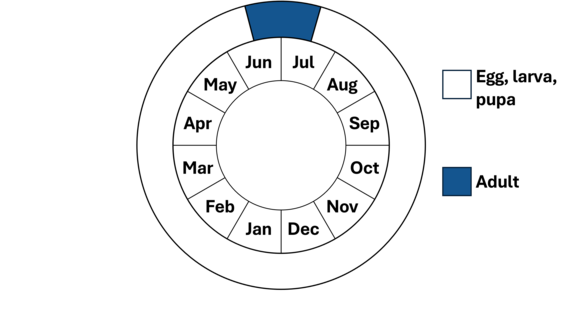
In Massachusetts, northern brocade moths fly from mid-June to mid-July. The larval host plant of this species is undocumented, but is likely a wetland grass (Poaceae) or sedge (Cyperaceae).
Distribution and abundance
The range of the northern brocade moth extends from Maine south to Massachusetts, and west to southern Ontario and Ohio (Forbes 1954, Troubridge & Lafontaine 2002). In Massachusetts, this species is only known from outer Cape Cod and Nantucket.
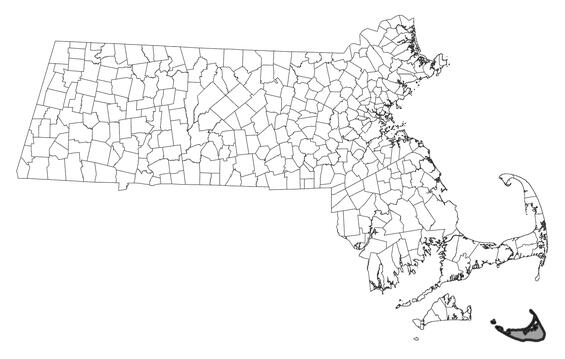
Distribution in Massachusetts.
1999-2024
Based on records in the Natural Heritage Database.
Habitat
In Massachusetts, the northern brocade moth inhabits fresh or brackish coastal marshes and bogs.
Healthy habitats are vital for supporting native wildlife and plants. Explore habitats and learn about conservation and restoration in Massachusetts.
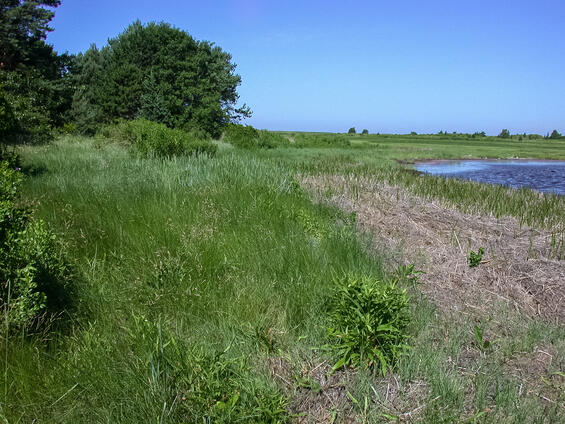
Upper reach of coastal marsh with grasses and sedges, habitat for the northern brocade moth. Habitat managed by Mass Audubon at Wellfleet Bay Wildlife Sanctuary.
Threats
The northern brocade moth is threatened by habitat loss and hydrologic alteration that disrupts the natural flooding of its habitat. Other potential threats include invasion by exotic plants, eutrophication or other water pollution, aerial insecticide spraying, non-target herbicide application, and off-road vehicles. This species is vulnerable to climate change, as its habitat is threatened by sea level rise.
Conservation
Land protection and habitat management are the primary conservation needs of the northern brocade moth in Massachusetts. In particular, fresh or brackish coastal marshes and bogs should be conserved, restored, and managed to maintain habitat for this species and other species dependent on such habitats.
Survey and monitoring
The distribution of the northern brocade moth in Massachusetts is not well documented, in part due to its close similarity to other species of Neoligia. It is likely that there are undocumented populations on outer Cape Cod and possibly other coastal locations. Known populations of this species should be surveyed to document persistence at least once every 25 years; every 10 years is more desirable when practicable.
Management
Management of fresh or brackish coastal marshes and bogs benefits a suite of rare and threatened species. Restoration and maintenance of natural hydrology and control of invasive exotic plants are of primary importance. Habitat condition should be monitored and management adapted as needed.
Research needs
The natural history and conservation needs of the northern brocade moth are poorly understood. In particular, the immature stages and larval host plants are undocumented. The habitat of this species is vulnerable to climate change; the future effects of a warming climate on this species should be studied.
References
Forbes, W.T.M. 1954. Lepidoptera of New York and Neighboring States. Part III. Memoir 329, Cornell University Agricultural Experiment Station, Ithaca, New York. 433 pp.
Troubridge, J.T. and J.D. Lafontaine. 2002. Revision of species of the “Oligia” semicana group (Lepidoptera: Noctuidae) with descriptions of a new genus and 12 new species. Canadian Entomologist 134 (2): 157-191.
Contact
| Date published: | March 24, 2025 |
|---|