
- Scientific name: Carex diandra Wahlenb.
- Synonyms: Carex teretiuscula Gooden (only in 19th Century records)
Species of Greatest Conservation Need (MA State Wildlife Action Plan)
Description
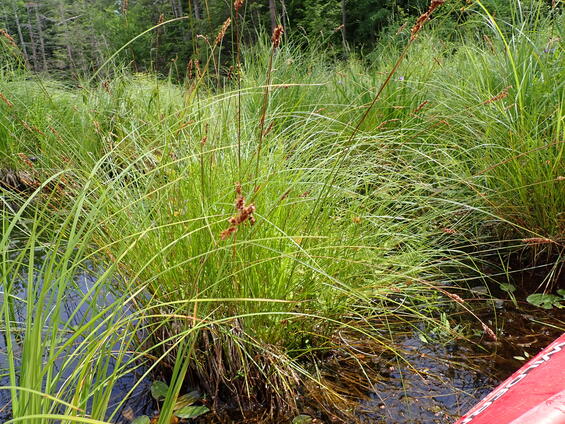
Panicled sedge in fruit showing tussock formation and typical water depth. Photo by Levi Smith. Used by Permission.
Panicled sedge is a grass-like plants in the genus Carex, the most species-rich genus in Massachusetts with 180 taxa, and throughout the northeastern states (Bennett 1996, Cullina et al. 2011). Technical skills and a detailed dichotomous key are needed for proper identification with this group of plants.
Panicled Sedge is cespitose, forming tussocks that rise vertically out of the wetland similar to the common and more familiar tussock sedge (Carex stricta). It can grow up to 90 cm (35 in) tall, and the leaves are up to 2.5 mm (0.1 in) wide. Leaf sheaths are a common and often determinative feature of sedges. In most grasses, where the leaf joins the stem, the edge of the leaf wraps around the stem, but in sedges, it forms a closed sheath. In this species, the sheaths are whitish with small but conspicuous red dots, straight across or curving upward at mouth, and prolonged up to 4 mm (0.16 in) beyond base of blade.
As described by Dodds (2024), “The spikes of the inflorescence are bisexual, with the male flowers located above the female: They are usually somewhat crowded along the stem. The perigynia are dark and shiny at maturity and most of them extend beyond the ends of the yellowish-brown scales. The two-sided achenes are ovoid, 1.4–1.7 mm [0.06–0.07 in] long, and 0.7–1.0 mm [0.03–0.04 in] wide.”
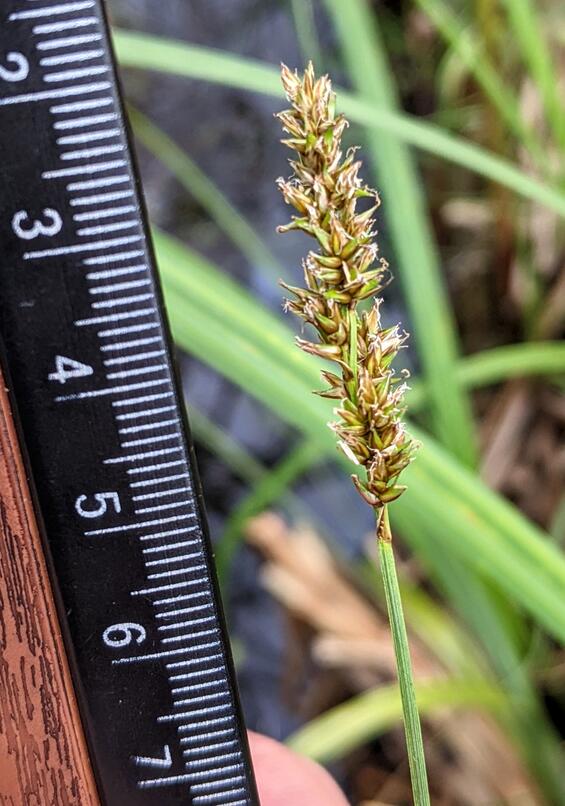
Fruiting head of Carex diandra showing 3 cm (1.2 inch) length and immature fruit. White filaments that previously held anthers are visible at the tip of male flowers.
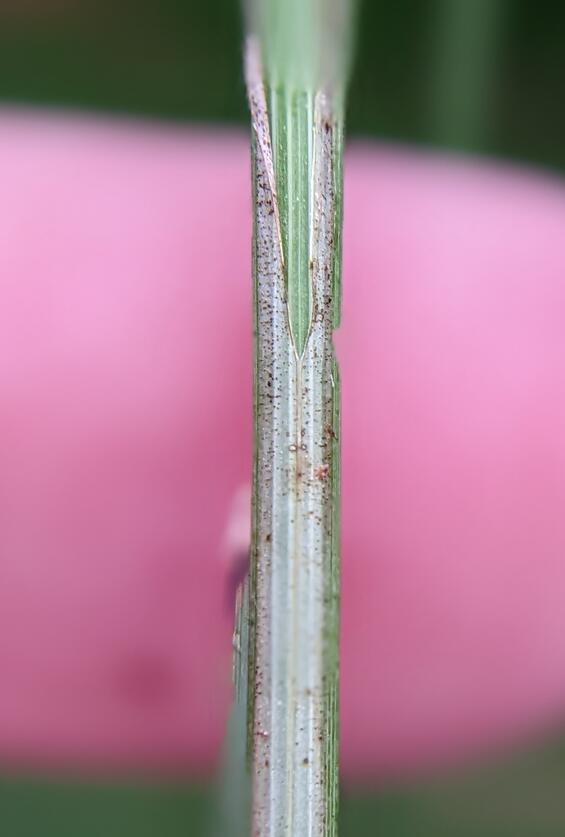
Sheath of Carex diandra showing whitish color speckled with red dots.
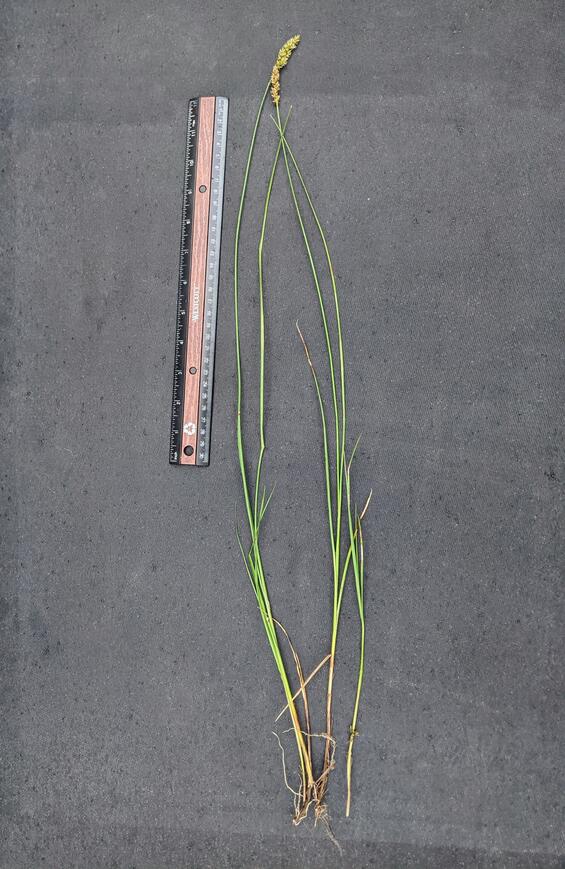
Full specimen showing average height for fruiting stems of 70 cm (28 inches).
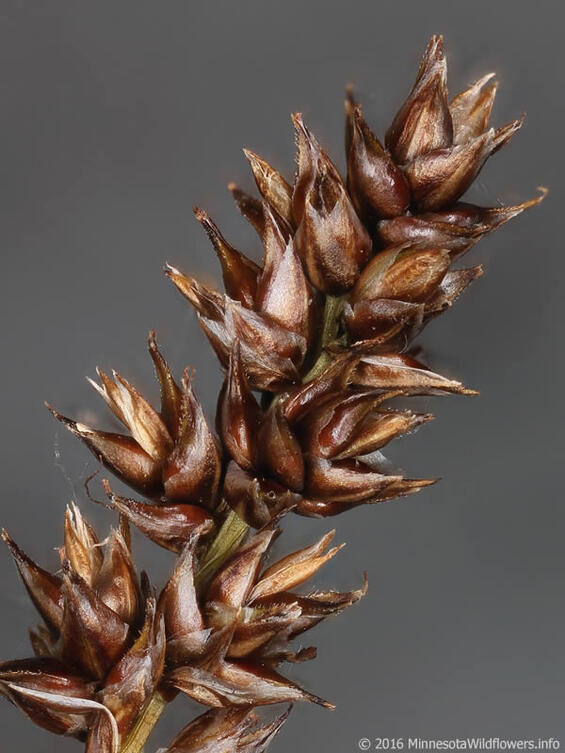
Panicle sedge mature fruit. Photo courtesy of Minnesota Wildflowers. Used by permission.
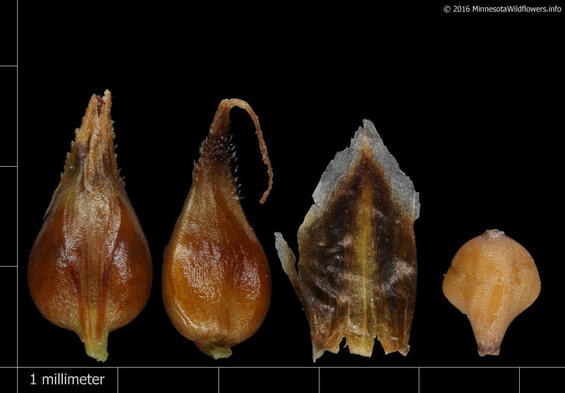
Carex diandra perigynia, pistillate scale and achene ©MinnesotaWildflowers.info. Used by permission.
Life cycle and behavior
Panicled sedge is a perennial and generally flowers every year. It is wind pollinated.
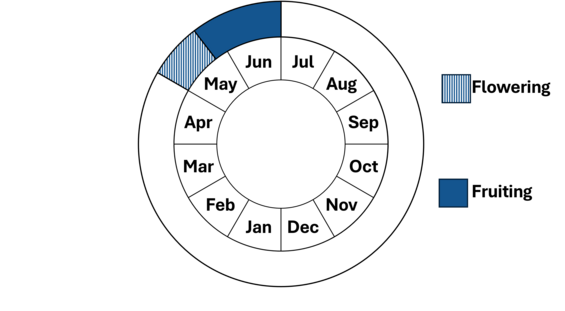
Carex diandra flowers can appear the first week of May and begin fruiting the last week of May retaining fruit for the remainder of June.
Population status
Panicled sedge has been tracked by MassWildlife’s Natural Heritage and Endangered Species Program as a watch-list species since 1988 and has only 3 records since that time. A dedicated 10-year effort in Franklin County with repeated surveys in all 26 towns resulted in finding this species in only two towns and failing to relocate records in all three towns where it had previously been found (Bertin et al. 2020). As of 21 Feb 2025, iNaturalist has 4 research grade observations for this species, all in the town of Stockbridge in Berkshire County, though 3 of these are from the same wetland. In Massachusetts, thirty herbarium records show 19th and early 20th century naturalists collected 21 specimens before 1920, followed by a 63-year gap with no collections, followed by 9 specimens collected after 1983 (CNH 2025). Even when in fruit, the species is easily overlooked, lacks features that readily stand out, and is often with other similar sedge species, so we can assume that more populations are likely to be discovered. However, the types of wetlands where this species occurs are generally quite wet with water up to 0.5 ft (20 in) deep. Because of these conditions, it takes a dedicated approach and the right equipment to survey successfully, so surveys may be quite limited.
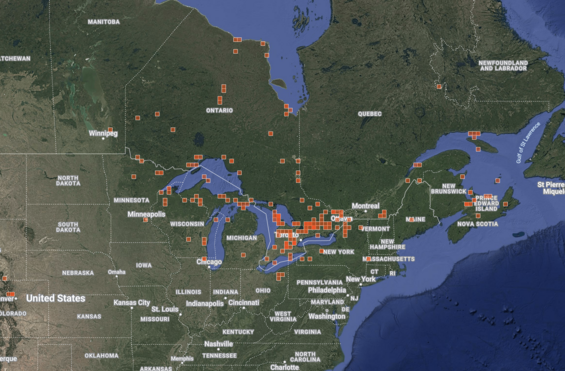
Map of research-grade observations of Carex diandra in eastern North America screen-capture from iNaturalist.org on 15 February 2025.
Distribution and abundance
Panicled sedge is a widespread species across northern latitudes in North America and circumboreal its distribution worldwide, occurring in Greenland and across Eurasia as well (POWO 2025). Panicled sedge is an S2 (threatened) species in New Hampshire but is not ranked in other New England states except Massachusetts where it is ranked as S1S2, between imperiled and critically imperiled. The plant has been found in Berkshire, Franklin, Hampden, Norfolk, Essex, Middlesex, and Nantucket counties (Bertin et al. 2020, Cullina et al. 2011, CNH 2025).
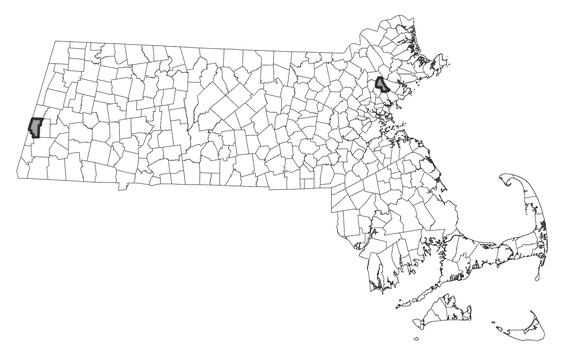
Distribution in Massachusetts
1999-2024
Based on records in the Natural Heritage Database
Habitat
Panicled sedge is an obligate wetland species that occurs typically in full sun in “swampy, marshy, or boggy areas, especially wet meadows, fens, muskegs, floating mats, and peaty or marly shores of lakes and ponds (often in shallow, sometimes brackish water), less often swales, springy thickets, ditches, and wet sandy beaches of non-alkaline lakes” (Cochrane 2020). Some of the associates noted with this species in Massachusetts include Calamagrostis canadensis (bluejoint grass), Carex comosa (bristly sedge), C. stricta (tussock sedge), C. lasiocarpa (wiregrass sedge), C. atlantica (Atlantic sedge), C. echinata (prickly sedge), Dasiphora floribunda (shrubby-cinquefoil), Alnus serrulata (smooth alder), Thelypteris palustris (marsh fern), Spiraea alba (white meadowsweet), Typha latifolia, T. angustifolia (cattail species) and willow shrub species (Salix spp.).
Healthy habitats are vital for supporting native wildlife and plants. Explore habitats and learn about conservation and restoration in Massachusetts.
Threats
Panicled sedge is threatened by succession when open wetlands becoming overgrown with shrubs and trees, and by problematic invasive species such as glossy buckthorn (Frangula alnus), purple loosestrife (Lythrum salicaria), and giant reed grass(Phragmites australis) which can all grow quickly and thickly, shading and crowding out the sedges. Disruption of the natural hydrologic regime is also a threat. Beaver dams causing significant water level increases in wetland basins can also create unfavorable conditions for this species. This being a species of more northerly distribution, climate warming is a potential threat. The past 130 years have seen a warming of 1.4 degrees C (2.5 degrees F) in the Northeast United States (Staudinger et al. 2024). Northern species can be expected to move much further north in an attempt to occupy a habitat within their climate envelope.
Conservation
Survey and monitoring
Most populations are likely in relatively stable habitats, and given these are perennial species, monitoring could be done on a five-year cycle in June with estimates of plant vigor, seed production and a threat assessment. Special emphasis should be made to target known sites that are 20 or more years overdue for survey and monitoring.
Management
An important aspect to management of wetlands is to remove and reduce populations of all invasive species, especially those mentioned in the threat section.Another aspect for this species is to watch for altered water levels from beaver activity, development, ditches, or road building.
Research needs
As this plant is under-surveyed, serious efforts should be made to conduct de novo surveys in areas where it is likely to occur or where records are over 100 years old. Additionally, standard information is needed such as lists of associated species, comments on habitat quality and threats, assessments of water levels and chemistry, and phenology. Research is needed to determine whether this plant can be grown in a nursery or garden setting for purposes of reintroductions. If habitat degradation accelerates losses of current populations, reintroductions could prove useful to the long-term conservation of this species.
References
Arsenault Matt, Glen H. Mittelhauser, Don Cameron, Alison C. Dibble, Arthur Haines, Sally C. Rooney, and Jill E. Weber. 2013. Sedges of Maine: A Field Guide to Cyperaceae. University of Maine Press, Orono, ME. 712 pp.
Bennett, J. P. 1996. Floristic summary of Manual of Vascular Plants of Northeastern United States and Adjacent Canada, second edition. The Botanical Review 62: 203–206.
Bertin, R. I., M. G. Hickler, K. B. Searcy, G. Motzkin, and P. P. Grima. 2020. Vascular Flora of Franklin County, Massachusetts. New England Botanical Club.
CNH 2025 Consortium of Northeastern Herbaria web site, www.neherbaria.org, accessed 21 Feb 2025.
Cochrane, T. S. Carex diandra Schrank. Page version 5 November 2020 In: Flora of North America Editorial Committee, eds. 1993+. Flora of North America North of Mexico [Online]. 25+ vols. New York and Oxford. Vol. 23. Website http://floranorthamerica.org/Carex_diandra [accessed 21 February 2025].
Cullina, M., B. Connolly, B. Sorrie, and P. Somers. 2011. The vascular plants of Massachusetts: a county checklist, 1st revision. Massachusetts Natural Heritage & Endangered Species. Massachusetts Division of Fisheries and Wildlife, Westborough, MA.
Dodds, Jill S. 2024. Carex diandra Rare Plant Profile. New Jersey Department of Environmental Protection, State Parks, Forests & Historic Sites, Forests & Natural Lands, Office of Natural Lands Management, New Jersey Natural Heritage Program, Trenton, NJ. 17 pp. (see https://www.nj.gov/dep/parksandforests/natural/heritage/docs/carex-diandra-lesser-panicled-sedge.pdf)
Fernald, M. L. 1950. Gray’s Manual of Botany, Eighth (Centennial) Edition—Illustrated. American Book Company, New York.
Gleason, Henry A., and Arthur Cronquist. Manual of Vascular Plants of Northeastern United States and Adjacent Canada, Second Edition. Bronx, NY: The New York Botanical Garden, 1991.
Haines, Arthur. Flora Novae Angliae. New England Wild Flower Society, Yale University Press, New Haven, CT. 2011.
Hipp, A. 2008. Field guide to Wisconsin sedges: An introduction to the genus Carex (Cyperaceae). Univ of Wisconsin Press.
iNaturalist. Available from https://www.inaturalist.org. Accessed 14 February 2025
Minnesota Wildflowers. Carex diandra (Lesser Panicled Sedge): Minnesota Wildflowers. Website https://www.minnesotawildflowers.info/grass-sedge-rush/lesser-panicled-sedge [accessed 25 February 2025].
Native Plant Trust. 2025. Go Botany website. https://gobotany.nativeplanttrust.org/ Accessed 2/17/2025
NatureServe. 2025. NatureServe Network Biodiversity Location Data accessed through NatureServe Explorer [web application]. NatureServe, Arlington, Virginia. Available https://explorer.natureserve.org/. Accessed: 2/14/2025
POWO (2025). "Plants of the World Online. Facilitated by the Royal Botanic Gardens, Kew. Published on the Internet; https://powo.science.kew.org/ Retrieved 17 February 2025."
Staudinger, M.D., A.V. Karmalkar, K. Terwilliger, K. Burgio, A. Lubeck, H. Higgins, T. Rice, T.L. Morelli, A. D'Amato. 2024. A regional synthesis of climate data to inform the 2025 State Wildlife Action Plans in the Northeast U.S. DOI Northeast Climate Adaptation Science Center Cooperator Report. 406 p. https://doi.org/10.21429/t352-9q86
Contact
| Date published: | March 25, 2025 |
|---|