

Striped Bass Migration Ecology
Striped bass are the most popular and pursued recreational finfish in Massachusetts. DMF prides itself on being a leadership in the research and management of striped bass to ensure that future generations of Massachusetts anglers can enjoy this amazing resource. In 2015 and 2016, we deployed 150 acoustic receivers on striped bass to understand how they use the waters of Massachusetts and the Atlantic coast and what that means for anglers.
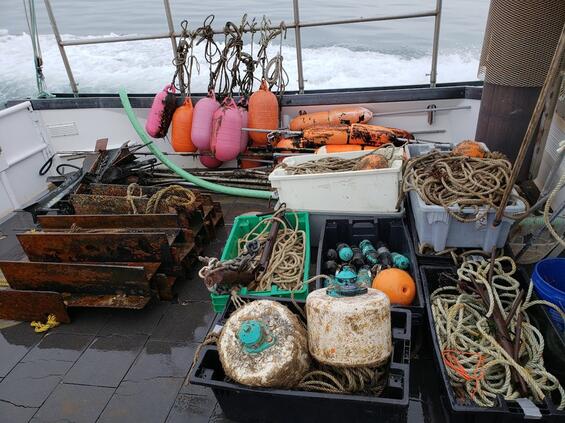
Acoustic receivers ready for deployment.
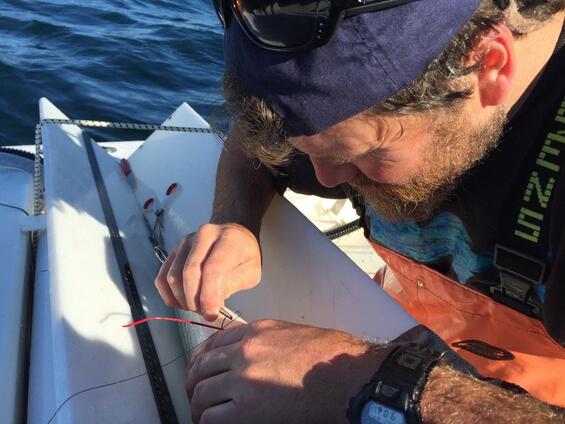
Suturing a striped bass after internally implanting an acoustic tag and external floy tag so anglers can report their catch.
Striped Bass Genetics
Did you know all the striped bass we catch in Massachusetts were born somewhere else? DMF, in partnership with the University of New Brunswick – St. John and University of Massachusetts Amherst developed a state-of-the-art genetics panel to determine the origin of striped bass caught in coastal waters, allowing us understand population dynamics and trajectory of the species. If you are interested in the welfare of striped bass and your fishing opportunities, pay attention to production in the Chesapeake Bay!
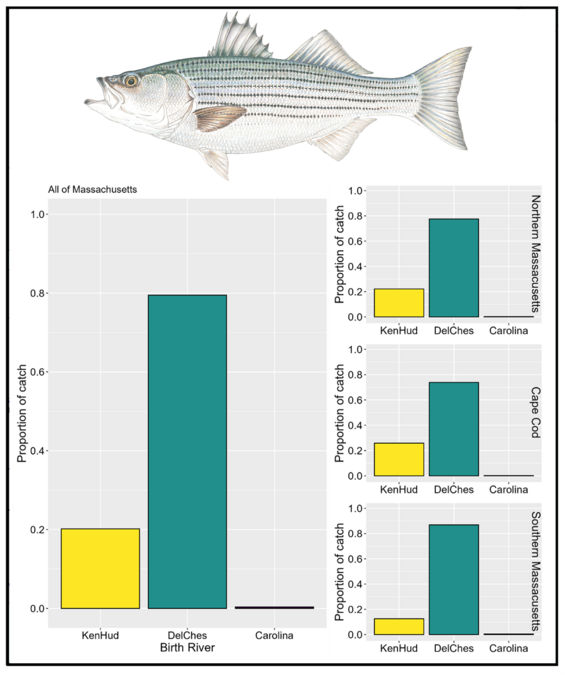
Striped bass caught in Massachusetts are from one of three genetically distinct population groups: The Kennebec and Hudson, Delaware River and Chesapeake Bay, and North Carolina. Overall and regardless of area caught in Massachusetts, more than 75% of striped bass were from the Delaware River – Chesapeake Bay group, followed by the Kennebec – Hudson.
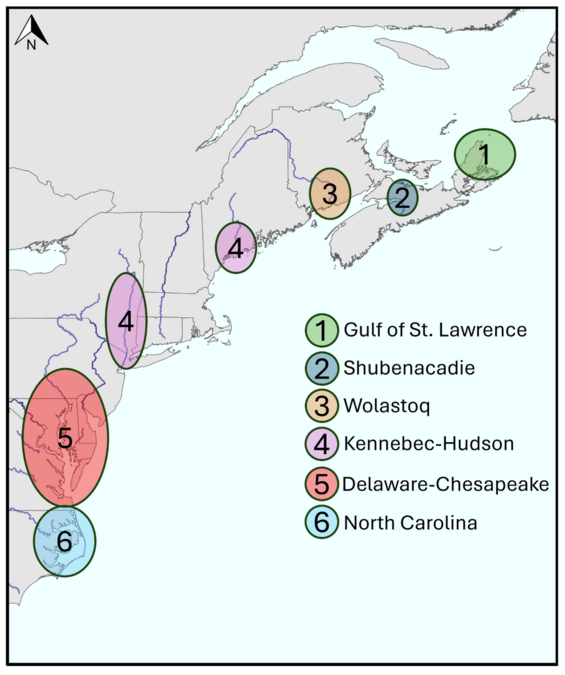
Genetic population groups determined through collection of spawning and age-0 striped bass collected in spawning estuaries in the United States and Canada. The Kennebec River was recently stocked with fish from the Hudson River and the C&D canal, which connects spawning areas in the Delaware River and Chesapeake Bay, have led to these spawning areas being genetically similar.
Striped Bass Post-Release Mortality
For decades, it has been assumed that 9% of striped bass that are released after being caught die afterwards, based on research performed by DMF 30 years ago. With post-release mortality by recreational catch and release angling being the top source of fisheries mortality for striped bass, it was important to reassess this figure using state of the art methods. DMF employed a three phase approach, combining acoustic telemetry to observe which fish live or die after release, a citizen-science project to identify the predictors of mortality, and a coast-wide angler survey to understand how and how many linesiders are caught across their range to estimate a new post-release mortality rate of 4.2%, half the previous estimate. You can do your part to go even lower by keeping handling time less than 45 seconds and removing multiple treble hooks from your lures if they have them.
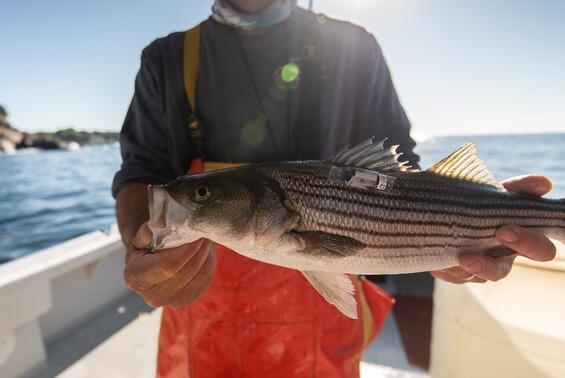
A striped bass outfitted with an acoustic tag with built-in accelerometer, used to determine survival, ready for release.
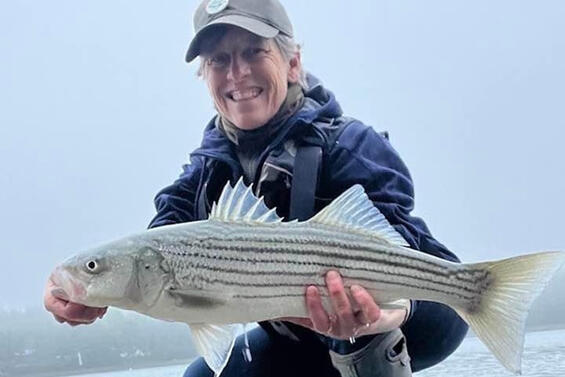
A happy striped bass angler with a fish they caught and submitted data for as part of DMF’s Citizen Science Project.
American Shad in the Charles
DMF is committed to restoring viable and robust populations of this large, fun to fish for herring to historical habitats in Massachusetts, and where better to start than the in the shadow of Fenway Park and the Citgo sign? DMF started restoration by stocking larvae into the river and followed that by placing acoustic tags in returning adult shad several years later to understand the possible barriers to long-term restoration. This work, with additional funding from the Charles River Watershed Association and in partnership with the United States Fish and Wildlife Service, identified that the Watertown Dam and operations at the New Boston Locks were potential barriers to full restoration of American shad in the Charles and helped inform ongoing efforts to remove the Watertown Dam.
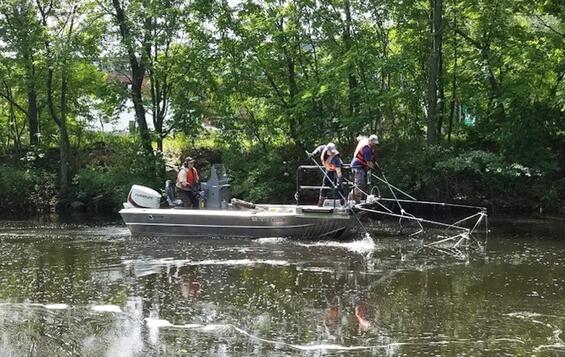
DMF and USFWS biologists collecting adult American shad on the Charles River using a boat electrofisher.
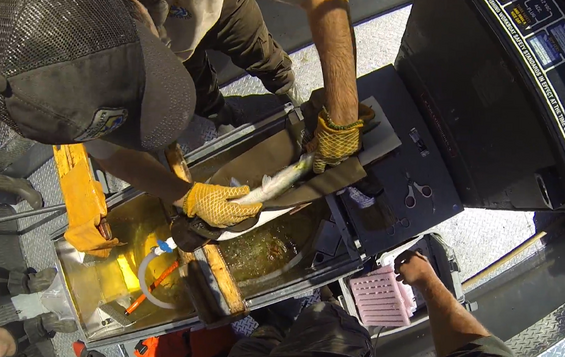
Take a look at how we tag American shad on the Charles River in this short video.