
- Scientific name: Euchlaena madusaria
- Species of Greatest Conservation Need (MA State Wildlife Action Plan)
- Special Concern (MA Endangered Species Act)
Description
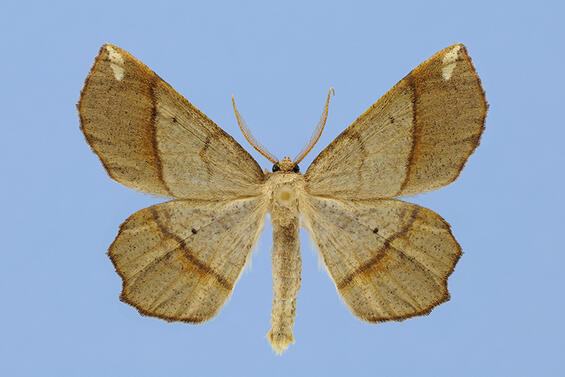
Scrub euchlaena (Euchlaena madusaria).
The scrub euchlaena (Euchlaena madusaria) is a geometrid moth with a wingspan of 28-40 mm (1.0-1.5 in) (McGuffin 1981). Both the forewing and the hind wing are light tan proximal to the postmedial line, and darker tan with black speckling distal to the postmedial line. The postmedial line on both forewing and hind wing is prominent, a rusty, reddish-brown color, and complete and smoothly curved from the costal margin to the inner margin. The antemedial line is brown and dentate on the forewing; on the hind wing it is weak to absent. The reniform and discal spots are reduced to small, solid, brownish-black dots, occasionally obscure to absent. The forewing has a broad, cream-colored apical dash. The fringe of both the forewing and the hind wing is rusty, reddish-brown in color, matching the color of the postmedial line. The head, thorax, and abdomen are all light tan in color, matching the wings proximal to the postmedial line. In Massachusetts, the pale spring brood of the deep yellow euchlaena (Euchlaena amoenaria) may be confused with the scrub euchlaena. On the underside of the hind wing of the scrub euchlaena, the outer postmedial line forms a wide loop as compared to the deep yellow euchlaena, which has a narrow loop (Forbes 1948).
Life cycle and behavior

In Massachusetts, the scrub euchlaena has two broods per year, the first flying from late May through late June, and the second flying in August. Larvae are probably somewhat polyphagous, but the habitat associations of the scrub euchlaena in Massachusetts indicate a likely preference for lowbush blueberries (Vaccinium angustifolium and V. pallidum). Larvae from the second annual generation overwinter partially grown, completing development in the spring.
Distribution and abundance
The scrub euchlaena ranges from Nova Scotia south to Florida, and west to British Columbia and Texas (Forbes 1948, McGuffin 1981). In Massachusetts, the scrub euchlaena is known to occur in sandplain habitats in the Connecticut River Valley, the Nashua River Valley and the northeastern part of the state, and on Cape Cod and the offshore islands.
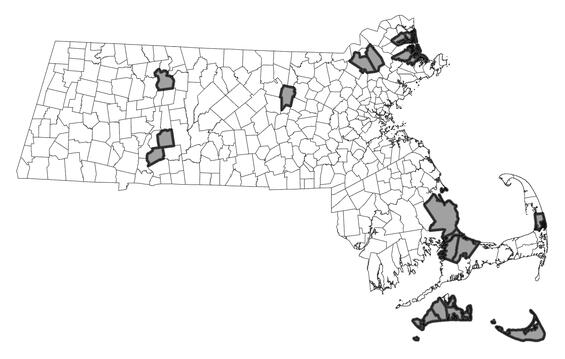
Distribution in Massachusetts.
2000-2025
Based on records in the Natural Heritage Database.
Habitat
In Massachusetts, the scrub euchlaena inhabits sandplain pitch pine-scrub oak barrens, heathlands, and shrubby grasslands.
Healthy habitats are vital for supporting native wildlife and plants. Explore habitats and learn about conservation and restoration in Massachusetts.
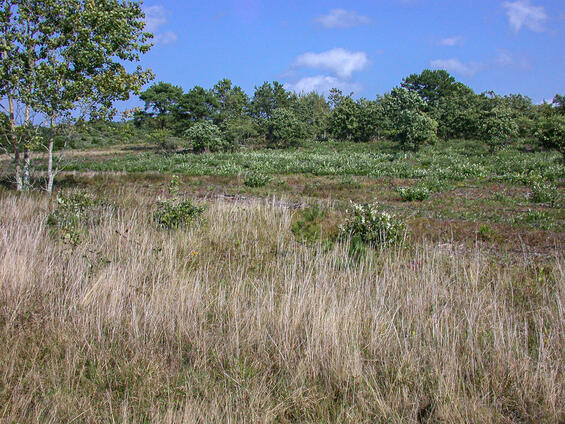
Sandplain heathland/shrubby grassland habitat with abundant lowbush blueberries, ideal habitat for the scrub euchlaena. Habitat managed by DCR and TNC at Manuel F. Correllus State Forest.
Threats
The scrub euchlaena is threatened by habitat loss and fire suppression in its disturbance-dependent habitats, in particular sandplain pitch pine-scrub oak barrens and heathlands. Other potential threats include introduced generalist parasitoids, aerial insecticide spraying, non-target herbicide application, and off-road vehicles. The effect of a warming climate may not be detrimental to this species in Massachusetts; its range extends south to Florida, suggesting adaptation to warm temperatures.
Conservation
Land protection and habitat management are the primary conservation needs of this species in Massachusetts. In particular, sandplain pitch pine-scrub oak barrens and heathlands should be conserved, restored, and managed to maintain habitat for this species and the entire suite of rare and threatened species dependent on such habitats.
Survey and monitoring
The distribution of the scrub euchlaena in sandplain pitch pine-scrub oak barrens and heathlands is well documented. Known populations of this species should be surveyed to document persistence at least once every 25 years; every 10 years is more desirable when practicable.
Management
Management of sandplain pitch pine-scrub oak barrens and heathlands benefits a suite of rare and threatened species, and habitat condition should be monitored and management adapted as needed. For the scrub euchlaena, open barrens with a shrub layer including lowbush blueberries (Vaccinium angustifolium and V. pallidum) is of particular importance.
Research needs
The natural history and conservation needs of the scrub euchlaena are relatively well known. However, the future effects of a warming climate on this species are unpredictable and should be documented.
References
Forbes, W.T.M. 1948. Lepidoptera of New York and Neighboring States. Part II. Memoir 274, Cornell University Agricultural Experiment Station, Ithaca, New York. 263 pp.
McGuffin, W.C. 1981. Guide to the Geometridae of Canada (Lepidoptera). Volume II. Subfamily Ennominae, part 3. Memoirs of the Entomological Society of Canada No. 117: 1-153.
Contact
| Date published: | March 7, 2025 |
|---|