

I. Purpose
Management of Change
- Change management is the process used to manage significant operational changes and new capital projects that will have a direct impact on system safety.
- The Federal Transit Administration (“FTA”) defines Safety and Security Certification (“SSC”) as “the series of processes that collectively verify the safety and security readiness of a project for public use.”1
- The Massachusetts Bay Transportation Authority’s (“MBTA”) Safety & Security Certification Program Plan (“SSCPP”) establishes the management responsibilities and the technical processes to identify and assess changes that may introduce new hazards or impact MBTA’s safety performance.2
- If MBTA determines that a change may impact its safety performance, then MBTA must evaluate the proposed change through its Safety Risk Management process.
- The Department of Public Utilities (“DPU”) Rail Transit Safety Division (“RTSD”), as the State Safety Oversight Agency (“SSOA”), oversees MBTA’s compliance with the SSC processes in MBTA’s SSCPP.
II. Requirement
49 C.F.R. § 673.27(c) (Public Transportation Agency Safety Plans):
(c) Management of change.
- A transit agency must establish a process for identifying and assessing changes that may introduce new hazards or impact the transit agency's safety performance.
- If a transit agency determines that a change may impact its safety performance, then the transit agency must evaluate the proposed change through its Safety Risk Management process.
49 C.F.R. § 674.25(c) (Role of the State Safety Oversight Agency):
An SSOA has the responsibility to provide safety oversight of an RTA's project(s) in the engineering or construction phase to verify compliance with all applicable Federal and State safety requirements. For purposes of §§ 674.33 and 674.35, this is limited to safety events that involve transit-related activities such as operations, testing, simulated service or pre-revenue service, or a transit-related maintenance activity.
220 CMR 151.03(1):
The Transportation Authority shall develop and implement a written Public Transportation Agency Safety Plan (“PTASP”) [in compliance with 49 C.F.R. Part 673].
220 CMR 151.10(5):
Department Access to Information. The Transportation Authority shall grant the Department access to information necessary to discharge the requirements set forth in the Program Standard including, but not limited to:
- Reports generated and databases utilized to monitor the status and performance of the Transportation Authority's rail transit system;
- All approved policies, procedures, directives, system element descriptions (general and technical), or documents that support the [System Safety Program Plan] SSPP or PTASP;
- The Transportation All-page System;
- The Operations Control Center Log; and
- Maintenance Databases.
III. Guidance
A. General
DPU’s SSOA role in safety certification for change management is to verify MBTA’s SSCPP and verify MBTA’s compliance with the SSCPP. DPU’s oversight responsibilities are on safety. DPU’s oversight role does not include substituting its engineering or technical judgement for MBTA, its contractors/consultants, or FTA, involving engineering design or construction practices. Also, DPU is not responsible for overseeing aspects of a project that are traditionally addressed through FTA's Project Management Oversight (“PMO”) program, including areas such as budgeting, financial planning, social and economic equity, and environmental protection. DPU does not conduct PMO reviews of MBTA as a federal grantee or recreate such processes.
B. MBTA Safety and Security Certification
MBTA SSCPP Generally
Consistent with FTA’s Handbook for Transit Safety and Security Certification, MBTA is a “self-certifying” agency responsible for determining which projects require SSC, the means and methods through which SSC will be carried out, and the process through which SSC requirements and outcomes will be documented and maintained.
The purpose of the SSCPP is to eliminate or reduce risks from new capital projects and system changes, in accordance with the requirements of 49 U.S.C. § 5327, FTA Circular 5800.1, 49 C.F.R. § 673, 49 C.F.R. § 670, 49 C.F.R. § 270, and DPU requirements as they pertain to SSC, change management, and SRM.
The SSCPP applies to projects whose results may affect the safety and security of the MBTA system. For purposes of DPU’s SSOA role, this includes, but is not limited to, rail transit (subway system) projects that involve stations, system extensions, rail rolling stock, all new infrastructure directly supporting revenue service, and any equipment addressing a major safety-or security-critical system. MBTA Safety and MassDOT Security and Emergency Management work with MBTA Project Managers to evaluate and determine the level of Certification required for each project.
The SSCPP addresses three separate but overlapping areas:
- System Safety and Security;
- Fire Life Safety; and
- Occupational Safety.
Additionally, the SSCPP scope establishes an SSC management and administrative mechanism, a framework of project team responsibilities, a detailed SSC 10-step process, documentation requirements, and configuration management covering all MBTA potential projects needing SSC. For Category 2 projects the SSC 10 step process can be tailored to fit the project.
SSCPP Committees
MBTA established a committee structure to oversee SSC activities:
- The Safety Management Review Committee (“SMRC”) oversees all SSC activities and provides approval of the SSC for each project.
- A project-specific Safety Management Working Group (“SMWG”) provides direct support and initial review and approval of all SSC activities, and reports certification efforts to the SMRC.
- Additional committees, such as the Fire Life Safety Committee (“FLSC”) and the Operational Readiness Committee (“ORC”) may be activated if determined to be necessary by MBTA Safety and the MBTA Project Manager during the SSC Project Assessment.
SSCPP Project Tiers (Categories)
Prior to starting the SSC process, projects are assessed by MBTA Safety with the support of the MBTA Project Manager. Projects are categorized and prioritized based on FTA funding, total project value, and safety sensitive or safety critical nature.
Unless otherwise directed by the SMRC, DPU, or FTA, a rail transit project will be considered to require SSC if the project meets any of the following criteria:
- Total cost meets or exceeds $100 million;
- New, changed, or rehabilitated public access areas or revenue vehicles;
- New, changed, or rehabilitated infrastructure directly supporting revenue service;
- New or changed equipment providing a safety-critical function; or
- Significant operational change.
Projects that need to have SSC are separated into two categories:
- Category 1:
- Generally, projects larger in scope or greater in complexity. These projects will have more stringent requirements.
- Each Category 1 project must have a project-specific Safety and Security Management Plan (“SSMP”) and Safety and Security Certification Plan (“SSCP”).
- Category 2:
- Projects smaller in scope or less complex fall into Category 2.
- MBTA Safety will review the Category 2 project and identify which SSC activities will be required based on the project’s scope, complexity, and potential impacts to safety and security.
- The required SSC activities for each project must be documented on the SSC Project Assessment Form (“PAF”), which is completed jointly by MBTA Safety and the Project Manager.
C. RTSD Oversight
DPU RTSD staff assigned to oversight of safety certification must review and be knowledgeable about MBTA’s SSCPP. Staff should annually review by December 31st relevant SSCPP sections to refresh their knowledge.
DPU RTSD staff track MBTA Capital projects through the engineering and construction phases of the project. When the project enters into the final stages of the engineering design phase and begins the construction phase, RTSD increases its oversight and begins its verification of the ten steps for safety certification. MBTA applies all ten steps to Category 1 projects. MBTA
Safety reviews Category 2 projects and may choose to apply less than all ten steps to Category 2 projects. RTSD collects evidence through its review of documents and attendance in meetings/field activities to verify that MBTA followed the requirements of MBTA's SSCP (a SSCP is created for each Category 1 project and is specific to that project).
MBTA’s ten Steps for the SSC Process are set forth below (most of the documents referenced below under each Step are contained in the MBTA Certification Workbook. RTSD staff will use RTSD’s “SSC Project Oversight Checklist” to guide and document their review.
- Identify Certifiable Elements
- Review Preliminary Hazard Analysis (“PHA”)
- Review Threat Vulnerability Assessment (“TVA”)
- Review Operational Hazard Analysis (“OHA”);
- Develop Safety and Security Design Criteria
- Certifiable Items List (“CIL”) (DPU review of the CIL continues throughout a project, and verifies that MBTA creates the CIL and follows its processes for confirming that items on the CIL are addressed);
- Develop and Complete Design Criteria Conformance Checklist
- This step generally does not require DPU oversight activity.
- Perform Construction Specification Conformance
- Review CIL and Design Criteria Conformance Checklist (“DCCC”).
- Identify Additional Safety and Security Test Requirements
- Review System Integration Testing Plans (“SIT”), to check they are filled out completely.
- Perform Testing and Validation in Support of the SSCPP
- Review Testing and Commissioning Reports by checking for signed-off reports. RTSD staff may observe operational testing as determined case-by-case.
- Manage Integrated Tests for the SSCPP
- This step generally does not require oversight action by DPU.
- Manage “Open Items” (continuous process throughout project)
- Review the Open Items Log (formerly called SOIL) and CIL – ensure mitigations are implemented for open items.
- Verify Operational Readiness
- Review the following:
- FTA OP54 Readiness for Service Report (if applicable; applies to larger scale projects in Category 1);
- Rail Activation Plan (if applicable; applies to larger scale projects);
- Temporary and Final Occupancy Permits – collect electronic copy; and
- Safety and Certification Verification Report (“SSCVR”) (if applicable; applies to larger scale projects in Category 1).
- Review the following:
- Conduct Final Determination of Project Readiness and Issue Safety and Security Certification
- Review the following:
- Open Items Log;
- Certificates of Conformance (tracks the CIL);
- Final SSCVR;
- CIL; and
- SMRC Final Safety Certification Document (signed by MBTA).
- For Category 2 projects, the RTSD Director or Assistant Director reviews the RTSD staff person’s completed checklist, discusses the project with the staff, reviews MBTA’s draft (as applicable) and final Safety Certification Document, and signs an internal memo of safety certification completeness for DPU’s files.
- For Category 1 projects the same steps of Category 2 projects apply plus an additional letter of concurrence from the RTSD Director or Assistant Director to MBTA accepting MBTA’s completion of the Safety and Security Certification process prior to MBTA’s full use of the project in accordance with section IV.A.3 (Category 1 projects) below.
- Review the following:
IV. Responsibilities
MBTA Responsibilities
For modifications to equipment, facilities, infrastructure, and/or procedures, MBTA must ensure that, consistent with the SSCPP or the Safety Risk Management process as defined in the MBTA System Modification Safety Program:
- A comprehensive review is conducted, and approvals/sign-offs are secured from management, project managers, and any applicable stakeholders before such changes are made;
- Primary and secondary safety and functional impacts of a proposed change are identified, evaluated, and addressed early in a project's design phase;
- The completed modifications are properly incorporated into the existing system; and
- Projects are tracked and documented through the use of Trimble (MBTA’s current designated database; previously e-Builder) and the DPU database/SharePoint.
Monthly Project Updates to DPU
For DPU to discharge the SSO Program requirements under 49 C.F.R. § 674.25(c), and pursuant to 220 CMR 151.10(5), MBTA must submit to DPU a monthly list of all projects that are in planning, design/engineering development, or under construction. The list must include the status, MBTA Department, project title, total (or estimated) project value (cost), Project Manager, estimated start date (of operations), Safety Certification Category, whether or not MBTA is certifying the project and whether an FTA PMO contractor (“PMOC”) is assigned. This list must also include projects that are currently not undergoing safety certification and the basis for that decision.
SSCPP-Related Meetings
Pursuant to 49 C.F.R. § 674.25(c), and 220 CMR 151.10(5), MBTA must grant DPU unencumbered access to, and DPU may attend, committee or working group meetings pertaining to any MBTA project under safety certification, including the SMRC, the SMWG and project status update meetings. MBTA must grant access to, and DPU personnel may review, associated documentation, including but not limited to agendas and meeting minutes. DPU is a non-voting member of the SMWG of all Category 1 and Category 2 projects.
MBTA must promptly notify DPU of all project-related committee and working group meetings, drills, exercises, or tests. In addition to schedule notification, MBTA must grant access to meeting information, and all associated materials, which include any relevant project meetings scheduled with contractors.
Category 1 Projects
For Category 1 projects, pursuant to 220 CMR 151.10(5), DPU may request, and MBTA must provide to DPU, regular updates and requested documents, as part of the following development phases:
- Project Planning
- Preliminary Engineering
- Final Design
- Procurement
- Construction
- Operations and Maintenance Procedures and Plans
- Training
- Testing
- Pre-revenue simulated service
For DPU’s closeout review, MBTA will provide DPU with access to its Project Management Information System (“PMIS”) SSC folder (folder 28, as may be renumbered) to view Certification documents which will include final occupancy permits and other SSC workbook documentation.
For Category 1 projects, MBTA may not use the project asset or area for passenger service or for any purpose other than testing, until DPU concurs in writing that MBTA has completed either (1) or (2) below:
- Completed an Interim Certificate. The Interim Certificate shall include the certifiable elements and safety-critical items that require temporary mitigations or restrictions. Interim Certificate shall be signed by the Project Director, Safety & Emergency Management Director, Chief Engineer, Chief Operating Officer, Chief of Construction & Safety Engineering, and the Chief Safety Officer; or
- Completed its safety certification process, including hazard identification, any mitigations or corrective actions, and the SMWG has determined project readiness by issuing a Project Certificate of Conformance (“COC”). The Project COC will include the certifiable elements and any remaining hazards that may be transferred to an appropriate MBTA department for custodial management. The Project COC signifies that all safety and security requirements have been verified complete or mitigated and each certifiable element has an Element Certificate of Conformance, or, all Elements are complete and stated as such in the Project COC which will supersede the individual Element COC’s. The Project COC shall be signed by the Project Director, Safety & Emergency Management Director, Chief Engineer, Chief Operating Officer, Chief of Construction & Safety Engineering, and the Chief Safety Officer. The Completed Project COC will be forwarded, along with a SSCVR to the SMRC at the scheduled monthly meeting for approval. Once approved by the SMRC, MBTA will provide the Project COC and SSCVR to DPU for final review and concurrence. DPU will provide a separate letter of Concurrence to MBTA’s Safety Engineering department to be kept with project documents for proof of project closeout and completion of the SSC process.
As part of the SSC process described above, MBTA will submit to DPU certificate documents in a timely manner along with test train sign-offs (if applicable) for DPU’s review and concurrence. Upon receipt and in both scenarios, DPU will be in a position to issue a concurrence letter without undue delay.
Category 2 Projects
For Category 2 projects, pursuant to 220 CMR 151.10(5), DPU may request, and MBTA must provide to DPU, regular updates and requested documents, as part of the following development phases:
- Final Design
- Procurement
- Construction
- Operations and Maintenance Procedures and Plans
- Training
- Testing
- Pre-revenue simulated service
For Category 2 projects, DPU will conduct periodic oversight during the construction – pre-revenue phases through document reviews, site visits, and attending project and SMWG meetings. Once Category 2 projects have been certified, DPU will collect all final safety certification documentation for review and conduct a final site visit. Unlike Category 1 projects, for Category 2 projects DPU concurrence is not mandatory prior to the release of the project assets or area for use or passenger service.
RTSD Responsibilities
Below is a summary of RTSD’s responsibilities for the Management of Change process.
General Summary
RTSD’s general responsibilities for Management of Change, including capital projects, are:
- Assure that MBTA processes for Management of Change follow industry standard practice and are adequately documented either in MBTA’s PTASP or in document(s) incorporated by reference in the PTASP.
- Monitor MBTA’s planning for system modifications or capital projects and the status of those projects (internal activities or procurement including technical services) to determine the appropriate timeframe to start or increase engineering and construction phase monitoring of specific projects.
- Assure that MBTA and the project team follow their documented processes from a safety oversight perspective only. This is completed through:
- receiving and reviewing copies of documents;
- receiving and reviewing copies of meeting minutes;
- attending meetings; and
- occasionally completing on-site walk throughs or examinations, as deemed appropriate.
As the project, modification, or procurement activities near completion, RTSD collects enough documentation, and participates in meetings and events as it deems necessary, to confirm whether the elements in IV.B.1 above are true and have been completed successfully, as documented in MBTA’s process documents. RTSD staff use RTSD’s SSC Project Oversight Checklist to confirm required processes have been completed.
RTSD Staff Activities for Management of Change
RTSD staff engaged in management of change activities may participate in the following activities:
- Track MBTA’s capital projects and improvements. RTSD logs and tracks all its safety certification notes, meeting minutes, site visits, project documents etc., in RTSD’s database and SharePoint;
- Access Trimble (previously eBuilder) to monitor projects and receive regular master schedule updates,
- Trimble is MBTA’s project tracking software;
- Participate in routine and special meetings with MBTA Safety Engineering Teams and Project Teams to discuss current and upcoming projects;
- Conduct field visits to observe project status, and field verification walkthroughs to confirm safety certifiable items have been completed and mitigations to exceptions are in place;
- Monitor rail car testing and acceptance by attending meetings, reviewing acceptance documents and conducting site visits to observe testing activities;
- Attend, as a non-voting member, the SMWG for Category 1 and Category 2 projects. Assigned RTSD staff must attend all such meetings unless approved otherwise in advance by RTSD management; and
- Review and track MBTA’s safety certification documents.
Reference List of MBTA Safety Certification Documents
- SSC Project Assessment Form
- Safety and Security Certification Program Plan (“SCPP”)
- Certifiable Elements List
- Preliminary Hazard Analysis (“PHA”)
- Mitigations and controls developed through the PHA become Certifiable Items which must be implemented and verified to achieve project certification. The PHA is developed early in the project life cycle, and should be updated as new hazards are identified as the project progresses or changes.
- For Rail Transit projects, MBTA will complete the PHA following the SRM processes defined in MBTA’s Transit Safety Plan.
- CIL
- Certifiable Items are individual components of each Certifiable Element for the project. Certifiable Items are documented individually on the CIL.
- The CIL is the primary tool to manage the certification process throughout the project’s life cycle. The CIL ensures that the criteria and relevant codes are incorporated into each project phase’s conformance checklist.
- Design Criteria Conformance Checklist (“DCCC”)
- Once the CIL and appropriate design criteria have been developed, the DCCC is used to document and verify that the project design incorporates the required design criteria to address safety and security risks.
- Open Items log (mitigations) (sometimes referred to as “SOIL”)
- Safety Critical Items List (“SCIL”)
- Safety and Security Certification Workbook
- Project Management Plan (“PMP”)
- System Integration Testing Plans (“SIT”) (SIT I and SIT II)
- System Security Emergency Preparedness Plan (“SSEPP”)
- Threat Vulnerability Assessment (“TVA”)
- Construction Specification Conformance Checklist
- Rail Activation Plan (“RAP”)
- Operational Hazard Analysis (“OHA”)
- OHAs are performed in preparation for operational readiness.
- OHAs are used to identify, document, analyze, and mitigate operational hazards caused by operating and support (i.e., maintenance) personnel.
- Mitigations and controls developed through the OHA become certifiable items which must be implemented and verified to achieve certification.
- Safety and Security Certification Verification Report (“SSCVR”)
- MBTA submits to SMRC for final sign-off.
- The SSCVR must include mitigations for any item not yet fully addressed.
- Temporary and Final Occupancy Permits
- SMRC Final Safety Certification Document
- Hazard Tracking Log
Category 1 Projects
For Category 1 projects, DPU will concur in writing after MBTA completes its safety certification process and presents DPU with a fully executed SSCVR. As part of DPU’s closeout review, MBTA will provide DPU with access to its Project Management Information System (“PMIS”) SSC folder (folder 28 as may be renumbered) to view Certification documents which will include final occupancy permits and other SSC workbook documentation, DPU will review the final sign-offs from the SMRC for a project, and will inform MBTA by a letter of concurrence (see Section III.C., step 10).
Category 2 Projects
For Category 2 projects, DPU will not concur in writing after MBTA completes its safety certification process. Notwithstanding, DPU will track the construction and final certification phases of the project. DPU will verify that mitigations or corrective actions have been identified and implemented for all identified hazards. DPU will review the final sign-offs from the SMRC for a project, and will collect (or confirm) the final safety certification documentation including all signed temporary and final occupancy permits (using RTSD’s SSC Project Oversight Checklist).
FTA Responsibilities
FTA’s Office of Program Management (“TPM”) conducts PMO as required. PMO applies to all recipients of FTA financial assistance (such as MBTA) undertaking a “Major Capital Project”, defined in 49 C.F.R. Part 633 as a project that involves:
construction, expansion, rehabilitation, or modernization of a fixed guideway that (i) Has a total project cost of $300 million or more and receives Federal funds of $100 million or more; and (ii) Is not exclusively for the acquisition, maintenance, or rehabilitation of vehicles or other rolling stock.
The FTA Administrator may also designate a project as a Major Capital Project where PMO will benefit the federal government or the grant recipient.
If federally funded, federal oversight begins at ~30% design of the Project Life-Cycle. Examples of funding sources that receive federal PMO are:
- Capital Investment Grant (“CIG”) – New Starts Projects, Small Starts Projects;
- Better Utilizing Investments to Leverage Development (“BUILD”) (formally named Rebuilding American Infrastructure with Sustainability and Equity (“RAISE”) and Transportation Investment Generating Economic Recovery (“TIGER”));
- Transportation Infrastructure Finance and Innovation Act (“TIFIA”) Loan; and
- State of Good Repair (“SGR”).
FTA oversight is conducted by the FTA Regional Offices, and FTA Headquarters Office of Program Management through its contractors. For MBTA projects that are overseen by FTA Region 1 office and PMOCs, DPU will coordinate oversight activities with FTA and the PMOC to the extent practicable. This includes document reviews, meetings, and field activities.
FTA oversight is guided by FTA guidance, including the following:
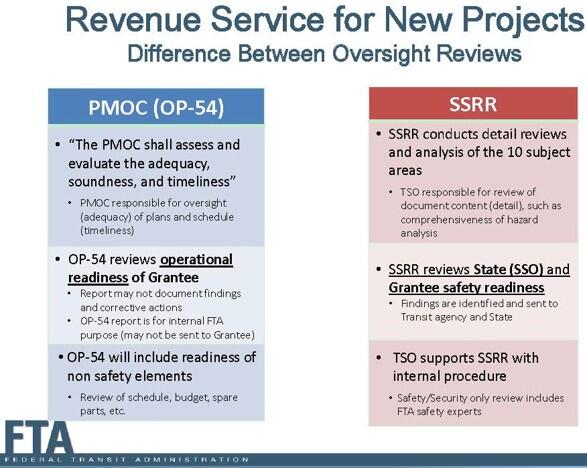
- OP-54 Readiness Review
This guidance contains recommended procedures and actions that FTA expects of PMOCs when evaluating project sponsors’ readiness for service, including completion of system integration testing, and pre-revenue operations and management capacity and capability. Its objectives are to ensure that:
- The system is safe for use by patrons;
- All systems, subsystems, components, equipment, conform to contract documents;
- The entire transit system, with all interfaces, operates as an integrated whole, and system operates safely through the host communities;
- The Grantee demonstrated the capacity and capability to safely operate and maintain the system;
- Prior to any trains operating on the alignment, all systems and security elements or an effective work-around should be in place and certified;
- Focus on transition from construction, to start-up, to operations is established; and
- Timeframe usually begins a year before the system opens for revenue service and requires reviews before System Integration Testing, Pre-Revenue Service, and Full Revenue Service.
- FTA Transit Safety and Oversight (“TSO”) – Safety and Security Readiness Review (“SSRR”)
FTA’s objectives outlined in this guidance document are to:
- Assess SSOA readiness to oversee New Starts projects;
- Implement FTA Circular 5800.1 (Safety and Security Management in Major Capital Projects);
- Confirm compliance with SSO Program Standard;
- Confirm completion of safety certification process;
- Conduct SSRR when applicable (federally funded); and
- If SSRR is not conducted, SSOA may conduct its own review.
Additional Documents (for background reference)
The following project-related documents are examples of documents that FTA may review during safety oversight of an MBTA project. Reviews will concentrate in areas related to the safety certification of the project. All documents below are available in RTSD’s Power DMS and in the SharePoint Engineering folder.
FTA Documents
- FTA Circular C5800.1 Safety and Security Management Guidance for Major Capital Projects
- FTA Safety and Security Certification Handbook
- FTA Research, Construction Management Handbook
- FTA Project and Construction Management Guidelines
- FTA Security Design Considerations
- FTA PMO Oversight Procedure (OP) 22 - Safety and Security Management Plan Review
- FTA PMO OP-54 Readiness for Revenue Service
MBTA Documents
- MBTA Configuration Management and Control Safety Program
- MBTA Safety and Security Certification Program Plan
- MBTA System Modification Safety Program
- MBTA Procurement Manual
- MBTA Contract Section 01569 System Safety Certification
- MBTA Contract Section 01568 Construction Safety
- MBTA Contract Section 00700 General Conditions
- MBTA Transit Asset Management Plan
- MBTA Safety Certification Program Guide, Vehicle Procurement/Vehicle Overhaul
Updates:
February 23, 2026 – Initial Release
April 15, 2026 – Revised