
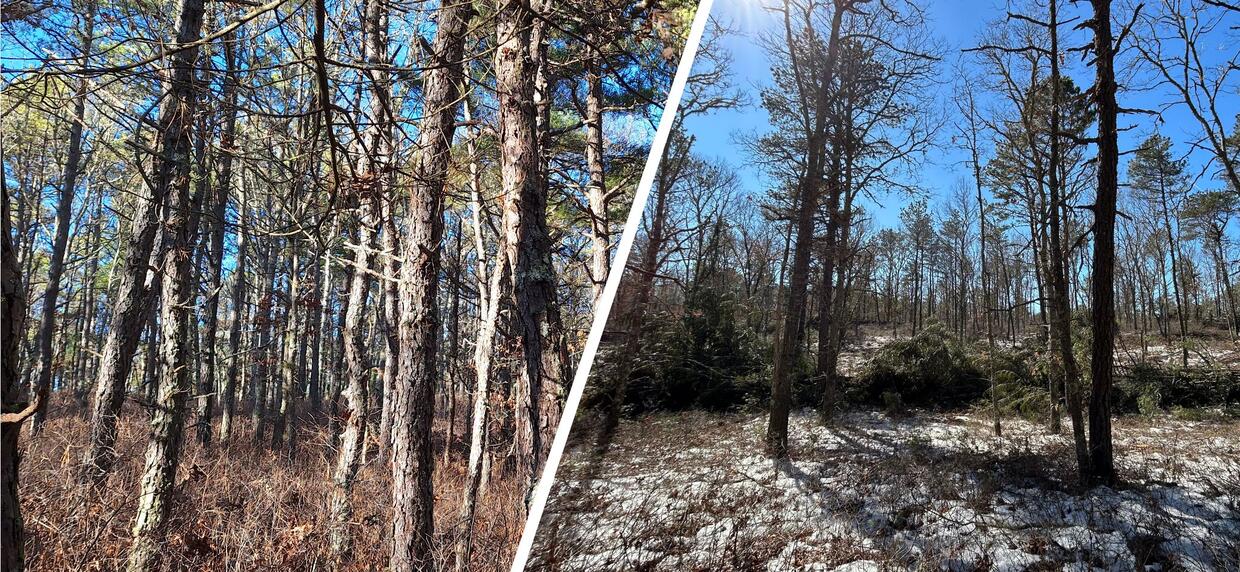
Practice description
Selective tree removal is the targeted cutting of trees for habitat and ecological restoration purposes. The practice is used for a variety of reasons: wildlife habitat management, forest products, wildfire risk reduction, promoting tree regeneration, forest stand improvement, and supporting forest health. Tree removal has a direct impact on the vegetation communities and typically aims to increase structural complexity within the habitat. The practice of selective tree removal can increase the resiliency of a natural community and enhance conditions that support greater biodiversity.
Goals and ecological processes
The goal of selective tree removal is to promote the vegetative structure and composition consistent with the target natural community. It is achieved by removing undesirable trees and opening the canopy cover. This practice is also used to remove tree species that have become established in the absence of natural disturbance.
This practice is often used to allow sunlight to reach below the tree canopy and promote vegetation (trees, shrubs, grasses, or forbs) that need full or partial sunlight. Different species have different tolerances to shade; some can thrive under a dense tree canopy, while many other species need partial or full sunlight to grow and reproduce. Selective tree removal can be used to manipulate light levels and to stimulate understory vegetation and engage the seed bank. Higher levels of sunlight in the understory are associated with increased plant and insect diversity.
The trees that are retained in a tree removal operation are intentional. These trees are free to grow to expand their canopy and create seed and mast for wildlife. They provide the primary composition and structure within the landscape.
In some cases, selective tree removal is done to reduce fuel loading, especially in fire influenced landscapes. In the northeast, selective tree removal is only temporary, and, without another repeated disturbance, the land will regrow back into a closed canopy forest over time.
Target habitats and species
This practice is often used in forested areas, post agricultural lands, and areas that have experienced long periods of fire suppression where the understory vegetative community’s vigor is reduced. It is often associated with dry, well-drained soils, like barren ecosystems, meadows, grasslands, and woodland areas where a strong shrub or sapling response is desired, such as aspen, maple, or oak stump sprouting, or where understory herbaceous vegetation, like forbs and grasses, are desired. This practice can take place in the following habitat types:
- Cultural shrublands
- Cultural grasslands
- Young forests
- Dry woodlands and barrens
- Dry grasslands and heathlands
- Oak forests and woodlands
Selective tree removal benefits a wide range of Species of Greatest Conservation Need, including snakes, turtles, rabbits, pollinators, rare plants, and birds (such as ruffed grouse, whip-poor-will, and blue winged warbler), as well as more common species, like deer, bear, and turkeys.
Associated practices
Selective tree removal is frequently part of efforts to restore forested habitats to shrub-dominated natural communities and habitat types. In this role, selective tree removal is often used to reduce the overstory tree canopy by removing some or all portions of the trees from the treatment area. It may be accompanied by other management practices:
- Invasive plant control may be used to address any invasive plant species present, using chemical or mechanical removal techniques to control the undesired vegetation.
- Prescribed fire also controls competing vegetation selectively but does so through the differential responses of species to fire and the resulting changes in soil conditions and microclimate.
- Mowing and mulching is sometimes used as a short-term replacement for prescribed fire to maintain or reset shrubs at a site when operational considerations delay the use of prescribed fire.
Methods
Selective tree removal includes many silvicultural techniques and approaches, ranging from intermediate treatments, like stand thinning, to regenerating silvicultural treatments, like shelterwood and variable retention harvests. Depending on habitat type and restoration goals, tree removals might target specific tree species and/or size classes.
The strategic approach to selective tree removals can widely vary in scale and methods. Tree removal operations can be large-scale commercial tree cutting where the value of the trees being cut produce income for the landowner. Or, they could be more specialized or small-scale cutting that are non-commercial operations where there is a cost to the landowner to complete the activities.
Many selective tree removal projects will implement whole tree removal operations where the entire tree is cut and extracted from the site. Alternately, a cut-to-length or tree-length approach, where the main stem is removed from the forest and treetops are left behind to decompose, can be taken. The site and natural community needs will dictate how much, if any, woody materials you want to leave. This type of work relies heavily on mechanized forestry equipment, including feller bunchers, harvesters, skidders, forwarders, log loaders, and chippers.
There may be small scale projects where trees are felled by hand-using chainsaws and left on site. These types of projects are usually specialized or in remote areas with limited access. An example would be creating small openings in forest canopy to promote growth of a rare understory plant species. Even small projects can have a big impact.
Trees removed during habitat management projects can be used as wood products. Depending on the species, tree size, and quality of the wood, there are many possibilities for use. Some wood may be used locally as firewood, some harvested materials can be cut to appropriate lengths and transported to processing mills to become lumber products, and some trees can be chipped to be processed into mulch.
Practice details
Planning
Working with a Massachusetts licensed forester is integral to planning any type of tree harvesting. A forester will develop the plan for tree removal based on the stated project goals and will file the required Forest Cutting Plan. They will mark which trees are to be removed or saved and will map out the project – selecting the layout of skid roads, landings, and/or stream crossings.
Projects should be designed and timed, when possible, to avoid impacts to wildlife during critical or vulnerable periods, such as during nesting or migration seasons. Following forestry best management practices will minimize impacts from tree cutting operations, particularly reducing the impact of heavy equipment use on soil conditions and aquatic resources.
Regulations and requirements for Forest Cutting Practices are covered under the Forest Cutting Practices Act (M.G.L Chapter 132). The scope of some tree cutting projects may go beyond the jurisdiction of a Forest Cutting Plan and require additional or alternative permitting. These are usually projects where there is extensive work in certain resources areas, such as wetlands. In such cases, a Notice of Intent permit or a Request for Determination with a towns’ Conservation Commission may be needed. Resource regulations are covered under M.G.L. Chapter 131 and the Wetlands Protection Act, 310 CMR 10.00.
Once the Forest Cutting Plan is approved by the Department of Conservation and Recreation, the forester will oversee the harvest and work directly with the timber harvesters completing the work.