
Author: Tony Rassias - Deputy Director of Accounts
This article focuses on Stabilization Funds, which are allowed under G.L. c. 40, § 5B. Data is taken from Schedule A, the Annual Report of cities and towns. Please note that data for three municipalities is missing in FY2025.
There are two general types of Stabilization Funds:
- General Stabilization Fund – commonly known as a “Rainy Day Fund”, this type can be appropriated for any lawful purpose. It requires a 2/3rds vote of the city, town or district legislative body to establish the fund; a majority vote of that body to appropriate into the fund; and a 2/3rds vote to appropriate out of the fund or transfer from it to another Fund.
- Special Purpose Stabilization Fund – these are for a particular purpose. It requires a 2/3rds vote of the city, town or district legislative body to establish the fund; a majority vote of that body to appropriate into the fund; and a majority vote to appropriate out of the fund. In order to change the purpose of the fund, a 2/3rds vote of the same body is required.
Either type of fund may be revoked in the same way it was accepted, subject to charter, but no sooner than three years after acceptance. G.L. c. 4, § 4B.
The following graph shows total Stabilization Fund balances as of June 30 for FY2015 to FY2025, both in total dollars and measured as a percent of budget.
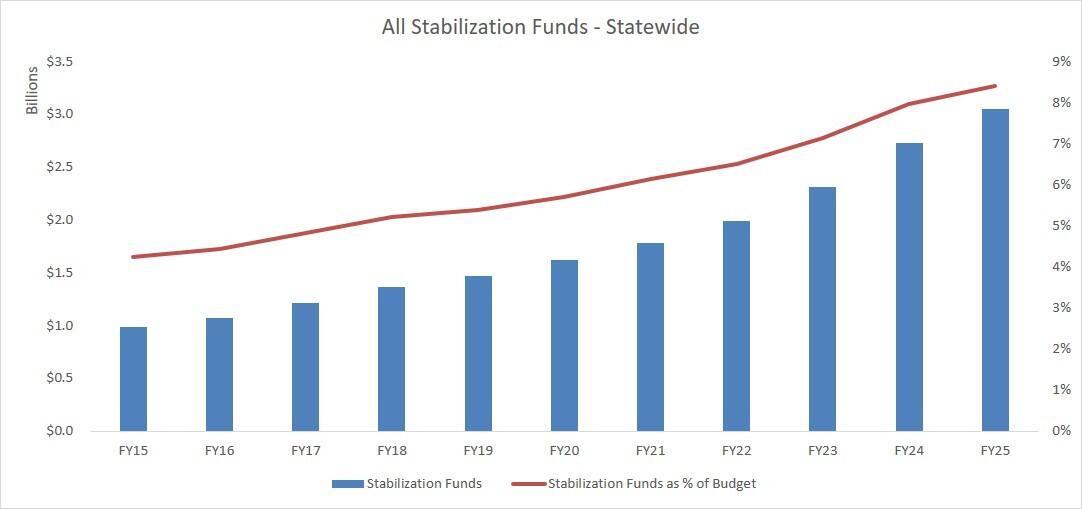
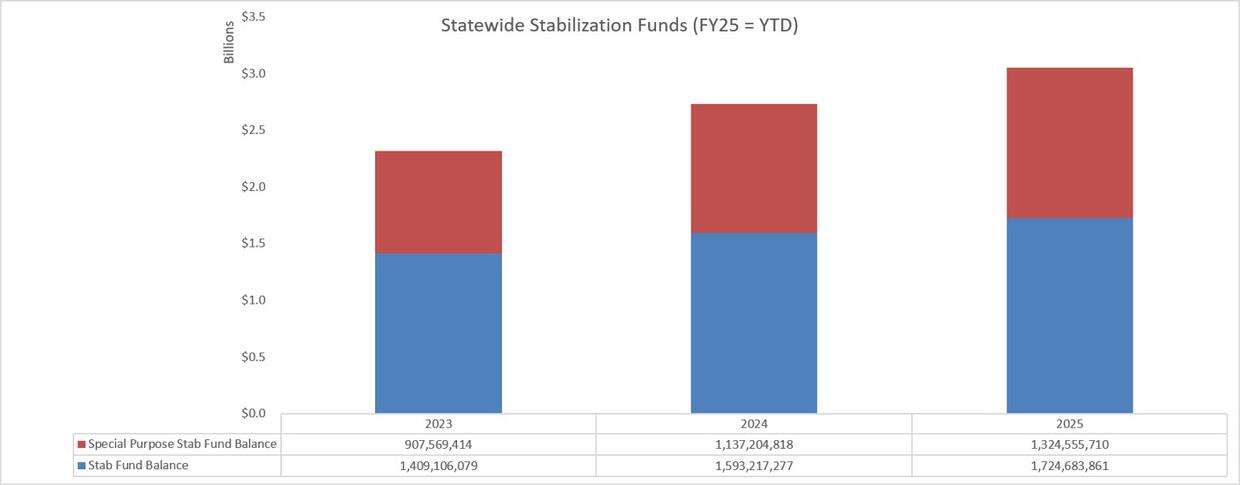
In FY2015, total Stabilization Fund balances were $984 million. In FY2025, the balance grew to $3.05 billion, an increase of 210%. As a percent of budget, it has grown from 4.2% to 8.4%. In FY2025, the $3.05 billion consisted of $1.73 billion of General Fund Stabilization and $1.32 billion of Special Purpose Stabilization, as reported by municipalities. The data indicates that the utilization of Special Purpose Stabilization Funds have become more prevalent among municipalities over the past few years: over the past three fiscal years, they have grown by $417 million, or 46%. Over the same period, General Purpose Stabilization Funds have increased $313.6M, or 22.3%. This is shown in the graph below:
The manner in which the data is reported to DLS in Gateway does not allow for an analysis of exactly what types of Special Purpose Stabilization Funds are being created, but a review of some of the Combined Balance Sheets (submitted as part of the Free Cash certification process) and the data reported on the B2 form (as part of the tax rate setting process) shows that capital projects is a primary type.
If you’re interested in seeing this data for individual communities, see Category 1 of our Municipal Finance Trend Dashboard.
The graph below shows the funding sources by year from FY2015 to FY2025:
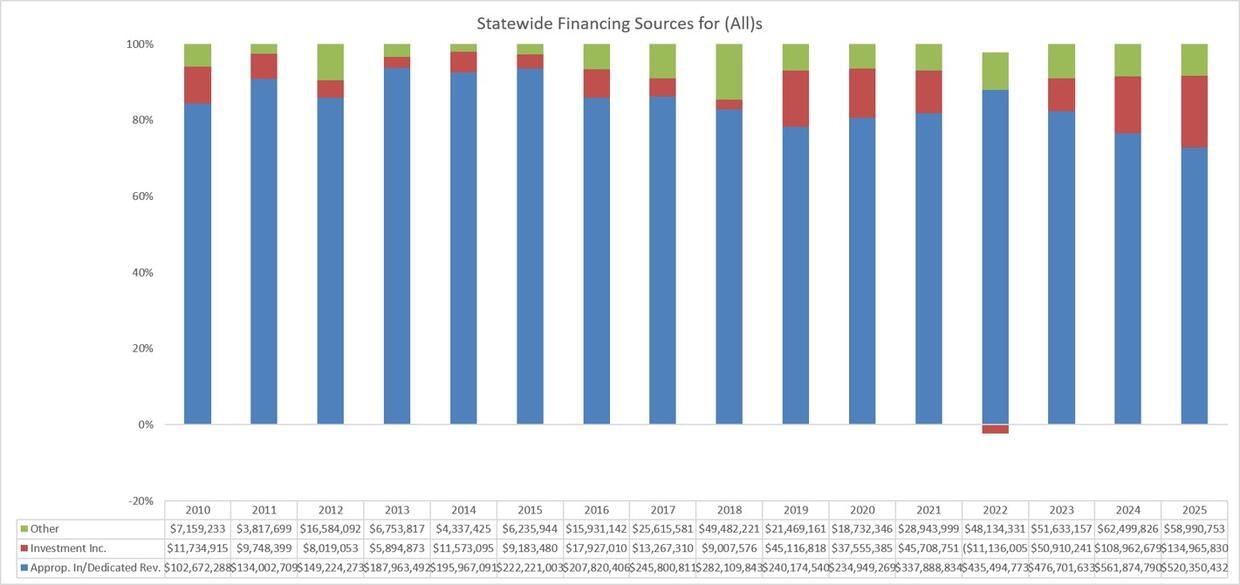
Note the increase in Investment Income, which has been caused by the higher interest rates that have been in effect for the past few fiscal years. In FY2025, this revenue source totaled nearly $135M, well above any other fiscal year. All interest earned on the deposit and investment of fund proceeds belong to the fund. The treasurer may pool monies from all such funds for investment purposes, but the accounting officer must account for them separately in the general ledger. As custodian of the fund, the municipal treasurer may deposit or invest Fund money into the following:
- a trust company, co-operative bank, or savings bank
- a national bank, federal savings bank or federal savings and loan association
- the Massachusetts Municipal Depository Trust (MMDT)
- securities that are legal investments for savings banks included in the annual legal list of investments established by the Commissioner of Banks under G.L. c. 167, §§ 15A-15K, and permitted by G.L. c. 167F, § 3 meeting the prudent investment standard governing the investment of public funds in G.L. c. 44, § 55B.
Investment options for this Fund are more liberal than options for other municipal monies but have certain legal restrictions written into the Fund’s General Law.
The graph below shows the amount of Stabilization Funds used by year, from FY2015 to FY2025. In terms of the breakdown of the $396.22 million used in FY2025, $284.58M, or nearly 72%, came from Special Purpose Stabilization Funds, meaning that the purpose(s) of the Funds has/have been met. For example, a municipality that had been depositing monies into a Public Safety Equipment Stabilization Fund used those monies to purchase the equipment, greatly diminishing/depleting the Fund. The breakdown of recent use between General Purpose and Special Purpose Stabilization Funds has been similar: 66%/34% in FY2024 and 62%/38% in FY2023.
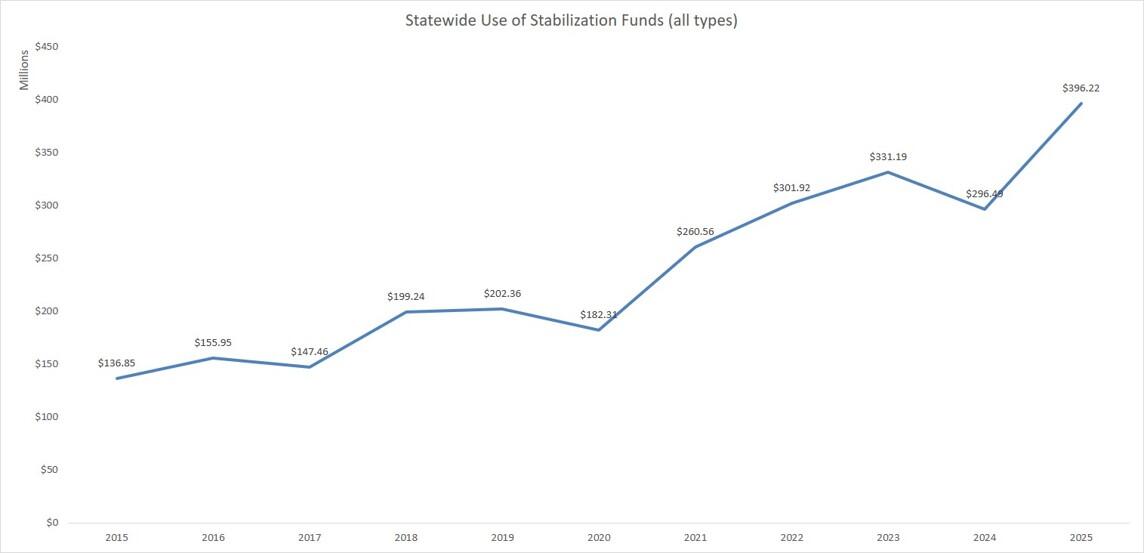
Fund balance reductions may not be cause for panic if other similar reserves remain healthy. For Special Purpose Stabilization Funds, reductions in fund balance may indicate that the purpose(s) of the Fund has/have been met. For the General Stabilization Fund, reductions in fund balance could be an indicator of budget stress. Annual reliance on the General Stabilization Fund is risky, so here are some recommendations on how to maintain a strong balance.
- Don’t Appropriate It All: If you do, the balance will have to be entirely rebuilt.
- Monitor the Fund’s Balance in the Budget Process: Since the Municipal Modernization Act (St. 2016, c. 218) eliminated caps (i.e., annual dollar, percentage appropriation and aggregate balance), more can be appropriated into the Fund.
- Dedicate an Allowable Revenue Stream into the Fund: By accepting the fourth paragraph of G.L. c. 40, § 5B, a city, town or district legislative body may vote to dedicate a revenue source to a Special Purpose Stabilization Fund by a two-thirds vote. The vote has required language and may include any fee, charge or other receipt except locally assessed taxes, excises and property tax surcharges and revenues reserved by law for particular purposes.
- Vote a Prop 2½ Stabilization Fund Override: Voters may approve a Prop 2½ levy limit override ballot question to fund any Stabilization Fund it establishes. If approved, the additional amount levied is earmarked to that fund in the fiscal year the override is effective and in subsequent years (G.L. c. 59, § 21C(g)
- Adopt a Stabilization Fund Policy: Similar to a free cash policy, adopting a policy on generating and using the Stabilization Fund’s balance is considered a best practice.
For more information on Stabilization Funds, visit the DLS Municipal Finance Training and Resource Center.
Helpful Resources
City & Town is brought to you by:
Editor: Dan Bertrand
Editorial Board: Tracy Callahan, Sean Cronin, Janie Dretler, Jessica Ferry, Brianna Ortiz, Christopher Ketchen, Paula King, Jen McAllister and Tony Rassias
| Date published: | July 16, 2026 |
|---|