
- Scientific name: Anthophora walshii
- Species of Greatest Conservation Need (MA State Wildlife Action Plan)
- Endangered (MA Endangered Species Act)
Description
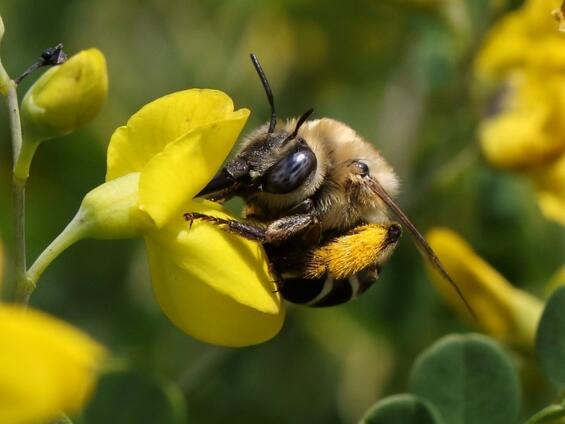
Walsh’s anthophora, Anthophora walshii
Walsh’s anthophora (Anthophora walshii) is a distinctive bee of moderate size 14-16 mm (0.55-0.63 in) in length and 5-6 mm (0.20-0.24 in) wide. The head, thorax, and first segment of the abdomen are covered in long, pale yellow setae (hairs). The remainder of the abdomen is dark except for narrow, ivory-colored bands around the posterior margin of the abdominal segments (the first four segments in the female, the first six in the male; Mitchell 1962). The banded abdomen is unique, not found in any other eastern species of Anthophora. Males are distinguished from females by the extensive ivory markings on the front of the face and base of the antennae; the male also has longer antennae than the female. In the field, the foraging behavior of Walsh’s anthophora helps differentiate it from other bees of similar size. Unlike both honey and bumble bees, which fly slowly and methodically between flowers while collecting pollen and nectar, the flight of Walsh’s anthophora is quick and direct. Each flower is visited briefly (typically less than 3 seconds) before moving on to the next.
Life cycle and behavior
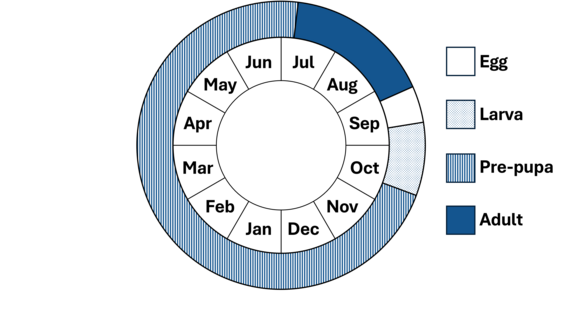
In Massachusetts, Walsh’s anthophora has been observed from early July through late September, with a majority of records between mid-July and mid-August. Like other Anthophora species, Walsh’s anthophora is a solitary (non-social) ground nester. Nesting has been documented in sparsely vegetated, sandy soils in or near stands of yellow wild indigo (Baptisia tinctoria). Other host plants in Massachusetts include orange milkweed (Asclepias tuberosa) and goldenrods (Solidago spp.). Nest entrance holes are circular, 6-7 mm (0.24-0.28 in) in diameter, and have a narrow fan of tailings extending about 4 cm (1.6 in) from the opening. Nests occur both individually and in small aggregations of three to seven (Veit 2019).
The life cycle of Walsh’s anthophora has not been studied in detail, but is likely similar to other species of Anthophora, as described by Danforth et al. (2019). Anthophora species overwinter as a pre-pupa; in spring or early summer, pupation occurs. Adult bees emerge about two weeks later, synchronous with the flowering of host plants. Males search for females on flowers. After mating, the female searches for an appropriate nest site. The female excavates a nest in the ground, with brood cells either arranged in a line along the main tunnel or located at the tips of lateral branches. Each nest has up to ten cells, occasionally more. Nest depth varies but can be as deep as 30 cm (12 in). Nest cells are lined with a waxy, waterproof substance produced by a gland at the tip of the female’s abdomen. A female makes multiple foraging trips to provision each cell with a mixture of nectar and pollen. After provisioning, a single egg is laid in each cell before it is sealed. After hatching, the larva feeds on the mixture of nectar and pollen, molting four times as it grows. About a month after hatching, the larva is a fully grown pre-pupa, which remains dormant until the following spring or early summer.
Distribution and abundance
Walsh’s anthophora is a species of the Great Plains and eastern slopes of the Rocky Mountains, ranging from Ohio north to Michigan, west to southern Saskatchewan and Montana, and south to Arizona and Texas (Ascher & Pickering 2020). Current Massachusetts records represent a peripherally isolated population more than 600 miles east of the eastern edge of this species’ primary range. In Massachusetts, Walsh’s anthophora has been found on Cape Cod, Martha’s Vineyard, and Penikese Island.
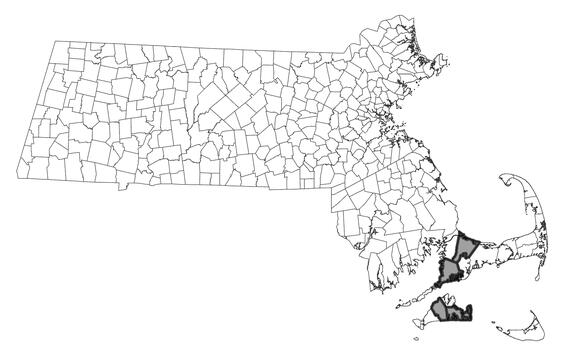
Distribution in Massachusetts.
1999-2024
Based on records in the Natural Heritage Database.
Habitat
In Massachusetts, Walsh’s anthophora inhabits open coastal habitats on sandy soil where yellow wild indigo (Baptisia tinctoria) is relatively abundant. Habitats include sandplain grasslands and similar anthropogenic habitats such as utility rights-of-way and fire breaks.
Healthy habitats are vital for supporting native wildlife and plants. Explore habitats and learn about conservation and restoration in Massachusetts.
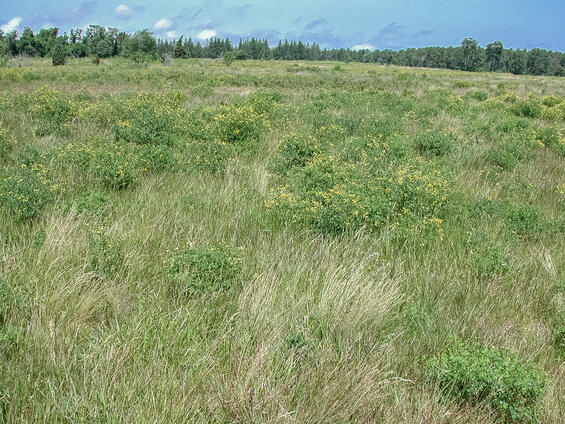
Sandplain grassland with yellow wild indigo (Baptisia tinctoria), habitat for Walsh’s anthophora. Habitat managed by MassWildlife at Frances A. Crane Wildlife Management Area.
Threats
Walsh’s anthophora is threatened by habitat loss and fire suppression. Fire maintains sandplain grassland habitat, promotes growth of host plants, and provides nest sites by reducing organic matter at the soil surface. Other potential threats include introduced pathogens, aerial insecticide spraying, non-target herbicide application, excessive deer browse of host plants, and off-road vehicles. It is not known how climate change may affect Walsh’s anthophora, though Massachusetts populations are vulnerable because they occur in a small area isolated from the main range of this species.
Conservation
Land protection and habitat management are the primary conservation needs of Walsh’s anthophora in Massachusetts. In particular, coastal sandplain grassland should be conserved, restored, and managed to maintain habitat for this species and the entire suite of rare and threatened species dependent on such habitat.
Survey and monitoring
Undocumented populations of Walsh’s anthophora may exist in southeastern Plymouth County, on Cape Cod, or the offshore islands, and should be surveyed for. Known populations of this species should be surveyed to document persistence at least once every 25 years; every 10 years is more desirable when practicable.
Management
Management of coastal sandplain grassland benefits a suite of rare and threatened species, and habitat condition should be monitored and management adapted as needed. For Walsh’s anthophora, sandplain grassland with yellow wild indigo (Baptisia tinctoria) is of particular importance.
Research needs
The natural history and conservation needs of Walsh’s anthophora are not fully understood, and further study is needed as applicable to this species in Massachusetts. In addition, the future effects of a warming climate on this species are unpredictable and should be documented.
Acknowledgements
Michael F. Veit has contributed significantly to knowledge of Walsh’s anthophora in Massachusetts, and provided much of the information presented here.
References
Ascher, J.S., and J. Pickering. 2020. Discover Life bee species guide and world checklist (Hymenoptera: Apoidea: Anthophila). http://www.discoverlife.org/mp/20q?guide=Apoidea_species.
Danforth B.N., R.L. Minckley, and J.L. Neff. 2019. The Solitary Bees: Biology, Evolution, Conservation. Princeton University Press, Princeton, New Jersey. 488 pp.
Mitchell, T.B. 1962. Bees of the Eastern United States. Volume 2. North Carolina Agricultural Experiment Station Technical Bulletin No. 152, Raleigh, North Carolina. 557 pp.
Veit, M.F. 2019. 2019 Camp Edwards Survey for Anthophora walshii (Hymenoptera: Anthophila). Unpublished report prepared for the Massachusetts National Guard Environmental and Readiness Center, Camp Edwards, Massachusetts.
Contact
| Date published: | March 26, 2025 |
|---|